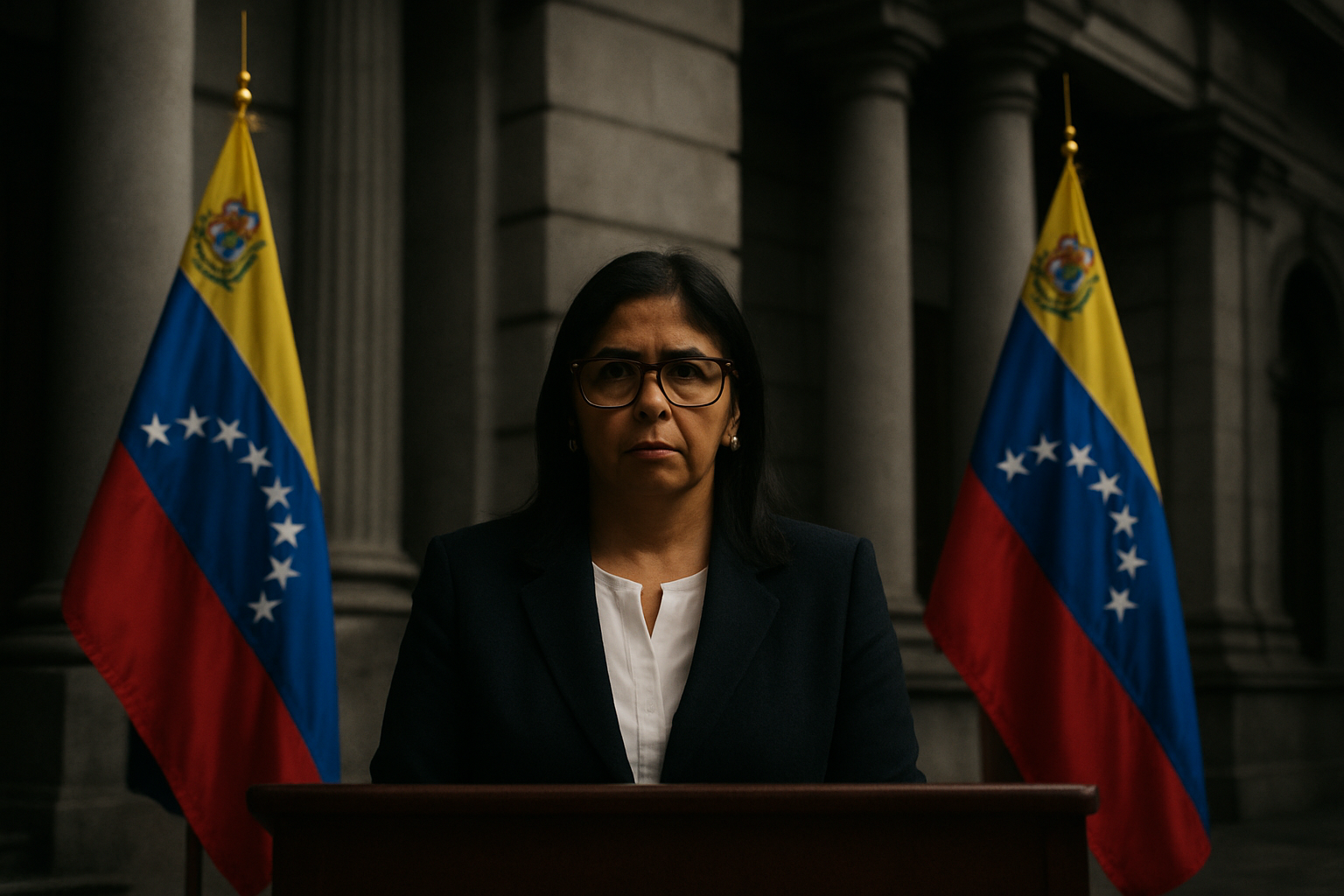
Venezuela's political crisis has entered a critical new phase as Nobel laureate María Corina Machado conducted a massive rally with Venezuelan exiles in Chile, while Acting President Delcy Rodríguez's interim government faces mounting international scrutiny over selective amnesty implementations and the legal fate of detained former president Nicolás Maduro.
The developments mark a significant escalation in Venezuela's complex political transition, which began following Maduro's capture by U.S. forces in January 2026. As the crisis unfolds across multiple theaters—from Santiago to New York courtrooms—the future of Venezuelan democracy hangs in the balance.
Machado's International Campaign Intensifies
María Corina Machado, the 2025 Nobel Peace Prize laureate who has emerged as Venezuela's most prominent opposition figure, received an enthusiastic welcome from thousands of Venezuelan exiles during her March 14 rally in Chile. Speaking to the diaspora community, Machado delivered a message of hope: "Soon we will embrace each other in Venezuela, with our families and in freedom."
The rally represented a strategic shift in opposition tactics, with Machado leveraging her international profile to maintain pressure on the interim government while building support among the estimated 7.7 million Venezuelans living abroad—one of the Western Hemisphere's largest displacement crises.
However, Machado's campaign has also sparked controversy. Venezuelan authorities accused the interim government of property seizures targeting opposition figures, including the confiscation of a home belonging to Laura Acosta, Machado's assistant of over 20 years who was forced into exile in 2024. Vente Venezuela characterized this as "political retaliation" against the Nobel laureate.
Legal Pressure Mounts on Maduro
Meanwhile, former president Nicolás Maduro's legal situation has deteriorated significantly. Sources familiar with his detention conditions at a New York federal prison reveal he is being held in solitary confinement "to protect him from Venezuelans who could attack him." The isolation underscores the former leader's precarious position even within the prison system.
U.S. prosecutors have intensified their efforts to prevent Venezuelan state funds from being used for Maduro's legal defense, arguing that the United States does not recognize him as Venezuela's legitimate leader. This legal maneuver could severely hamper Maduro's ability to mount an adequate defense against drug trafficking and corruption charges.
The prosecution's stance reflects the broader international consensus that has emerged since Maduro's removal, with the U.S. formally recognizing Acting President Delcy Rodríguez's interim government in March 2026.
Political Prisoner Crisis Persists
Despite the release of over 750 political prisoners since January 2026 under Rodríguez's comprehensive amnesty program—the most extensive political reconciliation effort in recent Latin American history—serious challenges remain. Human rights organization Foro Penal reports that over 600 political prisoners remain detained, with many amnesty applications being selectively denied.
The situation has sparked fierce criticism from opposition leaders and human rights advocates. "Selectively denying amnesty is repression," Machado declared in a social media statement. "The regime led by Delcy Rodríguez intends to prolong the terror to break the morale of those fighting for democracy and freedom in Venezuela."
Particularly controversial has been the denial of amnesty to Perkins Rocha, legal advisor to Venezuela's largest anti-Chavista coalition and a former deputy. The rejection has raised questions about the genuine scope of the reconciliation process and whether it represents authentic reform or selective political maneuvering.
"The regime led by Delcy Rodríguez intends to prolong the terror to break the morale of those fighting for democracy and freedom in Venezuela, which are now so close. You know what? They won't succeed."
— María Corina Machado, Nobel Peace Prize Laureate
Foro Penal, Venezuela's most prominent human rights organization monitoring political detentions, has sharply criticized the "denial of amnesty to political prisoners." Organization president Alfredo Romero characterized the rejections as evidence of "complicity" between judges and prosecutors, suggesting that the judicial system continues to operate under political influence despite promises of reform.
International Dimensions and Diplomatic Pressure
The crisis has significant international ramifications, with major powers closely monitoring developments. The United States has maintained its recognition of the Rodríguez interim government while simultaneously increasing pressure on Maduro's legal proceedings. Oil exports have surged 60% to 800,000 barrels daily, with the U.S. displacing China as Venezuela's top customer following comprehensive energy cooperation agreements.
European nations have also begun cautiously engaging with the interim government, though many maintain concerns about the selective nature of the amnesty process. Former Spanish Prime Minister José Luis Rodríguez Zapatero continues his mediation efforts in Caracas, while Cardinal Baltazar Porras has organized nationwide prayer vigils supporting reconciliation.
However, the international community's patience appears to be wearing thin regarding the pace and scope of democratic reforms. The selective denial of amnesty applications has raised questions about whether the interim government represents genuine change or merely a reconfiguration of authoritarian practices.
Economic and Social Challenges
Beyond the political drama, Venezuela continues to grapple with severe economic challenges that complicate the transition process. Despite the oil revenue surge, the country faces a 475% inflation rate—the world's highest in 2025—along with persistent infrastructure decay, power outages, and humanitarian needs.
The Venezuelan Migration Observatory reports that the majority of the 7.7 million Venezuelans living abroad have no immediate plans to return home, despite the political changes. This reluctance reflects deep-seated concerns about economic stability, security, and the sustainability of democratic reforms.
The diaspora's hesitation to return represents a significant challenge for Venezuela's long-term recovery, as the country needs the expertise and investment capacity of its educated population to rebuild institutions and the economy.
Regional Implications and Future Outlook
Venezuela's political crisis has broader implications for Latin American democracy and regional stability. The country's transition is being closely watched as a potential template for peaceful democratic change, though the current challenges highlight the difficulties of meaningful reconciliation following decades of authoritarian rule.
The selective application of amnesty laws, combined with continued political persecution, suggests that Venezuela's democratic transition remains incomplete. International observers emphasize that sustainable democracy requires not just prisoner releases but comprehensive institutional reforms, including judicial independence, press freedom protections, and guarantees for political opposition activities.
As the crisis continues to unfold, several key factors will determine Venezuela's democratic future: the scope and authenticity of the amnesty process, the international community's willingness to maintain pressure for genuine reforms, and the opposition's ability to unite around a coherent vision for democratic governance.
The Path Forward
The coming weeks will likely prove decisive for Venezuela's political trajectory. Machado's international campaign has reinvigorated opposition efforts, while mounting legal pressure on Maduro may accelerate accountability processes. However, the interim government's handling of political prisoner releases will serve as a crucial test of its commitment to democratic principles.
The crisis underscores the complex challenges facing countries attempting to transition from authoritarian rule to democratic governance. Success will require not only political will from Venezuelan leaders but sustained international support and civil society engagement to ensure that promises of reconciliation translate into genuine democratic reforms.
As one veteran observer of Venezuelan politics noted, "The country stands at a crossroads between genuine democratic renewal and the perpetuation of authoritarian practices under new management." The choices made in the coming months will reverberate throughout the region and influence democratic movements across Latin America for years to come.