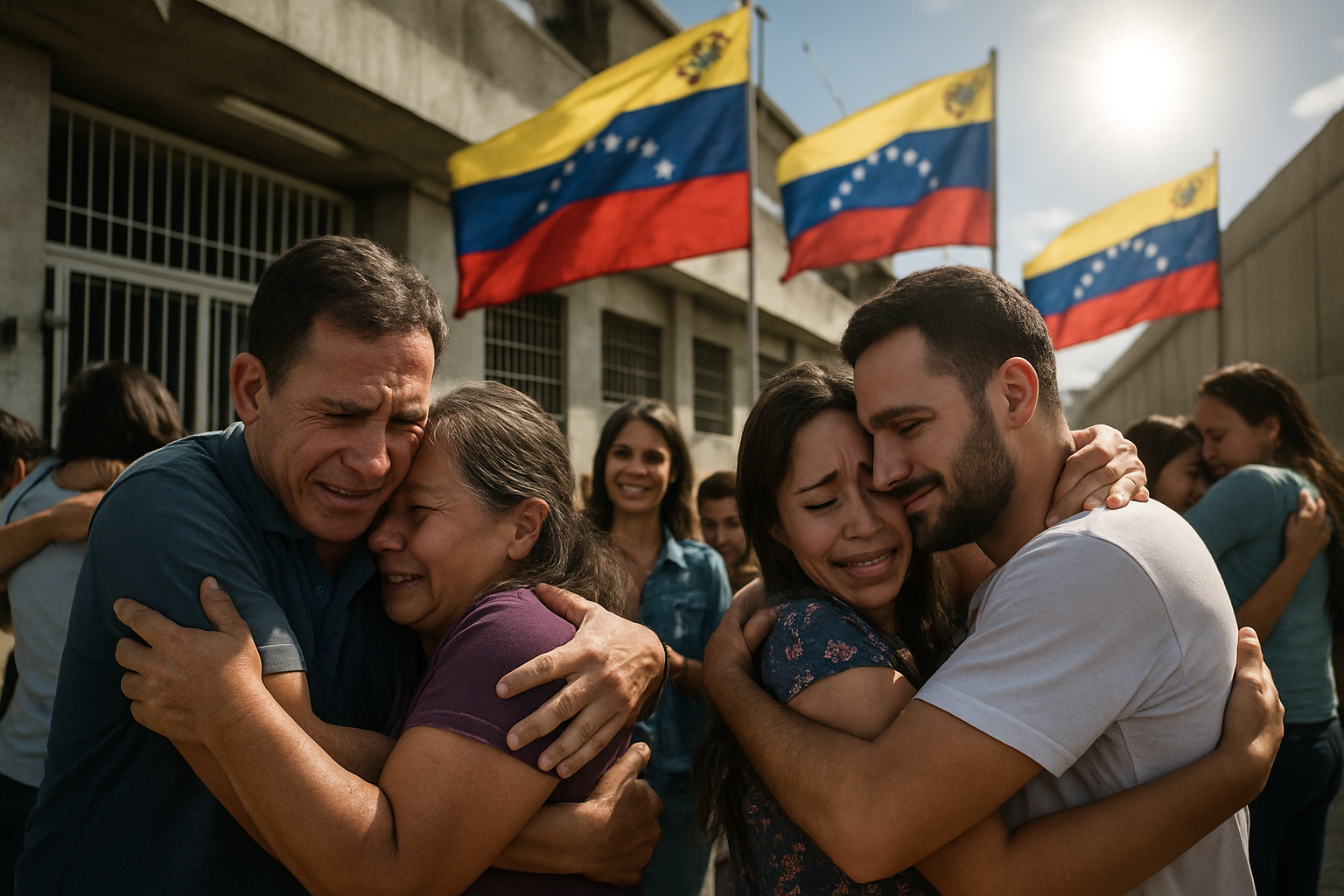
Venezuelan National Assembly President Jorge Rodríguez made an unprecedented promise to families of political prisoners that all remaining detainees will be freed "between Tuesday and Friday at latest" following the second reading approval of a comprehensive amnesty law, marking a dramatic escalation from the gradual release program implemented since January 2026.
Speaking to families maintaining a vigil at the Boleíta police station since January 8, Rodríguez delivered the most definitive timeline yet for Venezuela's political prisoner releases. "When the parliamentary norm is approved 'in second reading,' the liberation will be immediate," he told the gathered families, according to multiple sources.
The announcement comes as the 13-article amnesty legislation, originally proposed by Acting President Delcy Rodríguez on January 30, advances through Venezuela's National Assembly. The law covers political offenses committed between 1999-2026, potentially affecting hundreds of opposition figures, journalists, and activists detained under the former Maduro regime.
Historic Amnesty Framework
The comprehensive amnesty represents the most significant prisoner release program in recent Latin American history. Already, 367 political prisoners have been freed since Venezuela's democratic transition began in January 2026, including high-profile cases such as journalist Rory Branker, who was detained for nearly a year, and Javier Tarazona, director of the human rights organization Fundaredes, who was freed February 1 after more than four years in detention.
The legislation unanimously passed its first reading on February 5, with Assembly President Rodríguez emphasizing the urgency of the matter, saying "no tenemos mucho tiempo" (we don't have much time). The law is designed to provide "justice and coexistence among Venezuelans" while excluding constitutionally forbidden crimes, including hate crimes, though the scope of these exclusions has raised concerns among human rights groups.
"We ask for forgiveness because I don't like prisoners"
— Jorge Rodríguez, National Assembly President
International Mediation and Support
Adding international legitimacy to the reconciliation process, former Spanish Prime Minister José Luis Rodríguez Zapatero arrived in Caracas on February 6 to participate in the peace plan promoted by Acting President Delcy Rodríguez. Zapatero, who served as Spain's Prime Minister from 2004-2011 and has extensive experience in democratic transitions, expressed confidence that the amnesty promise will be fulfilled.
The Catholic Church has also thrown its support behind the process, with Cardinal Baltazar Porras organizing a "Saturday of prayers" with vigils and ecumenical moments outside prisons nationwide, adding moral authority to the reconciliation efforts.
Civil Society Perspectives and Concerns
While broadly supporting the prisoner releases, civil society organizations have expressed reservations about the process. Human rights group Cofavic emphasized that the releases constitute "restitution of rights, not State favor," while opposition leader Andrés Velásquez questioned the necessity of an amnesty, arguing that political prisoners "are innocent" and should simply be released without legal formalities.
Juan Carlos Apitz, dean of the Faculty of Legal and Political Sciences at the Central University of Venezuela (UCV), warned that amnesty should not become "a tool for impunity" or an "opaque instrument" that leaves intact the mechanisms of political persecution. He and other legal experts are demanding that the amnesty law include the repeal of repressive laws to prevent future persecution cycles.
Context of Democratic Transition
The prisoner release program occurs within Venezuela's broader democratic transition following the removal of Nicolás Maduro in January 2026. The interim government under Acting President Delcy Rodríguez has been working to normalize relations with the international community, particularly the United States, while addressing the humanitarian crisis inherited from the previous administration.
High-level diplomatic engagement has accelerated, with US-Venezuela meetings at the Miraflores Palace and the implementation of Secretary of State Marco Rubio's three-phase reconstruction plan focusing on stabilization, economic recovery, and democratic transition. Oil exports have surged 60% to 800,000 barrels daily, with the United States displacing China as Venezuela's top oil customer.
Challenges and Implementation
Despite the positive momentum, significant challenges remain for successful implementation. The releases require not only approval of the second reading but also the establishment of reintegration guarantees, monitoring mechanisms, and safeguards against future persecution. The success of the amnesty will depend on genuine commitment to democratic principles and human rights from all parties involved.
The opposition has demanded "all guarantees and international standards" for prisoner reintegration, while also calling for the safe return of political exiles. The law's ultimate effectiveness will be measured not just by the number of prisoners released, but by Venezuela's ability to prevent future persecution cycles and consolidate democratic institutions.
Regional and International Significance
The Venezuelan amnesty process is being closely watched by international observers as a critical test of the country's commitment to democratic transition. Regional powers including Brazil and European Union members have expressed cautious support for the reforms, while the Dominican Republic has begun reopening diplomatic and commercial relations with Venezuela.
If successful, the comprehensive political prisoner amnesty could serve as a model for post-conflict reconciliation in Latin America and demonstrate that negotiated transitions can provide alternatives to prolonged political confrontation. The international community continues to monitor the process as an indicator of Venezuela's genuine commitment to human rights and democratic consolidation.
With the second reading scheduled for early next week and Jorge Rodríguez's promise of immediate releases upon approval, Venezuela stands at a pivotal moment that could determine whether the country can successfully transition from authoritarianism to democracy while achieving lasting reconciliation among its citizens.