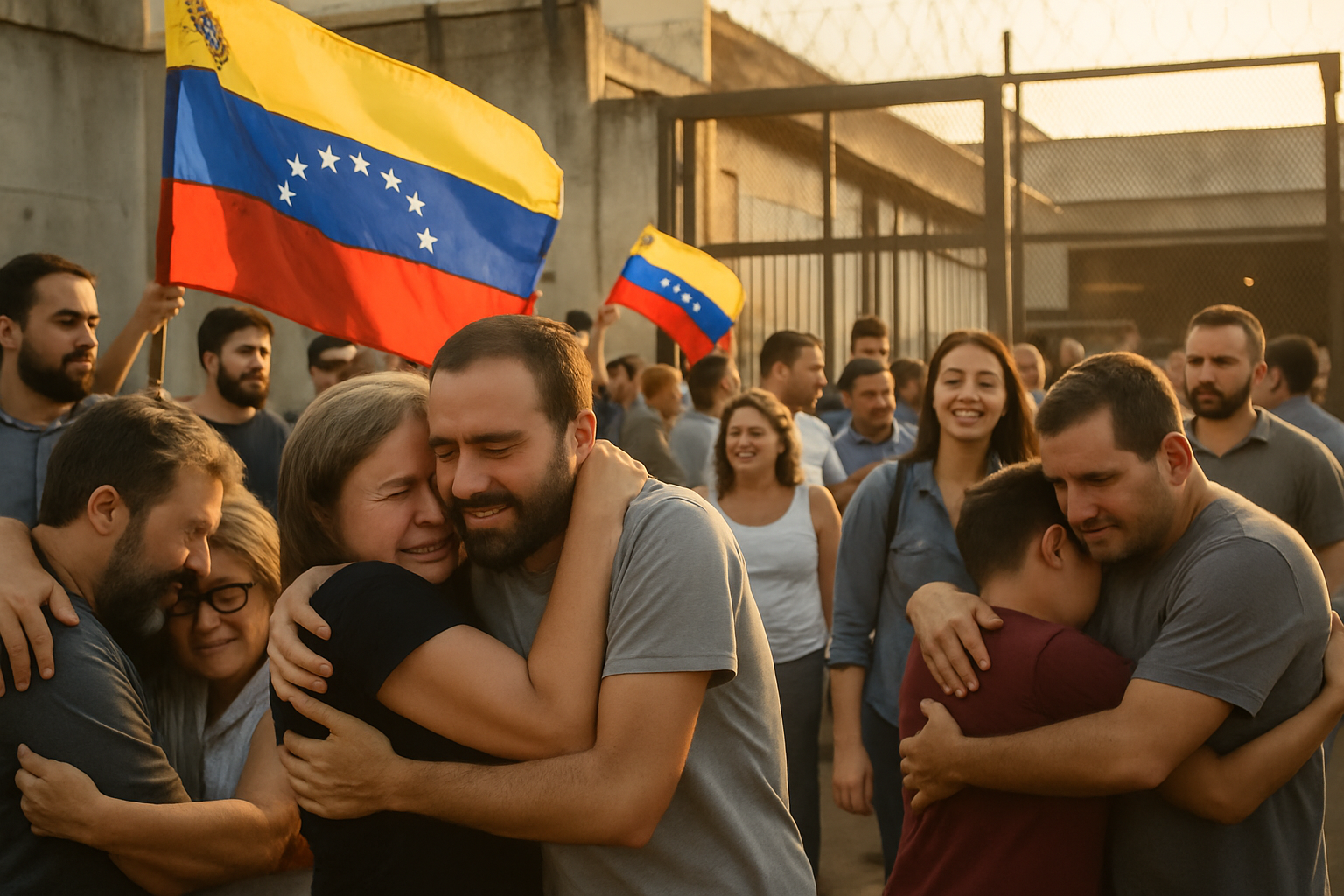
Venezuela's interim government has released an additional 22 political prisoners, including prominent journalist Rory Branker, as part of the ongoing amnesty program that has freed 367 individuals since the beginning of January 2026.
The latest releases, confirmed by human rights organization Foro Penal on February 4, 2026, represent the continuation of a sweeping political prisoner amnesty program announced by Acting President Delcy Rodríguez following the removal of Nicolás Maduro from power in January 2026.
The February 4 Releases
Among those freed was journalist Rory Branker, who had been detained for nearly a year as a political prisoner. His release was confirmed by multiple Venezuelan media outlets, including Efecto Cocuyo, which reported his liberation after almost 12 months of imprisonment.
Families of detainees confirmed to international news agency Efe that at least four of the releases came from El Rodeo penitentiary center in Miranda state, one of Venezuela's most notorious detention facilities.
"With this group, Foro Penal raises the total number of released prisoners to 367 since the beginning of January,"
— Foro Penal statement
The releases occurred across multiple detention centers, demonstrating the systematic nature of the amnesty program being implemented by the interim government under Acting President Delcy Rodríguez.
Historical Context of Venezuela's Political Prisoner Crisis
The current amnesty program represents a dramatic reversal of policies under the previous Maduro administration, which had detained hundreds of opposition figures, journalists, and activists on charges ranging from terrorism to treason.
The interim government's amnesty initiative began with the release of Javier Tarazona, director of NGO Fundaredes, on February 1, 2026, after more than four years in detention on terrorism and treason charges. His release marked the first significant action under the proposed general amnesty law announced by Acting President Delcy Rodríguez on January 30, 2026.
Opposition leader María Corina Machado celebrated the early releases, viewing them as a crucial step toward national reconciliation following Maduro's removal from power through U.S. military intervention in January 2026.
The Broader Political Transformation
The prisoner releases are occurring alongside Venezuela's dramatic political transition following Maduro's capture and transfer to federal custody in New York, where he faces drug trafficking and corruption charges alongside his wife Cilia Flores.
The interim government under Acting President Delcy Rodríguez has pursued an aggressive diplomatic engagement with the United States, including high-level meetings at the Miraflores Presidential Palace with U.S. Chargé d'Affaires Laura Dogu as part of Secretary of State Marco Rubio's three-phase reconstruction plan.
Venezuela has also experienced significant economic changes, with oil exports surging 60% from 498,000 to 800,000 barrels daily in January after the U.S. lifted its blockade, releasing 40 million barrels from storage and displacing China as Venezuela's top oil customer.
International Cooperation and Justice
The political transformation has also involved cooperation with U.S. law enforcement, as evidenced by the recent detention of Alex Saab, a Colombian businessman and former Maduro minister, in a joint FBI-SEBIN operation. Saab, who was previously held in U.S. custody on bribery and money laundering charges before being released in a 2023 prisoner exchange, is now awaiting possible extradition to the United States.
Venezuelan businessman Raúl Gorrín Belisario, a pro-Chavez media owner, was also detained in the same operation, reflecting the interim government's willingness to cooperate with U.S. authorities in pursuing figures connected to the previous administration's alleged criminal networks.
The Human Rights Impact
Human rights organizations have long documented the systematic detention of political opponents under the Maduro administration. Foro Penal, which has tracked political prisoners throughout Venezuela's crisis, has been instrumental in documenting releases and advocating for the amnesty program.
The organization's confirmation of the latest releases brings hope to families of the hundreds of individuals who remain in detention, as the amnesty program continues to process cases through Venezuela's judicial system.
Ongoing Challenges
Despite the political transformation, Venezuela continues to face significant challenges including hyperinflation, infrastructure decay, and the need for massive international investment to rebuild institutions and restore basic services. Power outages, fuel shortages, and food insecurity remain pressing concerns requiring sustained attention and resources.
The success of the amnesty program will likely depend on the interim government's ability to maintain international support while addressing these underlying economic and social challenges that have plagued Venezuela for years.
Looking Forward
As Venezuela continues its post-Maduro transition, the systematic release of political prisoners represents both a symbolic and practical step toward national reconciliation. The interim government's approach has garnered cautious support from international partners, including Brazil and the European Union, who view the prisoner releases as evidence of genuine democratic reform.
The amnesty program, once fully implemented through the National Assembly as proposed by Acting President Rodríguez, could affect hundreds more political prisoners detained under the previous regime, potentially marking one of the most significant human rights developments in Venezuela's recent history.
With 367 individuals already freed and more releases expected, the program signals a fundamental shift in Venezuela's approach to political opposition and press freedom, offering hope for a more democratic future as the country works to rebuild its institutions and restore international credibility.