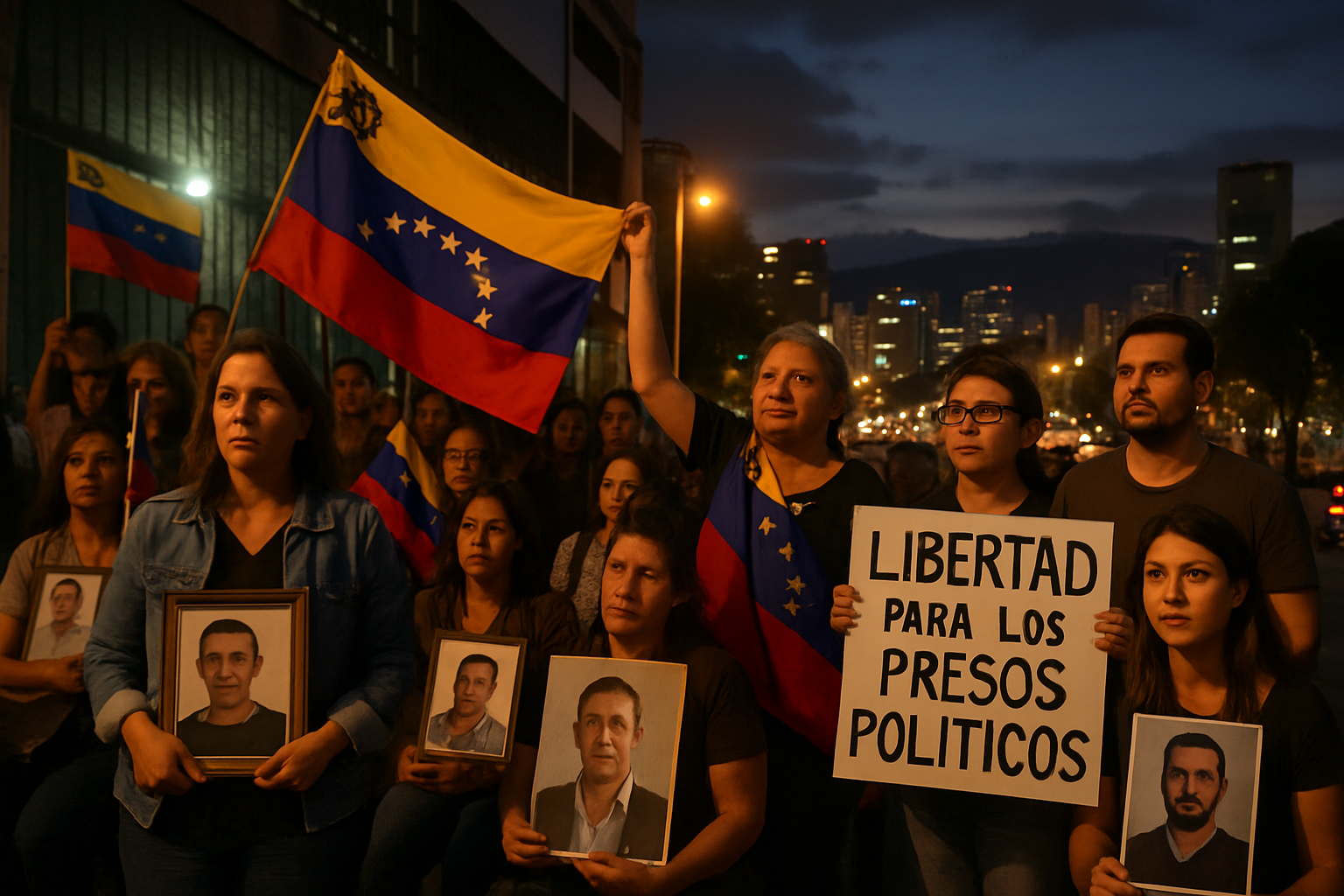
Venezuela's interim government released 17 additional political prisoners this weekend, including prominent union leader José Elías Torres, even as families of remaining detainees launched hunger strikes and opposition leaders faced continued harassment and detention.
The latest releases, comprising 10 men and 7 women according to organizations monitoring political detentions, bring the total number of prisoners freed since January 2026 to over 400 under Acting President Delcy Rodríguez's amnesty program. Among those released was Gabriel Sánchez, a 19-year-old on the autism spectrum, highlighting the diverse nature of those caught up in the previous regime's widespread detention campaign.
Hunger Strikes Demand Complete Freedom
Despite the continuing releases, families of political prisoners have entered their second day of hunger strikes outside the Zona 7 detention center of the National Bolivarian Police (PNB) in Caracas. The Committee for the Liberation of Political Prisoners (CLIPP) is demanding "immediate and complete freedom for all their loved ones unjustly imprisoned" at the facility.
The hunger strike represents escalating desperation among families who have maintained vigils for weeks, demanding accountability for what they characterize as systematic persecution under the Maduro regime. These protests come as the comprehensive amnesty law covering political offenses from 1999-2026 remains stalled in the National Assembly over disagreements about implementation details.
Opposition Leaders Face Continued Pressure
While hundreds have been released, opposition figures continue to face detention and harassment. Most notably, Juan Pablo Guanipa, a close ally of Nobel Peace Prize laureate María Corina Machado and former National Assembly vice-president, was re-arrested in February just hours after his initial release, sparking international concern about the sustainability of democratic reforms.
From an undisclosed location in the United States, Machado participated virtually in the Munich Security Conference, where she renewed calls for accelerating Venezuela's democratic transition. "They have been 27 years of brutal devastation: not only did we lose institutions and resources, our families were also destroyed. A third of the population has been forced to flee," she declared, referring to what she called a "criminal regime."
Machado predicted that once Venezuela achieves freedom, "Cuba and Nicaragua will follow the same path," linking Venezuela's struggle to broader regional democratic movements.
Presidential Communications from Detention
In a surreal development, Nicolás Maduro Guerra, son of the deposed president currently in U.S. custody, revealed details of a phone conversation with his father from detention. According to "Nicolasito," as he is known, the elder Maduro expressed confidence that "Venezuela is taking the right steps" and maintained faith in his remaining team's decisions.
"They are doing exactly what they need to do and are taking the right steps," Maduro allegedly told his son during the call, demonstrating continued engagement with Venezuelan politics despite his detention in New York on drug trafficking charges.
International Diplomatic Breakthrough
The prisoner releases occur against the backdrop of unprecedented U.S.-Venezuela diplomatic engagement under the interim government. High-level meetings between Acting President Rodríguez and U.S. Chargé d'Affaires Laura Dogu at the Miraflores Palace represent the most significant diplomatic contact since relations were severed in 2019.
Venezuela's oil exports have surged 60% to 800,000 barrels daily since January, with the United States displacing China as the top customer. This economic transformation, combined with the political prisoner releases, forms part of what Secretary of State Marco Rubio has outlined as a three-phase reconstruction plan: stabilization, economic recovery, and democratic transition.
The Amnesty Law Stalemate
The comprehensive amnesty law, which would cover political offenses spanning the entire Chávez-Maduro era from 1999-2026, passed its first reading unanimously in the National Assembly but faces delays over Article 7. This provision would require political prisoners to "present themselves to justice," which the opposition rejects as criminalizing persecution victims.
National Assembly President Jorge Rodríguez had previously promised that all remaining political prisoners would be freed "between Tuesday and Friday" following the law's final approval, but the February 11-14 deadline passed without resolution due to the ongoing parliamentary deadlock.
Civil society organizations remain divided on the amnesty process. Cofavic emphasizes that releases are "restitution of rights, not State favor," while opposition leader Andrés Velásquez questions the necessity of an amnesty law, arguing that political prisoners "are innocent."
Regional and International Support
International mediation efforts continue with former Spanish Prime Minister José Luis Rodríguez Zapatero participating in Caracas peace plan discussions since February 6. Cardinal Baltazar Porras has organized nationwide prayer vigils, adding religious legitimacy to the reconciliation process.
The Dominican Republic has reopened relations with Venezuela, while Brazil and the European Union express cautious support for the democratic transition. However, the international community remains watchful of whether the changes represent genuine democratic reform or cosmetic adjustments to maintain power.
Challenges Ahead
With over 600 political prisoners still detained according to human rights organization Foro Penal, the incomplete nature of the releases continues to generate tension. Recent reports from Laboratorio de Paz revealed that 32 prisoners from "Operation Gedeón" show "severe malnutrition, physical weakening, cognitive disorientation, and psychological trauma" due to inadequate detention conditions.
The success of Venezuela's democratic transition will largely depend on the complete resolution of the political prisoner crisis, the establishment of guarantees against future persecution, and the creation of conditions for the safe return of political exiles. As international observers monitor these developments, the coming weeks will prove decisive in determining whether Venezuela's transformation represents a genuine democratic breakthrough or merely a temporary political adjustment.
The February releases, while welcome news for the affected families, underscore the complexity of Venezuela's political transition—one that must balance immediate humanitarian concerns with long-term institutional reforms necessary for sustainable democracy.