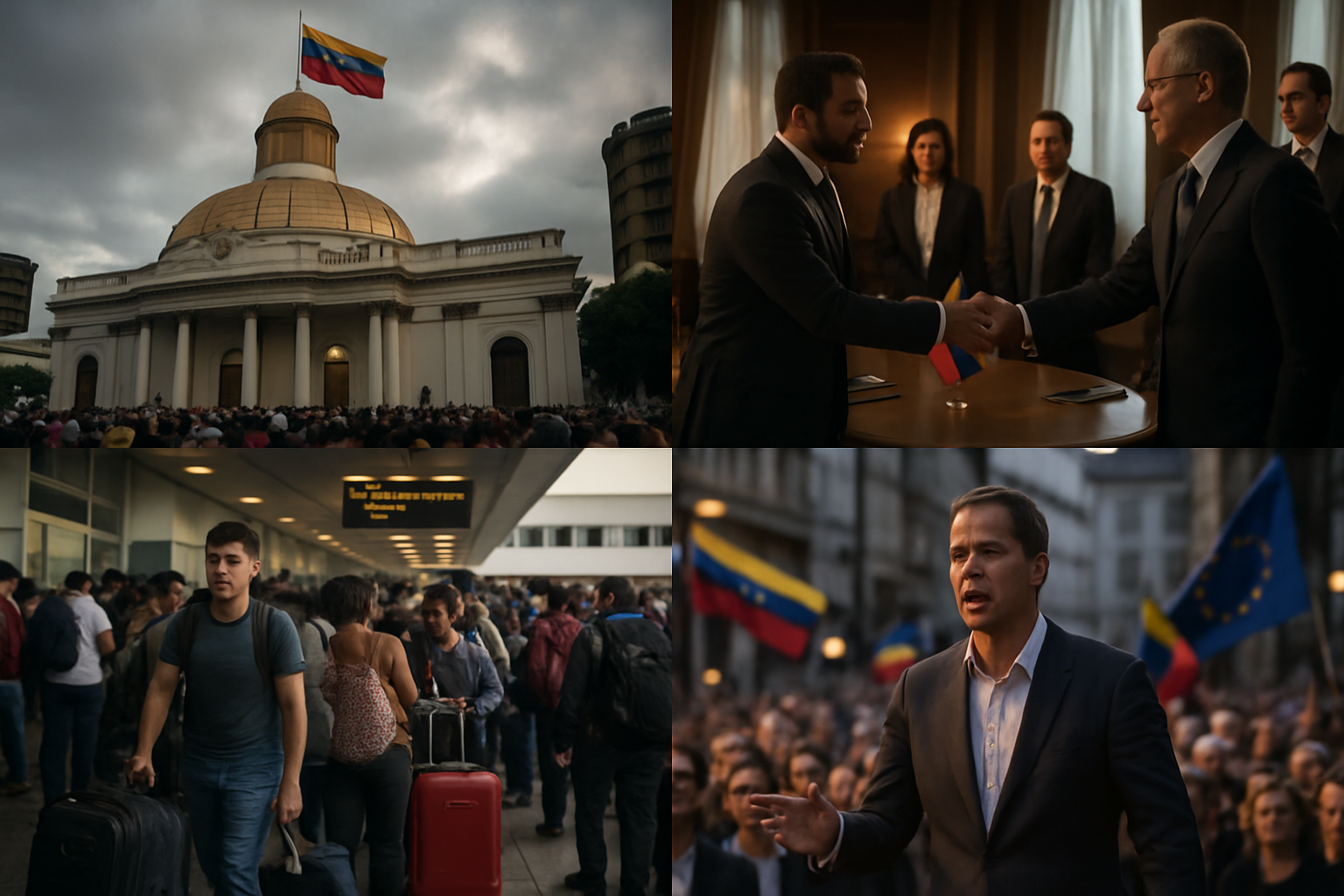
Venezuela continues navigating its complex political transformation as Acting President Delcy Rodríguez's interim government manages multiple critical developments including major migrant repatriations, opposition leader activities abroad, significant Central Bank restructuring, and Venezuela's historic return to the International Monetary Fund system.
The latest developments underscore the multifaceted challenges facing Venezuela as it attempts to build democratic legitimacy while managing the practical realities of governance during a transitional period that began with former President Nicolás Maduro's capture in January 2026.
Major Migrant Repatriation from United States
In one of the most significant single-day repatriations since the transition began, 328 Venezuelan migrants arrived at Simón Bolívar International Airport in Maiquetía on a repatriation flight from the United States. The returnees were received by Venezuelan authorities including pro-government deputy Pedro Infante, who oversees the country's migration program under the "Gran Misión Vuelta a la Patria" (Great Mission Return to the Homeland).
This operation represents part of a broader repatriation initiative that has brought over 5,000 migrants back to Venezuela during the first 100 days of Rodríguez's administration. The government has emphasized the logistical deployment associated with these repatriation flights, which aim to facilitate the safe and free return of nationals facing vulnerable situations abroad.
"The Gran Misión Vuelta a la Patria seeks to facilitate the safe and free return of compatriots who face situations of vulnerability abroad"
— Venezuelan Government Statement
However, the reality of Venezuelan emigration remains complex. According to the Venezuelan Migration Observatory, the majority of the estimated 7.7 million Venezuelans living abroad have no immediate plans to return home despite significant political changes under Acting President Rodríguez. Many emigrants have established stability in host countries that would be difficult to replicate in Venezuela, even with the democratic improvements achieved since January 2026.
María Corina Machado's European Diplomatic Tour
Meanwhile, opposition leader María Corina Machado's presence in Madrid has created significant diplomatic and emotional resonance within the Venezuelan diaspora in Spain. Her first day of activities included meetings with Spanish leaders, appearances on national television, and an institutional ceremony with Madrid City Hall authorities.
The Venezuelan diaspora in Spain has converted each of Machado's appearances into acts of hope and solidarity, highlighting the continuing political polarization that exists even as Venezuela undergoes its democratic transition. Machado's international advocacy continues to focus on accelerating democratic development and ensuring that the transformation represents genuine reform rather than cosmetic changes.
Machado's European tour occurs as she prepares for her announced return to Venezuela "within weeks" - a crucial test of the Rodríguez administration's commitment to democratic space and opposition rights. Her ability to return safely and participate freely in Venezuelan politics will serve as a critical indicator of the authenticity of the democratic transition.
Central Bank Leadership Transformation
In a surprising financial sector development, Acting President Delcy Rodríguez announced the resignation of Central Bank of Venezuela (BCV) President Laura Guerra and the designation of Luis Pérez as her replacement. This leadership change occurs within the context of recent movements in Venezuela's international financial scenario.
The Central Bank leadership transition comes just days after the United States lifted sanctions on Venezuela's public banking system, including the Central Bank itself, opening possibilities for reactivating financial and commercial operations with greater fluidity. This sanctions relief represents a significant diplomatic breakthrough for the Rodríguez administration.
Venezuela's Return to International Financial System
Perhaps most significantly for Venezuela's long-term economic recovery, the country has returned to the Bretton Woods system and gained access to $5 billion through the International Monetary Fund. According to IMF confirmation to EFE news agency, "Venezuela will now have access to its Special Drawing Rights (SDR), which are international reserve assets."
This restoration of IMF relations after a seven-year suspension represents a major diplomatic and economic breakthrough. The IMF and World Bank officially restored relations with Venezuela following Maduro's removal, based on majority voting power of member countries and government recognition protocols.
"Venezuela will now have access to its Special Drawing Rights (SDR), which are international reserve assets"
— International Monetary Fund Statement to EFE
The financial restoration creates opportunities for economic advisory services, potential international financing access, and global financial market credibility for Venezuela's recovery efforts. This development ends a diplomatic impasse that had frozen Venezuela from international financial institutions since 2019.
Ongoing Political Prisoner Challenges
Despite Venezuela's diplomatic and economic breakthroughs, the situation regarding political prisoners remains complex and incomplete. While over 750 political prisoners have been released under the comprehensive 1999-2026 amnesty program since January 2026 - representing the most extensive Latin American political reconciliation in recent history - approximately 600 individuals remain detained according to human rights organizations.
The amnesty law implementation has faced criticism for its exclusions and selective application. Article 9 excludes those who "promoted attacks on national territory by foreign states," while many releases have involved restrictive conditions rather than complete freedom. The case of Juan Pablo Guanipa, a close ally of María Corina Machado, exemplifies these challenges - he was released but subsequently placed under house arrest with electronic monitoring.
Economic Challenges and Opportunities
While Venezuela has achieved remarkable diplomatic rehabilitation, significant economic challenges persist. The country continues to face the world's highest inflation rate at 475% in 2025, oil production remains at only 700,000 barrels daily compared to its historical peak of 3 million barrels, and infrastructure decay with power outages continues affecting millions of citizens.
However, Venezuela's economic partnership with the United States has yielded substantial results. Venezuelan oil exports have surged 60% to 800,000 barrels daily, with the US displacing China as the top customer. Energy Secretary Chris Wright's February visit to Caracas resulted in comprehensive cooperation agreements that ended the 2019 oil embargo, and major companies including Chevron, BP, Shell, Eni, and Repsol have been authorized for expanded operations.
Regional and International Implications
Venezuela's transformation is being closely monitored throughout Latin America as a potential template for post-authoritarian transitions. The combination of military intervention, economic incentives, and selective diplomatic engagement represents an innovative approach to international crisis resolution in the era of great power competition.
Former Spanish Prime Minister José Luis Rodríguez Zapatero continues his mediation efforts in Caracas, while Cardinal Porras organizes prayer vigils as part of the reconciliation process. The Dominican Republic has reopened full diplomatic and commercial relations with Venezuela, while Brazil and the European Union maintain cautious but supportive engagement.
The success or failure of Venezuela's democratic transition will influence international approaches to territorial disputes and democratic transitions globally. The rapid transformation from "maximum pressure" to strategic partnership demonstrates the potential for dramatic diplomatic reversals when conditions align appropriately.
Looking Forward: Critical Tests Ahead
The coming months will be decisive in determining whether Venezuela's transformation represents genuine democratic development or cosmetic changes designed to achieve international legitimacy without substantive reform. Key indicators include the successful implementation of the political prisoner amnesty without restrictions, María Corina Machado's safe return and ability to participate freely in political activities, and the government's commitment to holding free and fair elections.
According to polling conducted in March 2026, 64% of Venezuelans demand presidential elections this year, demonstrating strong public appetite for democratic electoral processes. The international community continues monitoring Venezuela's progress as a test case for diplomatic engagement effectiveness and regional democratic consolidation.
As Venezuela manages the complex dynamics of political transition, migration flows, opposition activities, and international reintegration, the next phase of its democratic development will require sustained commitment from all parties to build lasting institutional changes that extend beyond immediate political benefits.