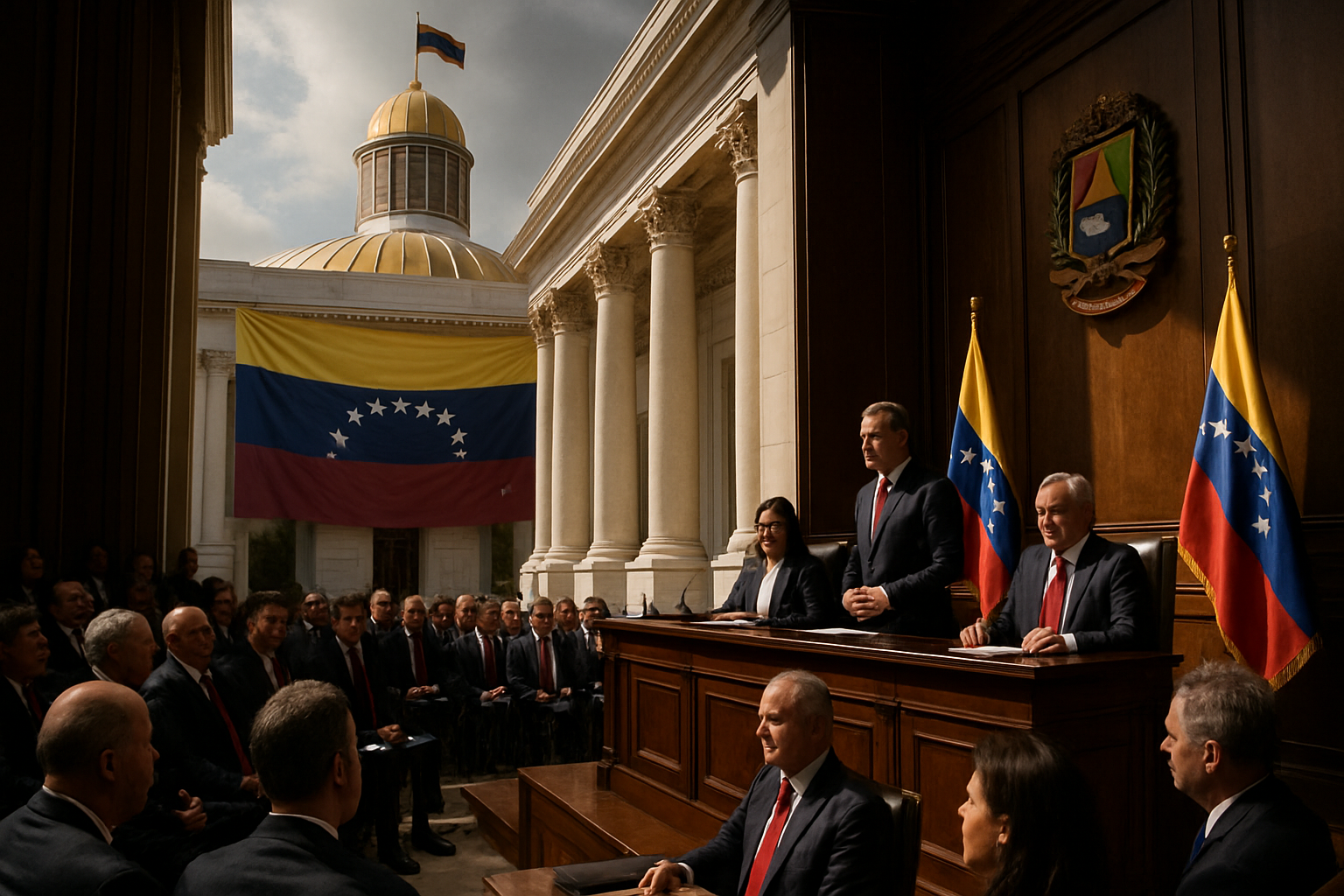
Venezuela's democratic transition gained unprecedented momentum Wednesday as Attorney General Tarek William Saab and Public Defender Alfredo Ruiz Angulo submitted their resignations to the National Assembly, while opposition forces moved to consolidate control over key judicial positions and international leaders intensified calls for free and fair elections.
The resignations, announced during an ordinary National Assembly session on February 25, mark a pivotal moment in Venezuela's ongoing political transformation following the January 2026 removal of Nicolás Maduro. The developments come as Acting President Delcy Rodríguez's interim government faces mounting pressure to accelerate democratic reforms and address the political prisoner crisis that has gripped the nation for over two decades.
Key Judicial Appointments Signal Opposition Control
In a swift response to the resignations, the National Assembly designated human rights lawyer Larry Devoe as interim Attorney General. Sources close to the Assembly indicate Devoe is considered an ally of the influential Rodríguez brothers, suggesting a strategic appointment aligned with the interim government's reconciliation efforts.
Perhaps most significantly, Tarek William Saab himself was appointed as interim Public Defender, effectively switching roles within Venezuela's justice system. This unprecedented move reflects the complex political calculations underway as the country navigates its transition from authoritarian rule toward democratic governance.
"This transition represents a fundamental shift in how justice will be administered in our country,"
— Assembly Secretary, National Assembly
International Pressure Mounts for Democratic Elections
U.S. Secretary of State Marco Rubio delivered his strongest statement yet on Venezuela's future during a Caribbean Community (CARICOM) summit in St. Kitts and Nevis, declaring that Venezuela will need "just and democratic" elections as the next phase of its political transition. Rubio emphasized that while immediate priorities focused on stability and preventing violence, electoral democracy remains the ultimate goal.
The timing of Rubio's comments coincides with unprecedented diplomatic engagement between Washington and Caracas. Since January 2026, the interim government has maintained high-level contacts with U.S. officials, including regular meetings between Acting President Rodríguez and U.S. Chargé d'Affaires Laura Dogu at the Miraflores Palace.
This diplomatic thaw has already yielded significant economic benefits. Venezuelan oil exports have surged 60% to 800,000 barrels daily, with the United States displacing China as Venezuela's top energy customer. The transformation reflects Rubio's three-phase reconstruction plan: stabilization, economic recovery through sanctions relief, and eventual democratic transition with free elections.
Opposition Intensifies Property Seizure Claims
Adding complexity to the transition narrative, opposition party Vente Venezuela denounced what it characterized as continued persecution by chavista forces. The party accused the interim government of confiscating the home of Laura Acosta, a longtime assistant to Nobel Peace Prize laureate María Corina Machado, describing the action as "political retaliation" against the 2025 Nobel winner.
According to Vente Venezuela, Acosta served as Machado's assistant for over 20 years before being forced into exile in 2024 following the disputed July 28 presidential elections. The party claims the property seizure represents continued harassment despite the change in government, highlighting ongoing tensions between opposition factions and forces loyal to the previous regime.
Amnesty Law Implementation Continues Amid Criticism
The judicial reshuffling occurs against the backdrop of Venezuela's historic amnesty law implementation, which has already resulted in over 750 political prisoner releases since January 2026. The comprehensive 1999-2026 amnesty legislation, covering 27 years of political persecution during the Chávez-Maduro era, represents the most ambitious reconciliation effort in recent Latin American history.
However, implementation has faced significant challenges. Civil society organizations like Foro Penal report that over 600 political prisoners remain detained despite the releases. Critics have particularly focused on Article 7 of the amnesty law, which required prisoners to "present themselves to justice" - a provision opposed by human rights groups who argued it criminalized persecution victims.
The appointment of Larry Devoe as interim Attorney General suggests the government may be positioning more moderate voices to oversee the remaining prisoner releases. Devoe's background in human rights law contrasts sharply with Saab's controversial tenure, during which he was accused by international observers of multiple irregularities and slow processing of political prisoner cases.
Regional Implications and International Support
Venezuela's transition is being closely watched throughout Latin America as a potential template for democratic renewal. Former Spanish Prime Minister José Luis Rodríguez Zapatero continues his mediation efforts in Caracas, while Cardinal Baltazar Porras has organized nationwide prayer vigils supporting the reconciliation process.
The Dominican Republic has reopened diplomatic and commercial relations with Venezuela, while Brazil and European Union nations maintain cautious but supportive positions toward the interim government. This growing international legitimacy stands in stark contrast to the previous regime's isolation.
Energy cooperation has emerged as a cornerstone of the new relationship with the United States. Energy Secretary Chris Wright conducted a historic visit to Caracas in February, signing comprehensive cooperation agreements that formally ended the 2019 oil embargo. The partnership encompasses oil, natural gas, and electricity production through American technical assistance and investment.
Ongoing Challenges and Future Prospects
Despite these significant developments, Venezuela's democratic transition faces substantial obstacles. The country continues to grapple with hyperinflation, infrastructure decay, and the aftermath of years of economic mismanagement. Oil production remains at approximately 700,000 barrels daily, far below the historical peak of 3 million barrels.
Political challenges also persist. The forced exile of numerous opposition leaders has created a complex dynamic where key figures like María Corina Machado must participate in the transition from abroad. Questions remain about the timeline for elections and the framework that will govern democratic competition.
The appointment of new judicial officials represents both opportunity and risk. While the changes signal a departure from the previous regime's authoritarian practices, they also highlight the ongoing struggle between different political factions for control of key institutions.
A Critical Juncture for Venezuelan Democracy
As Venezuela approaches what many observers consider the most promising democratic opening in over two decades, the stakes could not be higher. The successful implementation of judicial reforms, completion of political prisoner releases, and eventual conduct of free and fair elections will determine whether the country can emerge from its prolonged political crisis.
The international community's continued engagement will prove crucial. U.S. support for the transition, combined with regional diplomatic backing and technical assistance, provides resources that previous democratic movements lacked. However, sustainability ultimately depends on domestic consensus-building and the interim government's ability to demonstrate genuine commitment to democratic principles.
With over 750 political prisoners already released and new judicial leadership taking shape, Venezuela appears to be moving decisively away from its authoritarian past. The coming weeks and months will test whether these institutional changes can translate into lasting democratic transformation for the Venezuelan people.