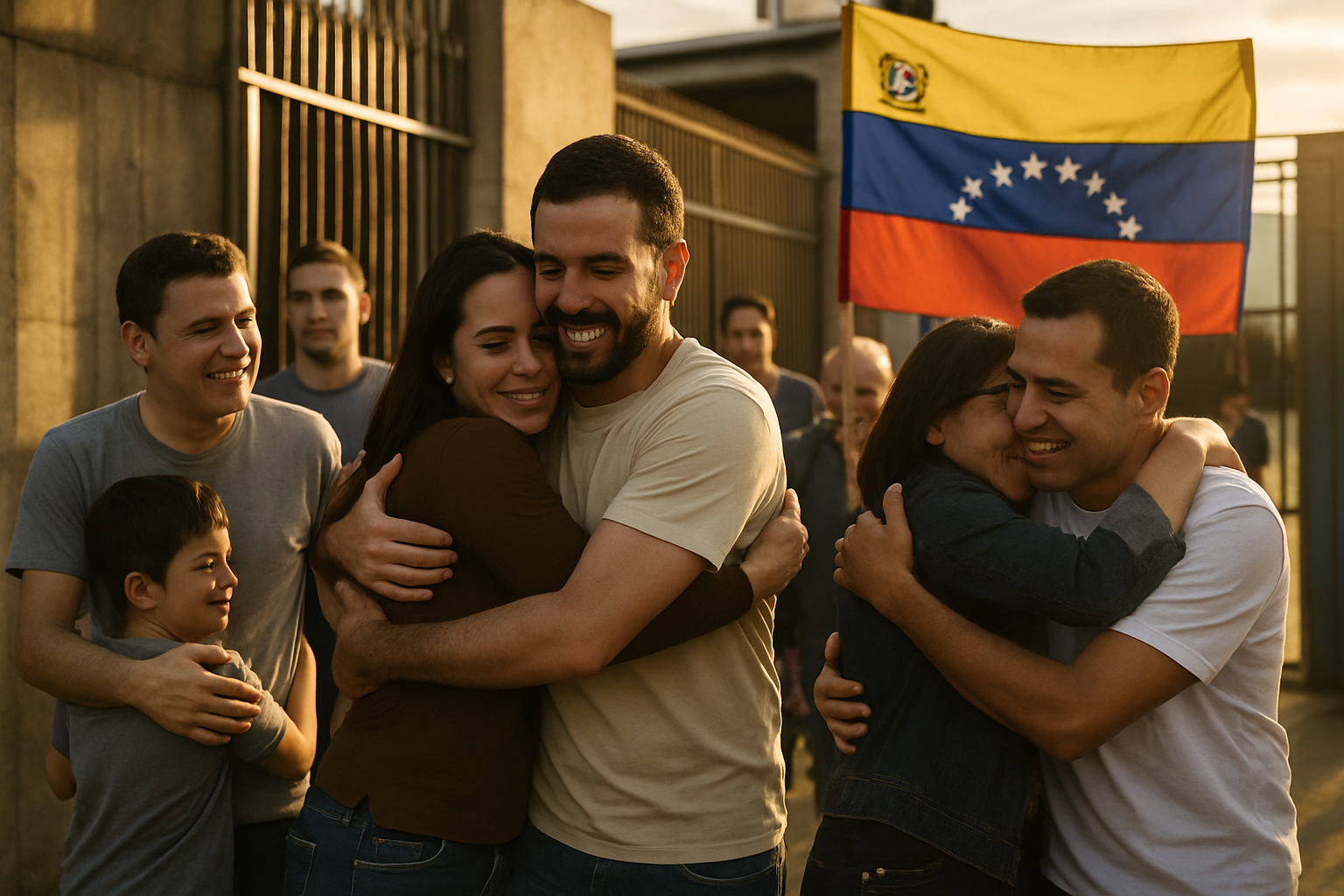
Venezuelan courts released 80 political prisoners on Saturday, February 22, as part of the accelerating implementation of the country's comprehensive amnesty law, while government officials announced they are evaluating additional "grace measures" for hundreds of cases excluded from the initial legislation.
The releases bring the total number of freed political prisoners to over 830 since Acting President Delcy Rodríguez began the amnesty program in January 2026, representing the most comprehensive political reconciliation effort in recent Latin American history.
Latest Release Details
National Assembly President Jorge Rodríguez confirmed the Saturday releases in Caracas, emphasizing that the implementation of the amnesty law is "not the end point, but the beginning of a new phase" in Venezuela's democratic transition. The releases occurred at multiple detention facilities across the capital region.
According to reports from Venezuelan media, authorities are now processing over 1,500 new applications for prisoner releases, indicating the scope of political detention under the previous Maduro regime was even broader than initially documented by human rights organizations.
"Today we are witnessing another step in the path toward reconciliation and peace that Venezuela deserves."
— Jorge Rodríguez, National Assembly President
Grace Measures for Excluded Cases
In a significant development, Venezuelan officials announced they are considering "measures of grace or pardons" for political prisoners excluded from the amnesty law's coverage. The historic legislation, which covers political offenses from 1999-2026, contains Article 9 exclusions for those who allegedly "promoted attacks on national territory by foreign states or corporations."
These exclusions have been criticized by civil society organizations as too restrictive. The Committee for Liberation of Political Prisoners (CLIPP) and other advocacy groups have demanded "inclusive rather than selective" amnesty coverage for all political detainees.
Prosecutor General Tarek William Saab has approved an implementation protocol for reviewing previously excluded cases, though the specific criteria and timeline remain unpublished. Interior Minister Diosdado Cabello is reportedly leading the review process for cases that fell outside the original amnesty framework.
International Context and Support
The prisoner releases occur amid unprecedented international diplomatic engagement with Venezuela's interim government. Former Spanish Prime Minister José Luis Rodríguez Zapatero has been mediating in Caracas since February, while Cardinal Baltazar Porras organized nationwide prayer vigils supporting the reconciliation process.
The amnesty implementation coincides with dramatic improvements in US-Venezuela relations. Venezuelan oil exports have surged 60% to 800,000 barrels daily, with the United States displacing China as Venezuela's top customer following the lifting of Trump-era sanctions.
Ongoing Challenges
Despite the significant progress, human rights organization Foro Penal reports that over 600 political prisoners remain detained across Venezuela's prison system. The organization has documented cases where some released prisoners face restrictions, including house arrest and electronic monitoring, raising questions about the completeness of their freedom.
The case of Juan Pablo Guanipa, a close ally of opposition leader María Corina Machado, exemplifies these challenges. After his initial release in February, Guanipa was re-arrested and placed under house arrest with communication restrictions, demonstrating the complex implementation dynamics of the amnesty process.
Families of remaining political prisoners have maintained vigils outside detention centers, with some engaging in hunger strikes to pressure authorities for complete releases. The Committee of Liberation of Political Prisoners has warned that government indifference puts protesters at "grave risk."
Historical Significance
Venezuela's amnesty law represents the most comprehensive political prisoner release program in recent Latin American history, covering 27 years of political conflict spanning the entire Chávez-Maduro era. The legislation passed the National Assembly unanimously without a single dissenting vote, marking a remarkable achievement given Venezuela's historically polarized political landscape.
The program has drawn comparisons to historical reconciliation processes in Chile, Argentina, and South Africa, though critics argue that genuine reconciliation requires not just prisoner releases but broader institutional reforms including justice system restructuring, press freedom guarantees, and opposition rights protection.
Civil Society Perspectives
Venezuelan civil society organizations have expressed mixed reactions to the amnesty process. Cofavic, a prominent human rights organization, has emphasized that the releases represent "rights restitution, not State favor," arguing that the detentions were illegitimate from the start.
Opposition leader Andrés Velásquez has questioned the necessity of amnesty legislation altogether, arguing that political prisoners "are innocent" and should be released unconditionally rather than through a legal framework that implies wrongdoing.
"These releases are not acts of clemency but the correction of injustices that should never have occurred."
— Cofavic Human Rights Organization
Looking Forward
The success of Venezuela's amnesty implementation is being closely monitored by the international community as a test of the country's democratic transition credibility. Acting President Delcy Rodríguez has called for "maximum speed" in implementation while acknowledging that "one must know how to ask for forgiveness and one must also know how to receive forgiveness."
The process faces several implementation challenges, including the need for reintegration guarantees, monitoring mechanisms to prevent future persecution, and safe return provisions for political exiles. Human rights advocates stress that sustainable reconciliation requires genuine commitment to democratic principles beyond immediate prisoner releases.
As Venezuela continues its democratic transition following Maduro's removal in January 2026, the amnesty program serves as both a symbol of change and a practical test of the interim government's commitment to human rights and political pluralism. The consideration of additional grace measures for excluded cases suggests authorities recognize the need for more comprehensive reconciliation to heal decades of political division.
The coming weeks will be crucial in determining whether the amnesty process achieves its goal of national reconciliation or remains a partial measure that leaves fundamental grievances unresolved. For the families still waiting for their loved ones' freedom, each additional release brings hope that Venezuela's dark chapter of political persecution is finally drawing to a close.