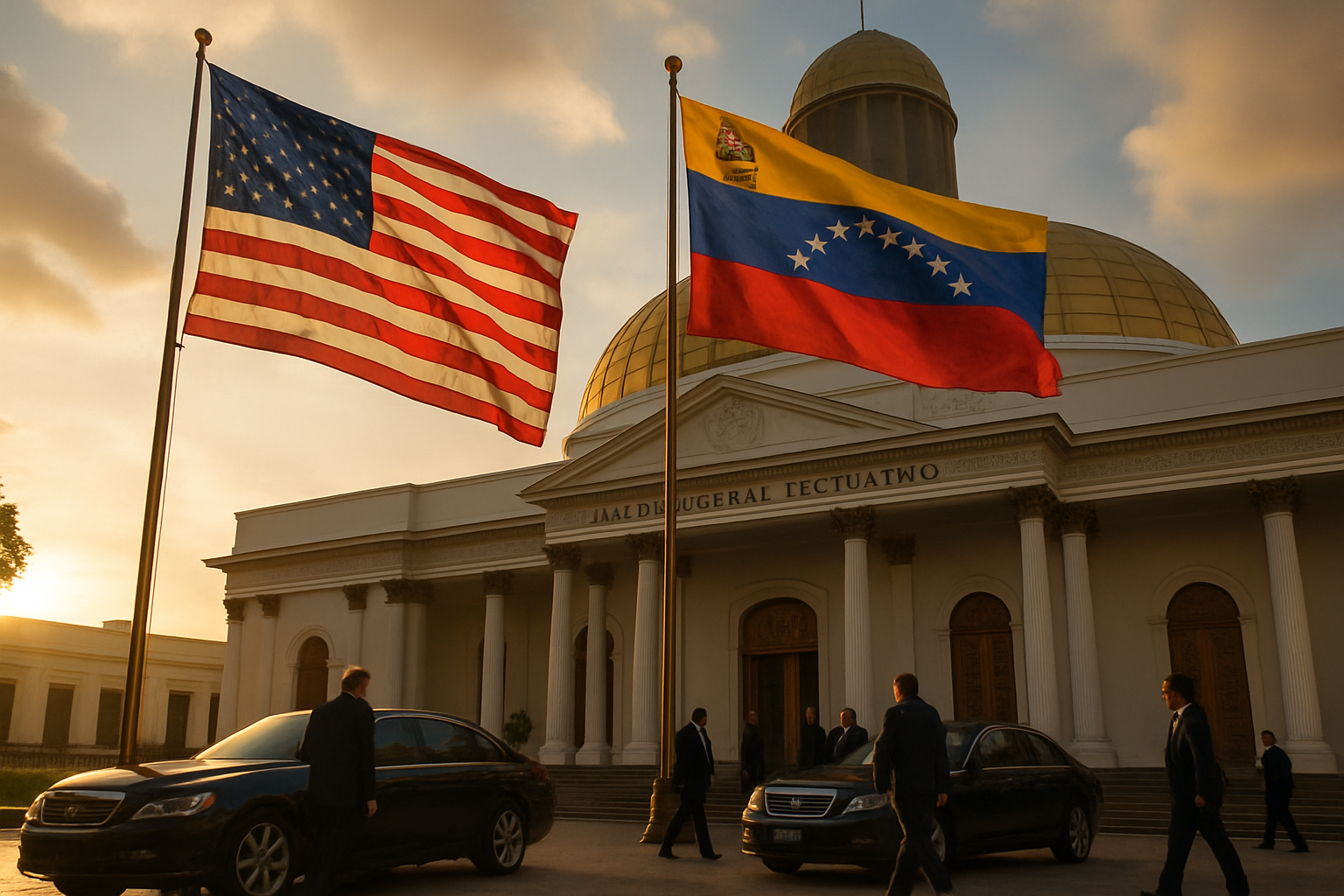
A high-level US delegation led by Chargé d'Affaires Laura Dogu met with Venezuelan Parliament President Jorge Rodríguez at the Federal Legislative Palace on Wednesday, marking the latest milestone in rapidly evolving US-Venezuela relations amid significant government restructuring under Acting President Delcy Rodríguez.
The diplomatic engagement occurred as Rodríguez announced major cabinet changes, most notably the removal of Defense Minister Vladimir Padrino López after more than eleven years in the position, replacing him with General Gustavo González López. The timing underscores the dramatic transformation of Venezuelan politics following the January 2026 capture of former President Nicolás Maduro.
Historic Parliamentary Diplomacy
The meeting between US officials and Venezuelan parliamentary leadership represents the highest-level diplomatic contact since the restoration of formal relations between the two countries in March 2026, ending a seven-year diplomatic break. According to sources from Efecto Cocuyo, Parliament President Jorge Rodríguez personally received the US delegation at the Federal Legislative Palace, demonstrating the significance of the engagement.
This diplomatic milestone builds on the dramatic transformation that began with Energy Secretary Chris Wright's historic February visit to Caracas, which resulted in comprehensive energy cooperation agreements that effectively ended the 2019 oil embargo. Venezuelan oil exports have since surged 60% to 800,000 barrels daily, with the United States displacing China as Venezuela's top customer.
The parliamentary visit comes as part of the ongoing implementation of Secretary of State Marco Rubio's three-phase reconstruction plan for Venezuela: stabilization through the removal of the previous regime, economic recovery through sanctions relief and international investment, and democratic transition through institutional reforms and eventual elections.
Defense Ministry Shakeup Signals New Era
Acting President Delcy Rodríguez's decision to remove Vladimir Padrino López marks the end of an era in Venezuelan military leadership. Padrino López had served as Defense Minister since July 2014, making him one of the longest-serving officials in the Chavista government and a key figure in maintaining armed forces loyalty during the economic and political crisis under Maduro.
His replacement, General Gustavo González López, brings a controversial background that has raised concerns among human rights organizations. González López has been sanctioned by both the United States and European Union for alleged human rights violations. A 2020 UN mission found "reasonable grounds to believe" he "had knowledge, participated and contributed to commission of serious violations and crimes against political opponents."
"The mandataria interina destituyó a Vladimir Padrino López como ministro de Defensa tras 11 años y 5 meses en el cargo y designó en su lugar a Gustavo González López"
— El Nacional, Official Government Statement
Human rights organization Provea criticized the appointment as "recycling of impunity," arguing it maintains repressive structures intact and obstructs genuine institutional reform. The appointment represents one of the most controversial decisions of Rodríguez's interim administration, raising questions about the balance between military continuity and democratic reform.
Broader Political Reconciliation Context
The ministerial changes and diplomatic engagement occur against the backdrop of Venezuela's most comprehensive political reconciliation process in recent Latin American history. Since January 2026, Acting President Rodríguez has overseen the release of over 750 political prisoners under a historic amnesty program covering political offenses from 1999-2026.
The National Assembly unanimously approved the comprehensive amnesty law in February, representing the most ambitious political reconciliation effort spanning the entire Chávez-Maduro era. Former Spanish Prime Minister José Luis Rodríguez Zapatero has continued mediating the process, while Cardinal Baltazar Porras has organized prayer vigils supporting national reconciliation.
However, challenges remain significant. Human rights organizations report that approximately 600 political prisoners remain detained despite the releases, and many of those freed face restrictive conditions rather than complete freedom. The case of Juan Pablo Guanipa, a close ally of Nobel Peace Prize laureate María Corina Machado, exemplifies these complexities—he was initially released but then placed under house arrest with electronic monitoring.
Economic Transformation and International Engagement
The diplomatic and political developments unfold amid Venezuela's dramatic economic transformation. Following the lifting of US sanctions, major oil companies including Chevron, BP, Shell, Eni, and Repsol have been authorized to expand operations in Venezuela. Interior Secretary Doug Burgum's March visit to Caracas focused on mining code reforms that would provide "unlimited opportunities for cooperation" for American companies seeking access to critical minerals.
This economic partnership addresses US supply chain security concerns, particularly regarding Chinese dominance in strategic materials, where China controls 60% of global production and 90% of refining capacity in critical minerals essential for renewable energy technology and defense applications.
The Dominican Republic has reopened full diplomatic and commercial relations with Venezuela, while Brazil and European Union nations maintain cautious but supportive approaches to the democratic transition. The rapid geopolitical realignment demonstrates what analysts call the "gravitational pull" of American economic partnerships in displacing Chinese influence in the region.
Congressional and Regional Responses
The US engagement with Venezuela has generated mixed responses in Washington. Republican lawmakers generally support the approach as an effective strategy for countering Chinese influence in the Western Hemisphere, while Democrats have demanded greater transparency regarding Venezuelan oil sales and the sustainability of human rights improvements.
Previous House votes requiring oversight of Venezuelan oil deals reflect bipartisan concerns about the rapid policy reversal from "maximum pressure" to strategic partnership. The presence of US senators in the parliamentary delegation suggests growing legislative branch engagement with the transformation process.
Regionally, the Venezuela case is being monitored as a potential template for "bilateral energy diplomacy" that combines economic incentives with democratic transitions. The success or failure of this approach could influence how the United States addresses similar challenges in other strategic regions globally.
Ongoing Challenges and Future Prospects
Despite the diplomatic progress, significant challenges persist in Venezuela's democratic transition. Oil production remains at only 700,000 barrels daily, far below the historical peak of 3 million barrels, requiring sustained international investment and technical assistance. Infrastructure decay, hyperinflation, and power outages continue to affect millions of Venezuelans.
The appointment of González López as Defense Minister will be closely monitored as an indicator of Venezuela's genuine commitment to democratic governance and human rights during the transition process. Critics argue that recycling controversial figures from the previous system undermines the credibility of democratic reforms.
María Corina Machado's announced return to Venezuela "within weeks" will serve as a crucial test of the interim government's commitment to political pluralism and opposition rights. Her second White House meeting with senior Trump administration officials, including Secretary Rubio and Chief of Staff Susie Wiles, signals continued US support for democratic opposition voices.
President Trump's indicated intention to visit Venezuela—which would make him the first US president to visit since 1997—represents the potential culmination of the most dramatic foreign policy transformation in recent American history. However, the timing of such a visit would likely depend on sustained progress in democratic reforms and human rights improvements.
Historical Significance
The convergence of US parliamentary diplomacy and Venezuelan ministerial changes represents a critical juncture in the most significant hemispheric realignment since the end of the Cold War. The rapid transformation from diplomatic isolation to strategic partnership provides a potential template for international crisis resolution through combined military pressure, economic incentives, and selective engagement.
The success of Venezuela's democratic transition has implications far beyond the Western Hemisphere, as international observers study the effectiveness of this approach for managing territorial disputes, democratic transitions, and great power competition globally. The coming months will be decisive in determining whether the changes represent genuine democratic transformation or temporary arrangements serving competing interests.
As Venezuela continues to navigate this unprecedented transition, the balance between military continuity and democratic reform, economic recovery and political reconciliation, and regional stability and international engagement will determine the sustainability of what has become one of the most closely watched political transformations of the 21st century.