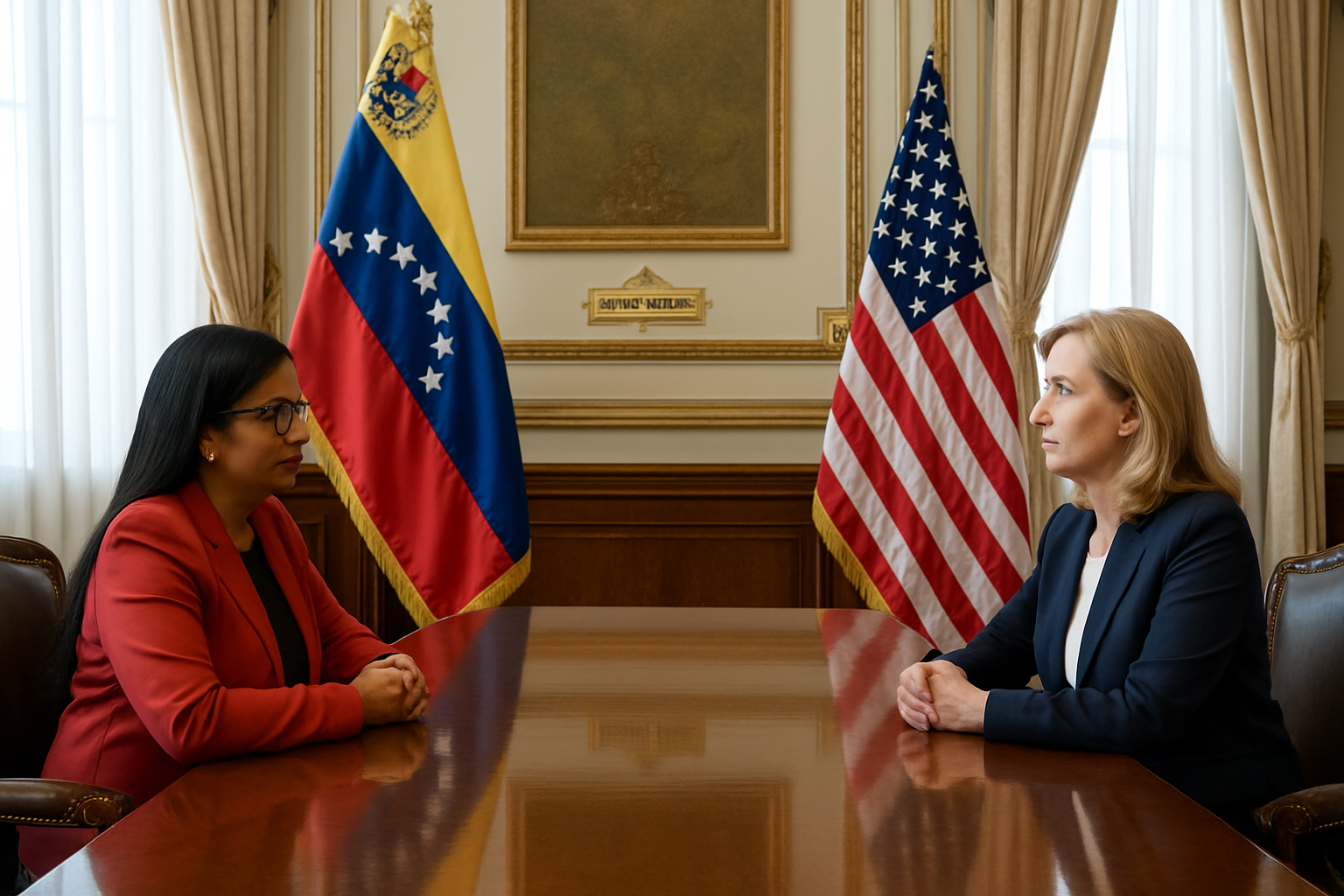
Venezuela's interim President Delcy Rodríguez met with US Chargé d'Affaires Laura Dogu at the Miraflores Presidential Palace in Caracas Monday, marking the highest-level diplomatic engagement between the two countries since Nicolás Maduro's removal from power in January 2026.
The historic meeting, confirmed by Venezuela's Information Minister Miguel Angel Perez, represents a dramatic shift in US-Venezuela relations after years of diplomatic isolation. Dogu announced on social media platform X that she had discussed "transition" with both Rodríguez and National Assembly President Jorge Rodríguez during the landmark encounter.
The talks come exactly one month after Maduro's capture by US military forces, ending his 11-year rule that had been marked by economic collapse, widespread emigration, and international isolation. Since assuming the interim presidency, Rodríguez has moved quickly to signal Venezuela's willingness to rebuild relationships with the international community.
Three-Phase Reconstruction Plan
According to diplomatic sources familiar with the discussions, US Secretary of State Marco Rubio has outlined a comprehensive three-phase plan for Venezuela's reconstruction. The framework begins with immediate stabilization efforts, followed by economic recovery initiatives, and culminating in a democratic transition process.
The stabilization phase focuses on addressing Venezuela's humanitarian crisis, which has seen over 7 million people flee the country since 2015. Economic recovery will require the gradual lifting of US sanctions that have crippled Venezuela's oil industry, once the backbone of its economy. The final phase envisions establishing democratic institutions and preparing for free and fair elections.
"This represents the most significant diplomatic opening between our countries in over a decade,"
— Laura Dogu, US Chargé d'Affaires for Venezuela
The meeting at Miraflores Palace, the traditional seat of Venezuelan presidential power, carried deep symbolic significance. For the first time since 2019, when the US severed diplomatic relations with the Maduro government, American and Venezuelan officials sat across from each other in the ornate halls of the presidential complex.
Signs of Political Reconciliation
The diplomatic breakthrough extends beyond the bilateral meeting. Rodriguez has announced plans to appoint a new head of Venezuela's diplomatic mission to the United States, reversing years of fractured communication channels. This reciprocal gesture follows Washington's decision to send Dogu as its representative to Caracas.
In a parallel development that signals broader reconciliation efforts, Rodríguez has moved forward with a proposed general amnesty law for political prisoners. The first releases have already begun, with Javier Tarazona, director of the human rights organization Fundaredes, freed on February 1 after more than four years in detention on terrorism and treason charges.
Opposition leader María Corina Machado, who had been barred from political participation under Maduro's regime, welcomed the prisoner releases as a crucial step toward national reconciliation. The amnesty could potentially affect hundreds of political prisoners detained during the previous government's crackdown on dissent.
Regional Context and International Support
The Venezuela transition talks occur amid broader diplomatic initiatives throughout Latin America. President Trump has simultaneously signaled willingness to negotiate with Cuba while maintaining economic pressure on the island nation through threatened oil sanctions affecting Mexico and other regional suppliers.
Regional powers have largely welcomed the Venezuelan political transition. Brazil, which shares an extensive border with Venezuela and has hosted hundreds of thousands of Venezuelan refugees, has expressed support for a peaceful democratic transition. The normalization of US-Venezuela relations could significantly impact migration patterns throughout South America.
European Union officials have also indicated their readiness to support Venezuela's transition process, potentially offering both financial assistance and technical expertise for rebuilding democratic institutions. The EU had imposed its own sanctions regime on Venezuelan officials during the Maduro era.
Economic Challenges Ahead
One month after Maduro's departure, Venezuela remains in the grip of a severe economic crisis. Hyperinflation, currency collapse, and infrastructure deterioration have left the country dependent on imports for basic necessities. The population oscillates "between hope and fear," according to local reports, as citizens cautiously welcome change while remaining uncertain about the future.
Oil production, which once exceeded 3 million barrels per day, has fallen to approximately 700,000 barrels daily due to years of mismanagement, sanctions, and infrastructure decay. Restoring the energy sector will require massive international investment and technical expertise.
The interim government faces immediate challenges in providing basic services. Power outages remain common across much of the country, while fuel shortages affect transportation and commerce. Food security concerns persist, with many Venezuelans still dependent on government food distribution programs.
Democratic Transition Timeline
While Monday's talks represent a crucial first step, significant challenges remain in crafting a sustainable democratic transition. The interim government must balance calls for rapid political change with the practical requirements of institutional rebuilding.
International observers emphasize that any successful transition will require broad domestic consensus among Venezuela's polarized political factions. The involvement of civil society organizations, labor unions, and business groups will be essential for legitimizing the process.
Electoral preparations alone could take months, requiring the reconstitution of voter registration systems, establishment of independent electoral authorities, and creation of transparent voting mechanisms. International election monitoring will likely be necessary to ensure credibility.
Looking Forward
As Venezuela navigates its post-Maduro transition, the success of ongoing diplomatic efforts will largely depend on sustained international support and domestic stability. The meetings between Rodriguez and Dogu establish a framework for continued dialogue, but implementation of concrete reforms will test both countries' commitment to normalization.
The international community faces delicate decisions about the pace of sanctions relief and aid distribution. Too rapid a removal of economic restrictions could undermine leverage for democratic reforms, while maintaining excessive pressure could hamper recovery efforts and fuel popular discontent.
For ordinary Venezuelans, the diplomatic breakthrough offers hope for improved living conditions and eventual political participation. However, rebuilding trust in democratic institutions after years of authoritarian rule will require patience, transparency, and measurable progress in addressing the country's multiple crises.