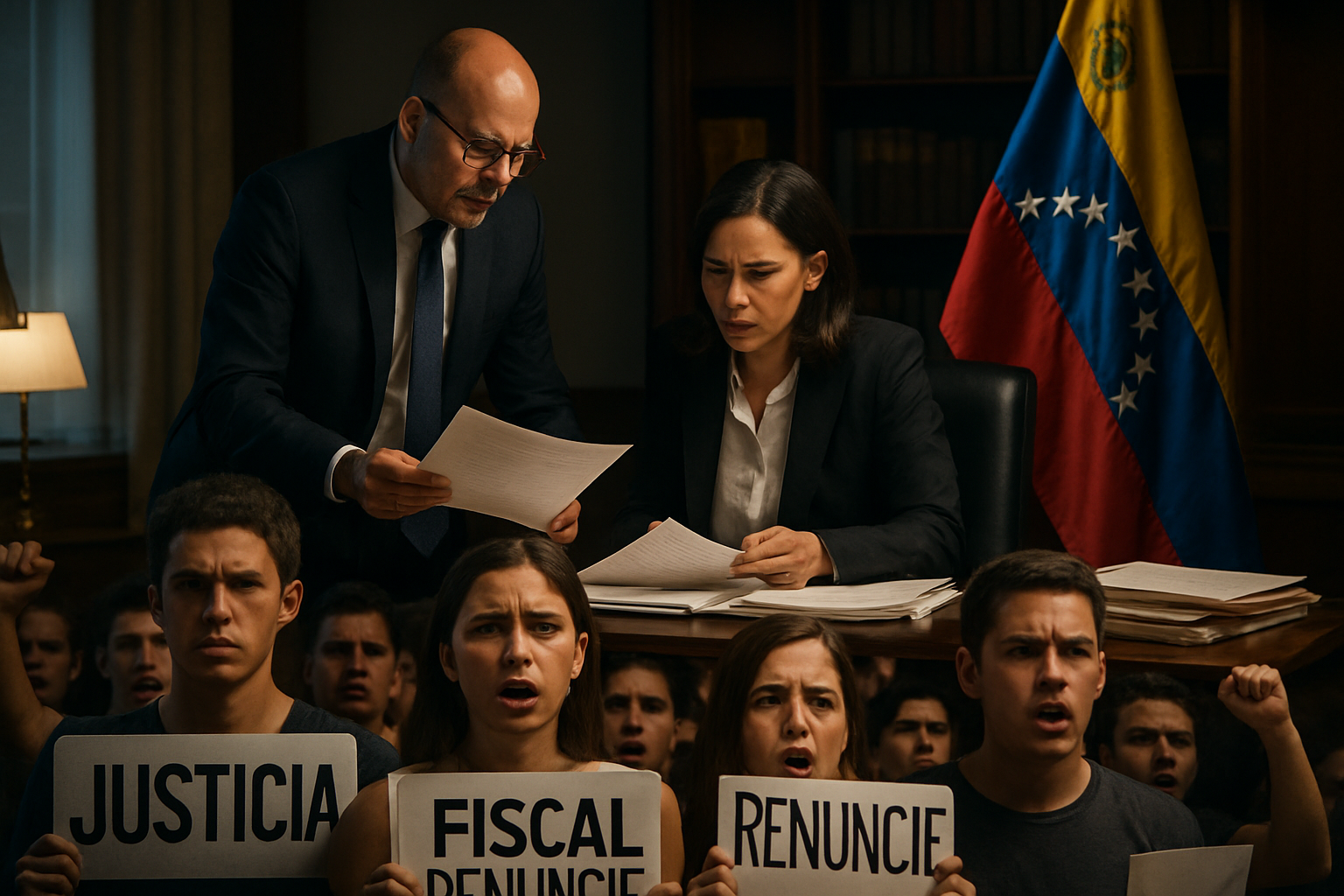
Venezuelan opposition lawyers have formally petitioned the United States Department of Justice to open a criminal investigation into former president Nicolás Maduro for torture crimes, while university students simultaneously staged protests demanding the resignation of interim Public Defender Tarek William Saab.
A group of Venezuelan lawyers in exile submitted a formal request to US authorities on March 2, 2026, seeking an investigation that could potentially result in life imprisonment for the deposed leader. The petition represents a significant escalation in international accountability efforts against the former Venezuelan regime.
According to sources from Efecto Cocuyo, the legal petition focuses on systematic torture allegations during Maduro's presidency, which ended when he was captured by US forces on January 3, 2026, and now faces drug trafficking charges in New York federal prison alongside his wife Cilia Flores.
Student Opposition to Prosecutor Appointment
In a parallel development that highlights ongoing concerns about Venezuela's transitional justice system, students from Universidad Central de Venezuela (UCV) marched to the office of the Public Defender to demand the resignation of Tarek William Saab, who controversially transitioned from his role as prosecutor general to interim Public Defender.
Student leader Miguelangel Borsegui, secretary of International Affairs for the UCV University Student Federation, articulated the protesters' position: "It cannot be that the former prosecutor general of the Republic, who imprisoned thousands of Venezuelans on false charges, is now the one who is supposed to defend them."
The students' protest underscores deeper concerns about institutional continuity and credibility during Venezuela's democratic transition under Acting President Delcy Rodríguez, who assumed power following Maduro's removal.
Historical Context of Accountability Efforts
The US petition comes amid Venezuela's most significant political transformation in decades. Since January 2026, the interim government has released over 750 political prisoners under a comprehensive amnesty law covering the period from 1999-2026, spanning the entire Chávez-Maduro era.
However, implementation of the amnesty has faced significant challenges. More than 600 political prisoners remain detained according to human rights organization Foro Penal, while many releases have been conditional rather than complete. Juan Pablo Guanipa, a close ally of Nobel Peace Prize laureate María Corina Machado, exemplifies these complications – he was released then placed under house arrest with electronic monitoring.
The appointment of Tarek William Saab as interim Public Defender has particularly sparked controversy. During his tenure as prosecutor general under Maduro, Saab oversaw the prosecution of thousands of opposition figures, journalists, and activists on what critics describe as politically motivated charges.
International Dimension of Justice Efforts
The lawyers' petition to the US Department of Justice represents the latest attempt to pursue international accountability for alleged crimes during the Maduro era. Previous efforts have included referrals to the International Criminal Court and documentation by UN human rights mechanisms.
The timing coincides with unprecedented US-Venezuela diplomatic engagement under the interim government. Oil exports have surged 60% to 800,000 barrels daily, with the US displacing China as Venezuela's top customer following the lifting of sanctions. Energy Secretary Chris Wright conducted a historic visit to Caracas in February, signing comprehensive cooperation agreements.
Former Spanish Prime Minister José Luis Rodríguez Zapatero continues mediation efforts in Caracas, while Cardinal Baltazar Porras has organized nationwide prayer vigils to support the reconciliation process. The Dominican Republic has reopened diplomatic relations, and Brazil and EU nations have expressed cautious support for the transition.
Challenges to Transitional Justice
The controversy over Saab's appointment reflects broader challenges facing Venezuela's transitional justice framework. Civil society organizations have emphasized that prisoner releases should be viewed as "rights restitution, not state favor," while questioning the appropriateness of former regime officials occupying human rights protection roles.
The comprehensive amnesty law, while unprecedented in its 27-year scope, has faced criticism for various exclusions. Article 9 excludes those who "promoted attacks on national territory by foreign states or corporations," while Article 7's requirement that prisoners "present themselves to justice" created implementation delays and controversy.
Families of political prisoners have maintained vigils and hunger strikes at detention centers, with some protests entering their second month. The Committee for Liberation of Political Prisoners (CLIPP) has demanded "inclusive rather than selective" amnesty coverage, highlighting the gap between legislative achievement and practical implementation.
Regional Implications
Venezuela's transition is being closely monitored as a potential template for Latin American reconciliation processes. The comprehensive nature of the amnesty law – covering nearly three decades of political conflict – represents one of the most ambitious reconciliation efforts in recent regional history.
However, the ongoing challenges with implementation, including the controversial appointment of former regime officials to human rights roles, raise questions about the authenticity of democratic reform versus cosmetic changes designed to maintain institutional control.
The success or failure of Venezuela's transitional justice process could influence similar efforts throughout the region, particularly as other Latin American nations grapple with legacies of authoritarian rule and human rights violations.
Looking Forward
The lawyers' petition for US investigation into torture crimes represents a parallel track to domestic reconciliation efforts, reflecting skepticism about the completeness of internal accountability mechanisms. The involvement of US authorities could provide an external avenue for justice that bypasses potentially compromised domestic institutions.
María Corina Machado has announced her intention to return to Venezuela "in a few weeks" to help guarantee a transition to democracy, which could further complicate the political landscape and accountability discussions.
As Venezuela navigates this critical period, the tension between reconciliation and accountability remains central to the country's democratic future. The handling of figures like Tarek William Saab – and the broader question of how to address past abuses while building new institutions – will likely determine whether Venezuela achieves genuine democratic transformation or merely superficial change.
The coming weeks will prove decisive as the international community watches whether Venezuela can successfully balance the demands of justice with the practical requirements of political stability during its most promising democratic opening in over two decades.