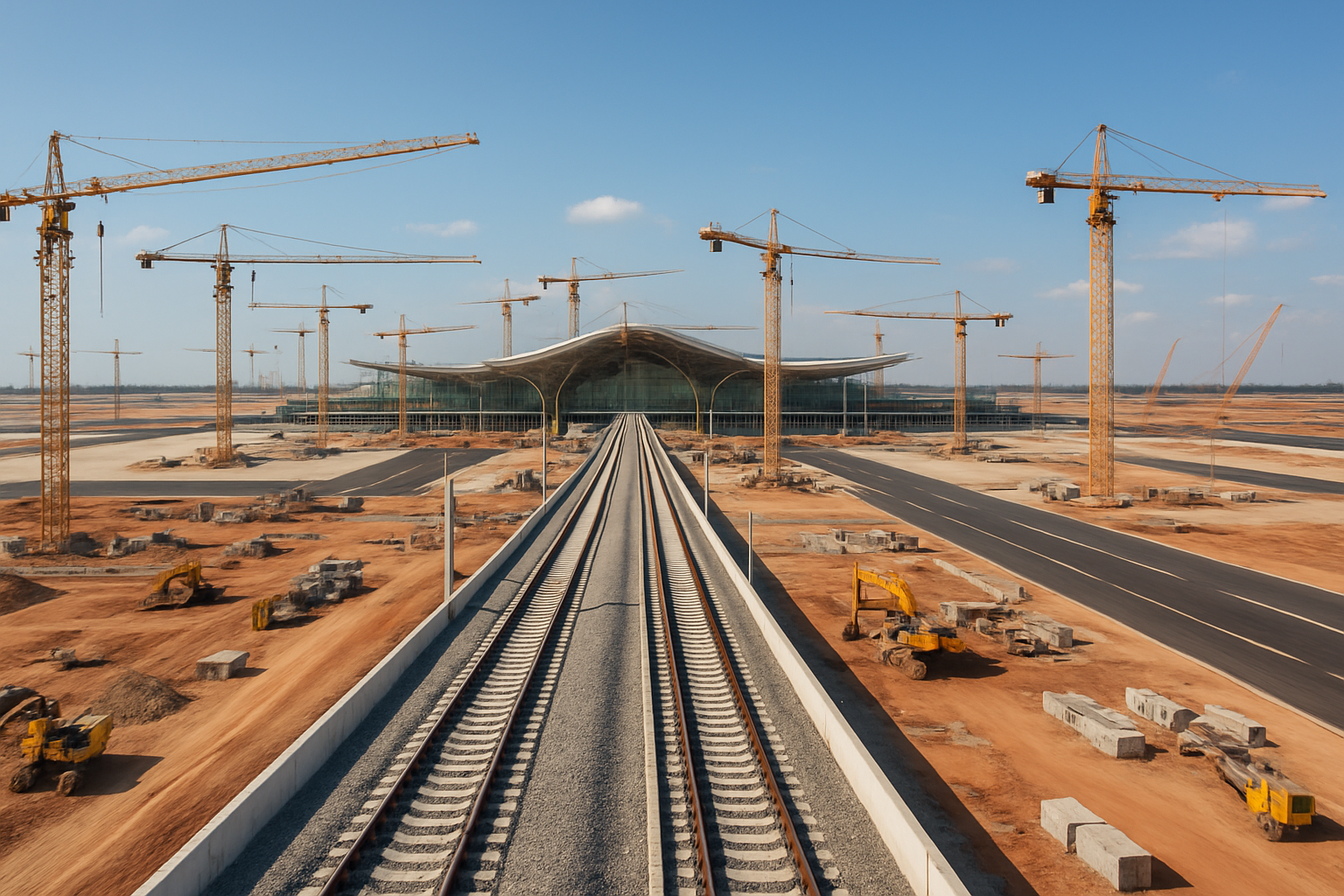
Vietnam's Prime Minister Pham Minh Chinh has issued an urgent directive to accelerate construction of Long Thanh International Airport in southern Dong Nai Province, setting a firm deadline for commercial operations to begin in the fourth quarter of 2026, while neighboring Laos has approved a historic railway connection to Vietnam that could reshape regional economic integration.
The dual infrastructure developments represent a pivotal moment in Southeast Asia's transportation transformation, occurring within the broader context of Vietnam's $120 billion commitment to build 9,000 kilometers of expressways by 2050 and an unprecedented $570+ billion global infrastructure surge documented throughout 2026.
Long Thanh Airport: Southeast Asia's Aviation Gateway
Prime Minister Pham Minh Chinh's directive comes as Vietnam positions Long Thanh International Airport to become Southeast Asia's largest aviation hub, requiring critical transportation connectivity to ensure its success. The airport project has been central to Vietnam's economic modernization strategy, with authorities recognizing that seamless ground transportation will be essential for realizing its full potential.
According to historical development patterns tracked since February 2026, Vietnam faces a critical transportation challenge in reducing the current 3-hour journey from downtown Ho Chi Minh City to the airport location to just 30 minutes through integrated transportation planning, high-speed rail connections, dedicated highway infrastructure, and digital traffic management systems.
The government has already announced emergency construction of Ben Thanh-Thu Thiem Metro Line No. 2, a $1.25 billion project creating strategic connectivity between the city center and Long Thanh International Airport. This metro expansion is part of Ho Chi Minh City's broader $20 billion metro network expansion, which will build five additional lines by 2030, extending the total network to 187 kilometers beyond the existing Ben Thanh-Suoi Tien line.
Laos Railway Connection: Breaking the Landlocked Barrier
In a parallel development that could transform regional trade dynamics, the Lao National Assembly has granted in-principle approval for a railway project linking Thakhek township in Khammouane Province with Vietnam's Mu Gia border gate in Quang Tri Province. The project will operate under a build-operate-transfer (BOT) model, representing Laos's strategic bid to overcome its landlocked geographical constraints.
This railway connection, approved during the inaugural session of Laos's 10th legislature, will provide the landlocked nation with crucial access to Vietnam's extensive transportation networks and ultimately to international ports. The project aligns with broader regional integration efforts that have been accelerating throughout 2026, as documented in multiple infrastructure development initiatives across Southeast Asia.
The railway represents more than just physical connectivity—it embodies the shift toward regional cooperation over individual nation competition that has characterized infrastructure development in 2026. Similar to successful models implemented between other countries, this project will likely incorporate sophisticated technology integration including real-time monitoring, predictive maintenance, and environmental optimization as standard features rather than retrofitted additions.
Regional Integration and Economic Implications
These infrastructure developments occur within the context of ASEAN's evolving economic integration strategy, where transportation networks are increasingly viewed as strategic foundations for regional competitiveness rather than simple connectivity projects. The economic multiplier effects extend far beyond construction employment, creating reduced logistics costs, enhanced market access, and improved business productivity that supports broader ASEAN cooperation frameworks.
"Vietnam's infrastructure surge demonstrates the country's commitment to becoming Southeast Asia's logistics hub while simultaneously supporting regional integration through enhanced connectivity with neighboring nations."
— Infrastructure Development Analysis, March 2026
The timing of these announcements reflects Vietnam's sophisticated understanding of infrastructure as an economic competitiveness tool. Historical analysis reveals that successful infrastructure projects in the region have consistently incorporated climate adaptation measures, technology integration, and regional cooperation from the initial design phase rather than as afterthoughts.
Technology Integration and Climate Adaptation
Both the Long Thanh Airport acceleration and the Laos railway connection exemplify modern infrastructure development standards that have emerged throughout 2026. Contemporary projects universally incorporate sophisticated technology integration from the design phase, including real-time monitoring systems, predictive maintenance capabilities, digital payment integration, and comprehensive environmental optimization.
Climate adaptation has evolved from an optional consideration to a mandatory requirement, particularly given that January 2026 marked the 18th consecutive month of global temperatures exceeding 1.5°C above pre-industrial levels. Both projects will need to incorporate enhanced drainage systems, weather-resistant materials, backup power systems, and flood management features designed for future climate conditions rather than historical weather patterns.
The semiconductor shortage affecting global infrastructure development, with memory chip prices experiencing sixfold increases through 2027, has accelerated innovation in efficient algorithms and distributed processing systems. This technological challenge has actually driven more resilient and adaptable infrastructure networks, with both Vietnamese projects expected to implement cutting-edge solutions that overcome traditional hardware dependencies.
Financing Innovation and International Cooperation
The financing approaches for both projects reflect broader trends in infrastructure development observed throughout 2026. Vietnam's domestic commitment to the airport acceleration demonstrates sustained political commitment that transcends electoral cycles, while Laos's BOT model for the railway represents innovative public-private partnership approaches that enable developing nations to undertake previously impossible projects.
International cooperation has evolved beyond traditional North-South aid models to sophisticated peer-to-peer knowledge sharing and technical assistance frameworks. The success of these projects will likely influence global transportation strategies for decades ahead, as they represent templates for balancing immediate mobility needs with long-term sustainability objectives.
Implementation Challenges and Success Factors
Both projects face universal implementation challenges that have characterized major infrastructure developments throughout 2026, including material cost inflation, skilled labor shortages, environmental compliance requirements, and complex multi-stakeholder coordination. The global context of supply chain disruptions requires sophisticated procurement strategies and adaptive management approaches.
Success factors consistently identified across similar projects include sustained political commitment, transparent governance frameworks, comprehensive stakeholder engagement, and adaptive management that can respond to changing conditions while maintaining core development objectives. International cooperation involving technical assistance, knowledge sharing, and coordinated procurement has proven essential for overcoming these challenges.
Strategic Significance for Southeast Asia
The convergence of Vietnam's airport acceleration and Laos's railway approval represents a watershed moment in Southeast Asian infrastructure development. These projects establish precedents that will influence regional transportation strategies for decades ahead, particularly in their integration of technological advancement, environmental sustainability, and international cooperation.
The choice between transformative infrastructure adaptation versus reactive crisis management has become increasingly critical as the window for preventive climate action narrows while urbanization and economic pressures intensify worldwide. Both Vietnam and Laos appear to have chosen the transformative approach, investing in infrastructure that serves both immediate development needs and long-term regional integration objectives.
As part of the broader $570+ billion global infrastructure surge documented throughout 2026, these projects demonstrate how nations can systematically build the physical foundations for sustainable prosperity in an uncertain but interconnected future. The success of Vietnam's airport deadline and Laos's railway connection will provide valuable lessons for infrastructure development across the developing world, potentially serving as models for balancing rapid economic growth with environmental responsibility and regional cooperation.