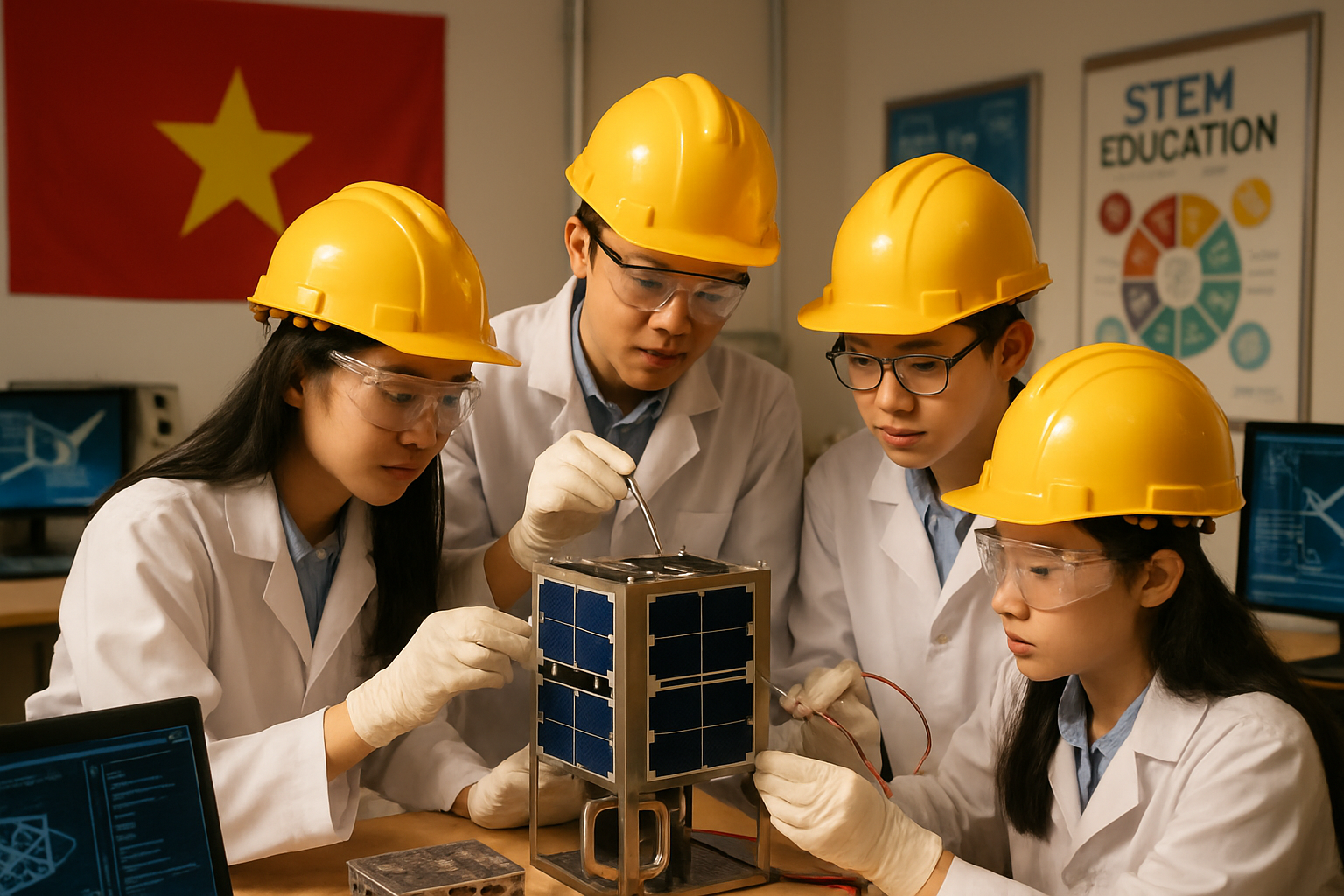
Four Vietnamese high school students have designed a revolutionary $400 satellite capable of detecting clear-air turbulence, the invisible atmospheric phenomenon that causes aircraft to shake violently without warning and cannot be identified by conventional weather radar.
This remarkable achievement represents a quantum leap in Vietnam's technological education landscape, positioning the Southeast Asian nation as a serious contender in global aerospace innovation. The students' breakthrough comes amid a broader transformation in Vietnam's educational system, which has been systematically investing in STEM education and producing extraordinary results on the international stage.
Revolutionary Satellite Technology
The student-designed satellite addresses one of aviation's most persistent safety challenges. Clear-air turbulence occurs in cloudless skies where conventional radar systems fail to detect atmospheric disturbances, making it particularly dangerous for commercial aviation. The Vietnamese students' innovative approach uses advanced sensor technology to identify these invisible phenomena, potentially saving lives and improving flight safety worldwide.
What makes this achievement particularly impressive is the cost-effectiveness of their solution. At just $400, their satellite design demonstrates how innovative engineering can create sophisticated solutions without requiring massive budgets traditionally associated with aerospace technology. This approach reflects Vietnam's broader strategy of achieving technological excellence through intelligent resource allocation and creative problem-solving.
Vietnam's Educational Excellence Trajectory
This satellite project exemplifies Vietnam's systematic approach to educational transformation over the past decade. The country has implemented comprehensive reforms that balance traditional academic rigor with cutting-edge technological innovation, creating an environment where students can pursue ambitious projects while maintaining strong foundational knowledge.
Recent achievements underscore Vietnam's educational momentum. Two students from Hanoi's Foreign Language Specialized School achieved perfect IELTS band scores of 9.0 on their first attempt, while the government conducted a nationwide English proficiency assessment of over one million teachers—the world's first comprehensive evaluation of its kind. These accomplishments demonstrate Vietnam's commitment to both linguistic competency and technical innovation.
International Recognition and Impact
Vietnam's educational excellence extends far beyond national borders. Vietnamese students have earned prestigious recognition in international competitions, including mathematics olympiads and computing research awards. A Vietnamese student at Pomona College in California recently became one of only eight nationwide winners of a prestigious US computing research award, co-authoring a research paper ranked in the top 1% globally.
This international success reflects Vietnam's sophisticated understanding that educational excellence requires both local cultural preservation and global competency development. The satellite project embodies this philosophy—using advanced technology to address universal challenges while maintaining Vietnam's distinctive approach to innovation and problem-solving.
Strategic Educational Investment
Vietnam's achievements occur within the broader context of what international observers term the "2026 Educational Technology Renaissance"—a coordinated global movement toward thoughtful digital tool integration with traditional educational values. Unlike some nations that have pursued wholesale technological replacement, Vietnam has emphasized human-centered approaches that enhance rather than replace fundamental teacher-student relationships.
The country's success factors include sustained political commitment beyond electoral cycles, comprehensive stakeholder engagement involving educators, students, families, and communities, and adequate resource allocation for long-term sustainability. These elements have created an educational ecosystem where ambitious projects like satellite design can flourish while maintaining academic excellence across all subjects.
Regional Leadership and Cooperation
Vietnam's technological education success positions the country as a regional leader in Southeast Asia's educational transformation. The nation has engaged in extensive international cooperation through knowledge sharing agreements with countries like Bangladesh and Malaysia, Commonwealth Youth Awards participation, and bilateral partnerships that enable access to global expertise while contributing innovations to the international knowledge base.
This cooperative approach reflects Vietnam's understanding that educational excellence in the 21st century requires both individual national achievement and collaborative international development. The satellite project demonstrates how students can work on locally relevant problems while contributing to global scientific knowledge and aviation safety.
Infrastructure and Innovation Balance
Vietnam faces the same global challenges affecting educational technology implementation, including semiconductor shortages and infrastructure bottlenecks. However, the country has turned these constraints into opportunities for innovation, developing efficient, sustainable approaches that emphasize educational goals over technological novelty.
The student satellite project exemplifies this approach—achieving sophisticated results through intelligent design rather than expensive components. This methodology could provide templates for other developing nations seeking to advance technological education without massive infrastructure investments.
Future Implications
The success of Vietnam's educational transformation, exemplified by projects like the student satellite design, suggests broader implications for global educational policy. The country demonstrates that effective modernization requires maintaining human creativity, critical thinking, and cultural knowledge while preparing students for an interconnected global economy demanding both technical competence and cultural authenticity.
As Vietnam continues expanding its educational infrastructure—with plans for 986 new schools by 2045 to accommodate growing demand—the nation's balanced approach to innovation and tradition provides valuable insights for educational systems worldwide. The satellite project represents not just individual student achievement, but a comprehensive educational philosophy that could influence international approaches to STEM education and technological innovation.
Vietnam's rising technological stars demonstrate that educational excellence emerges from thoughtful integration of advanced tools with enduring educational principles, creating graduates capable of addressing complex global challenges while maintaining their cultural identity and innovative spirit.