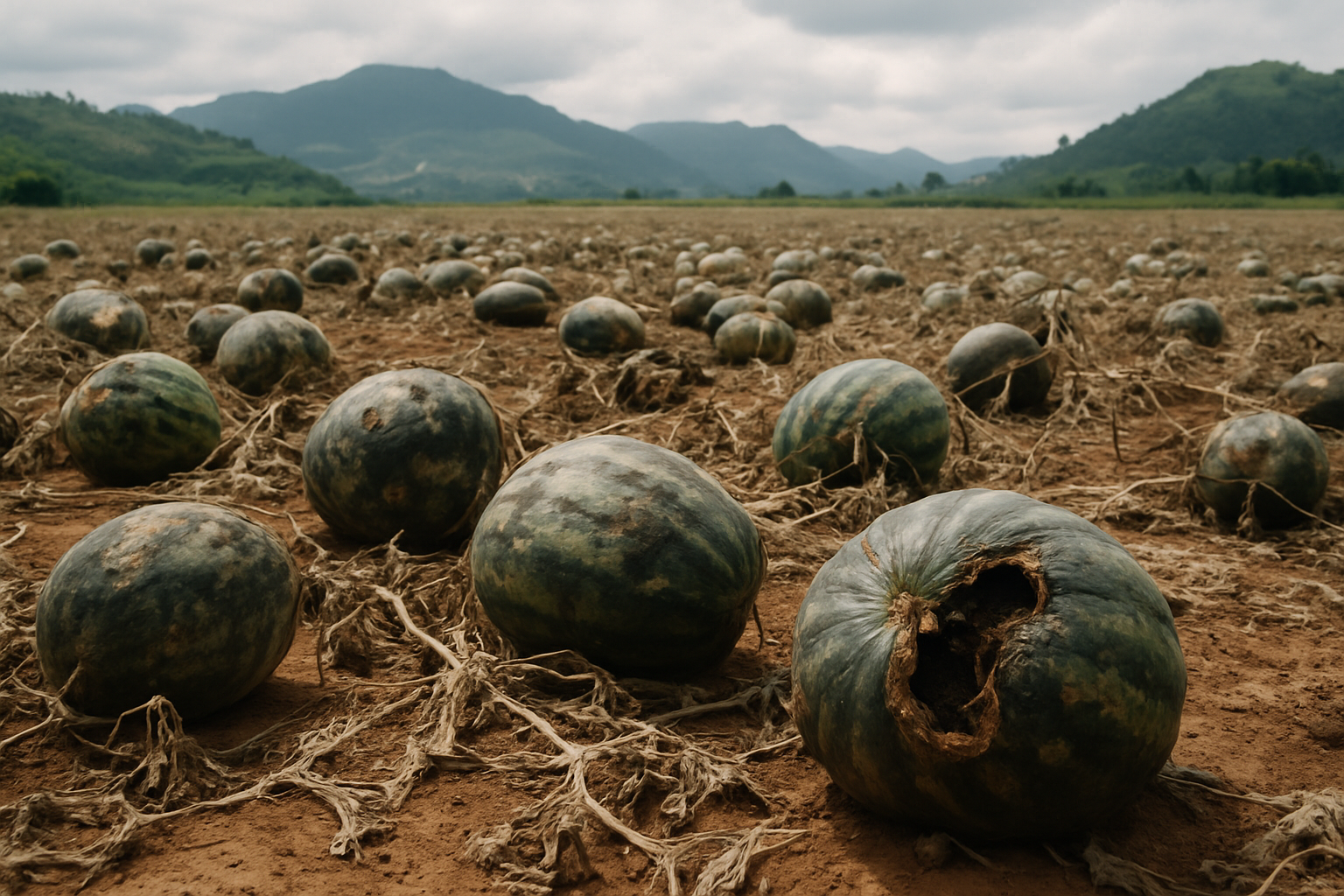
More than 200 tons of watermelons worth approximately $336,000 have been left to rot in Vietnam's Central Highlands fields following a devastating breakdown in harvest agreements between growers and traders, marking one of the most significant agricultural supply chain failures in the region during the critical Tet holiday selling season.
The crisis, unfolding in Vietnam's agricultural heartland during what should have been the peak profit period, represents far more than a local dispute—it exemplifies the growing fragility of global food systems under mounting climate pressures. The incident occurred during the 18th consecutive month of global temperatures exceeding 1.5°C above pre-industrial levels, creating unprecedented stress on agricultural operations worldwide.
Harvest Deal Collapse Triggers Massive Waste
According to official reports, the dispute originated from disagreements over crop yields between local watermelon growers and established trading partners in Vietnam's Central Highlands. Neither side was willing to compromise during negotiations, leading to a complete breakdown in what industry experts describe as typically stable commercial relationships.
The timing proved catastrophic. The Tet holiday period represents the most lucrative sales window for Vietnamese agricultural producers, when demand peaks and prices traditionally reach their highest levels of the year. The failure to resolve the dispute during this critical period has resulted in total crop loss, devastating farmer incomes, and highlighting dangerous vulnerabilities in agricultural supply chain coordination.
Regional Agricultural Crisis Context
This Vietnam watermelon crisis emerges within a broader pattern of agricultural instability affecting Southeast Asia and beyond. Recent memory of regional agricultural challenges includes similar crop failures, pricing disputes, and supply chain breakdowns that have collectively undermined food security and farmer livelihoods across the region.
The Central Highlands region, traditionally considered Vietnam's agricultural powerhouse, has been experiencing increased weather volatility, irregular rainfall patterns, and temperature extremes that complicate traditional farming cycles. These environmental pressures create additional stress on farmer-trader relationships, where any disruption in expected yields or quality can trigger disputes that escalate beyond resolution.
"When agricultural partnerships break down during peak seasons, the losses extend far beyond individual farms to affect entire regional economies and food security networks."
— Regional Agricultural Expert
Global Agricultural Renaissance Under Pressure
The Vietnam crisis contrasts sharply with successful agricultural innovations documented across other developing nations. Recent agricultural breakthroughs include Malaysia's transition to "outcome-driven delivery" agricultural policies, which have transformed rural development approaches. Dr. Stephen Rundi Utom, Sarawak State Minister of Food Industry, announced fundamental shifts from "routine administration to outcome-driven delivery," positioning regions to become major food producers and future net exporters.
Similarly, Papua New Guinea has pursued large-scale commercial farming initiatives representing fundamental agricultural paradigm shifts. The Markham Valley corn production alone expects K5+ million in revenue, with mechanized harvesting demonstrations at Rumion Farm proving commercial viability. These successes highlight the potential for agricultural transformation when proper coordination and investment align.
Climate Change Amplifying Agricultural Vulnerabilities
Agricultural experts emphasize that climate change is fundamentally altering the risk profile for crop production and supply chain relationships. The 18th consecutive month of temperatures exceeding 1.5°C above pre-industrial levels has created optimal conditions for pest outbreaks, disrupted traditional growing seasons, and increased the likelihood of extreme weather events that can destroy crops or prevent timely harvesting.
These environmental pressures place additional strain on farmer-trader relationships, where traditional agreements based on historical weather patterns and crop performance may no longer reflect current realities. When yields vary significantly from expectations—whether due to climate impacts, pest pressures, or market volatility—the risk of commercial disputes increases substantially.
Technology and Traditional Knowledge Integration
Successful agricultural adaptation globally has required sophisticated integration of cutting-edge technology with traditional farming knowledge. African nations have demonstrated this approach through initiatives like Algeria's "Tamr Al-Aghanm" date waste to livestock feed conversion, Kenya's Nguruman irrigation scheme rehabilitation benefiting over 10,000 farmers, and Uganda's Teso cattle farming revival after decades of decline.
These successes share common factors: sustained political commitment, transparent governance frameworks, community ownership principles, and adaptive management capabilities that respond to rapidly changing environmental conditions. The Vietnam watermelon crisis suggests that similar approaches may be necessary to prevent future agricultural supply chain failures.
Economic Implications Beyond Individual Farms
The $336,000 loss from the watermelon crisis represents more than immediate farmer income reduction. Agricultural economists note that such failures create cascading effects throughout regional economies, affecting transportation companies, packaging suppliers, retail distribution networks, and ultimately consumer food prices and availability.
The crisis also undermines confidence in Vietnamese agricultural exports, potentially affecting international trade relationships and the country's reputation as a reliable agricultural supplier. This reputational damage can have long-lasting effects that extend far beyond the immediate financial losses from rotting crops.
South-South Cooperation as Alternative Model
Recent global agricultural developments suggest that South-South cooperation—peer-to-peer knowledge transfer between developing nations—may offer more sustainable solutions than traditional North-South aid relationships. Examples include Bolivia-India agricultural partnerships combining modern research with locally-adapted practices, and regional integration through initiatives like the African Continental Free Trade Agreement creating agricultural partnership opportunities.
Vietnam's agricultural sector could benefit from similar collaborative approaches, particularly with other Southeast Asian nations facing comparable climate challenges and supply chain vulnerabilities. Such partnerships could provide alternative trading relationships, shared risk management strategies, and coordinated responses to climate-related agricultural disruptions.
Prevention Strategies and Future Resilience
Agricultural experts identify several strategies that could prevent similar crises in the future. These include diversified trading partnerships that reduce dependency on single buyer relationships, flexible pricing mechanisms that adapt to changing market conditions, improved weather forecasting and crop insurance systems, and enhanced communication protocols for resolving disputes before they escalate to total breakdown.
Additionally, investment in post-harvest processing infrastructure could provide alternative markets for crops when primary trading relationships fail. Value-added processing, direct-to-consumer marketing, and regional food processing cooperatives could create more resilient agricultural supply chains less vulnerable to individual partnership failures.
International Cooperation Requirements
The Vietnam watermelon crisis highlights the need for enhanced international cooperation in agricultural development and crisis prevention. This includes technology transfer for improved crop storage and processing, financial mechanisms for agricultural insurance and risk management, and coordination of regional food security initiatives that can respond rapidly to local supply chain failures.
The window for building resilient, equitable food systems is narrowing rapidly as climate change accelerates and population growth creates additional food security pressures. The tools and knowledge exist for effective responses, but success depends on sustained political commitment, adequate and predictable funding for both emergency response and long-term development, and coordination between immediate crisis response and resilience building efforts.
Lessons for Global Food Security
The Vietnam watermelon crisis serves as a critical case study for global food security planning during an era of accelerating climate change. It demonstrates how local agricultural disputes can have broader implications for food system stability, economic development, and rural community resilience.
The incident underscores the importance of treating food security as a global public good requiring unprecedented international cooperation. Success in preventing similar crises depends on recognizing the interconnected nature of agricultural systems, climate change impacts, and economic development challenges that affect rural communities worldwide.
As global temperatures continue to exceed critical thresholds and weather patterns become increasingly unpredictable, the agricultural sector must develop more sophisticated approaches to risk management, partnership coordination, and crisis prevention. The Vietnam watermelon crisis provides valuable lessons for building more resilient agricultural systems capable of serving growing populations while protecting both farmer livelihoods and global food security.