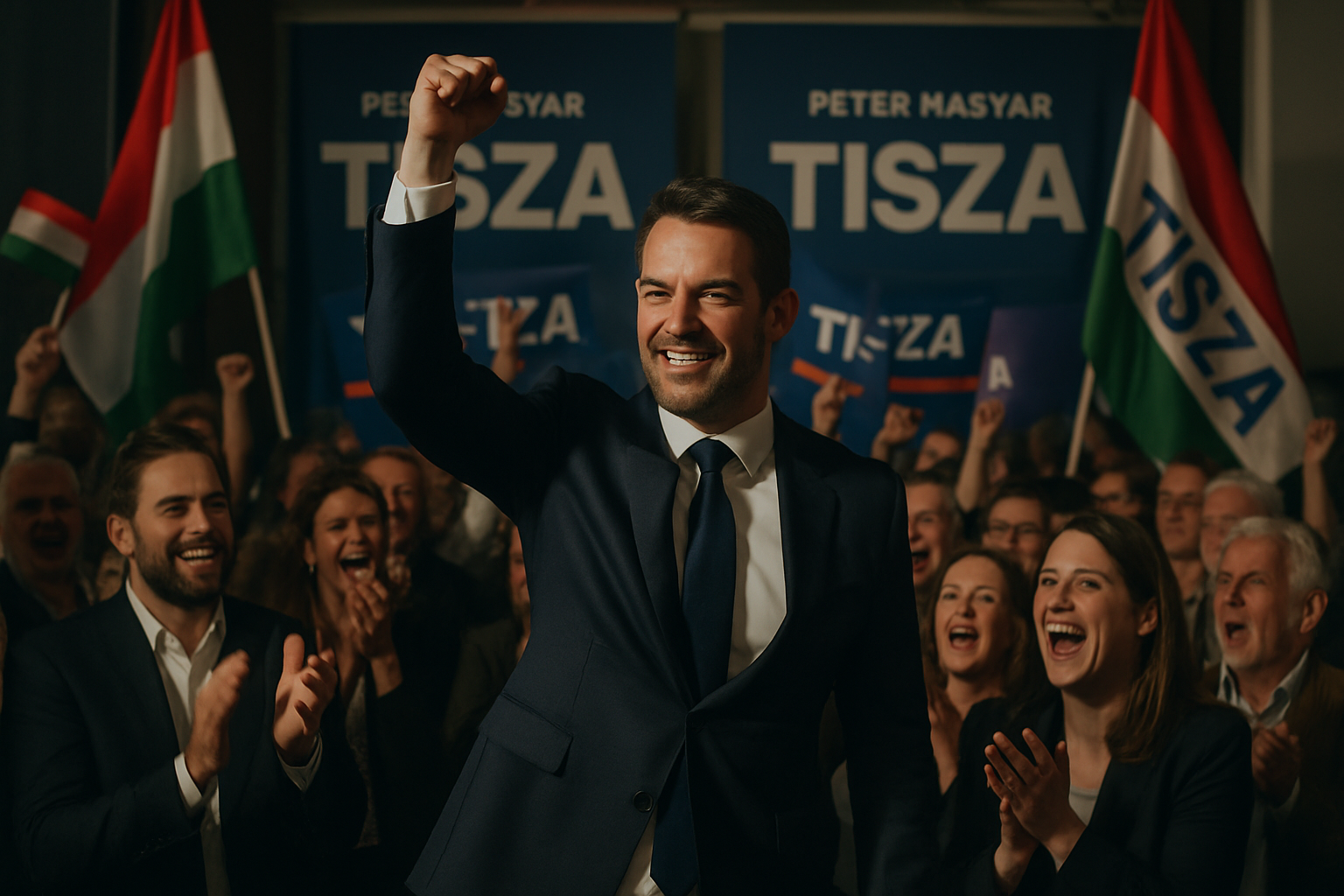
Hungarian Prime Minister Viktor Orbán has conceded defeat in a stunning electoral upset that ends his 16-year rule, as opposition leader Péter Magyar's Tisza party secured a commanding two-thirds majority in parliament with what early projections suggest is the most decisive victory in Hungary's post-communist democratic history.
The results, based on nearly complete vote counts, show Magyar's pro-European Tisza party winning 138 seats in the 199-member parliament—a constitutional majority that will enable sweeping democratic reforms. Orbán's Fidesz party suffered a devastating collapse, winning just 55 seats in what represents the most dramatic political reversal in Central Europe since 1989.
"The election result is painful but clear," Orbán said in a brief concession speech at his campaign headquarters Sunday evening. "I congratulated the winning party." The 62-year-old leader, who had dominated Hungarian politics since 2010, appeared visibly shaken as he acknowledged the end of an era that had made him one of Europe's most controversial and longest-serving leaders.
Historic Turnout Delivers Democratic Mandate
Voter turnout reached a historic 78%—the highest since Hungary's transition to democracy in 1989—signaling the depth of public engagement in what was widely viewed as a referendum on the country's democratic future. The massive participation contradicted expectations based on previous elections, where turnout typically favored Orbán's rural base.
Magyar, speaking to an estimated 100,000 supporters gathered in Budapest's Heroes' Square, declared the victory a triumph for democracy itself. "We have liberated Hungary," the 45-year-old former government insider proclaimed. "We have taken back our country from those who would divide us, who would isolate us from Europe, who would steal our future."
"Tonight, the heart of Europe beats stronger in Hungary. Hungary has chosen Europe. A country has found its European path again. The Union grows stronger."
— Ursula von der Leyen, European Commission President
The victory represents a stunning reversal for Orbán, who had seemed politically invincible just months ago. Magyar's campaign successfully mobilized what pollsters called "Generation Orbán"—voters aged 18-30 who had come of age under the Prime Minister's rule but increasingly rejected his nationalist, anti-EU messaging.
From Insider to Opposition Leader
Magyar's journey from Orbán ally to his most effective opponent reads like a political thriller. A lawyer by training, Magyar had served in various government positions and was married to former Justice Minister Judit Varga, making him a fixture in Budapest's political elite. His transformation into the opposition's standard-bearer began in 2024 when he broke dramatically with Fidesz over what he described as systemic corruption and authoritarian overreach.
The turning point came with Magyar's organization of the "Greatest National March" in March 2026, which drew an estimated 500,000 participants—the largest opposition demonstration since 2010. The massive rally demonstrated Magyar's ability to unite Hungary's fractured opposition behind a coherent pro-European platform promising wealth taxes, euro adoption, and stronger ties with NATO and the European Union.
Magyar's insider knowledge proved devastating in exposing Fidesz's vulnerabilities. His detailed allegations of government corruption, combined with his credible alternative vision, resonated with voters exhausted by political scandals and economic stagnation under Orbán's increasingly authoritarian rule.
International Dimensions and Foreign Interference
The election was marked by unprecedented foreign interference from multiple directions. Investigative reporting by Szabolcs Panyi revealed the first concrete evidence of Russian operative teams actively supporting Fidesz—the first documented case of Kremlin agents directly participating in a European Union electoral campaign.
Simultaneously, the Trump administration provided explicit political backing for Orbán, culminating in Vice President JD Vance's visit to Budapest just five days before the election. Vance condemned what he termed EU "shameless interference" while declaring Orbán a "model for Europe"—the most direct American intervention in an EU member state election in modern history.
This dual foreign interference created an unprecedented international dimension to the domestic Hungarian contest, with both Moscow and Washington openly supporting the incumbent against a pro-European challenger backed by Brussels.
European Union Crisis and Energy Weaponization
The election occurred against the backdrop of Hungary's blockade of a historic €90 billion EU aid package for Ukraine—the largest single-nation assistance program in EU history. Orbán had maintained this veto over disputes concerning the Druzhba oil pipeline, creating the deepest institutional crisis within the European Union since Russia's invasion of Ukraine.
Lithuanian Foreign Minister Kestutis Budrys had warned that "the EU cannot become Budapest's hostage," while European Commission President Ursula von der Leyen froze €19 billion in Hungarian funding over rule-of-law concerns. The crisis had accelerated discussions about "enhanced cooperation" mechanisms that would allow 26 EU member states to proceed without Hungary—a fundamental departure from the bloc's consensus-based decision-making.
Magyar's victory promises to immediately resolve this crisis. His campaign pledged to lift the Ukraine aid blockade and restore Hungary's position as a constructive EU member state, potentially ending years of institutional deadlock in Brussels.
Pipeline Sabotage and Security Concerns
Adding drama to the final week of campaigning, Serbian authorities discovered sophisticated explosive devices near the Balkan Stream pipeline infrastructure exactly one week before the election. The timing raised suspicions, with opposition leaders dismissing the incident as "tactical panic-making" designed to boost Orbán's security credentials.
Ukraine's Foreign Ministry characterized the discovery as "most likely a Russian false flag operation as part of Moscow's large-scale interference in Hungary's elections." The incident highlighted the complex web of energy security, geopolitical manipulation, and electoral politics that had come to define Hungarian democracy under Orbán's rule.
Media Breakthrough and Digital Resistance
One of the election's most significant developments was the opposition's successful escape from government media control through digital platforms and international coverage. Despite Fidesz's extensive dominance of traditional Hungarian media, Magyar's campaign effectively reached younger demographics through social media, podcasts, and alternative news sources.
Platforms like Márton Gulyás's "Partizán" built counter-narratives that reached millions of Hungarians, particularly in urban areas and among college-educated voters. This digital breakthrough represented a crucial shift that undermined Orbán's information monopoly despite his government's systematic capture of mainstream media outlets.
Constitutional Supermajority and Reform Agenda
Tisza's two-thirds parliamentary majority—the same constitutional threshold Orbán had used to reshape Hungarian institutions—now gives Magyar the power to reverse much of his predecessor's controversial legislative legacy. The opposition leader has promised comprehensive reforms including:
- Restoration of judicial independence and constitutional court authority
- Dismantling of media ownership restrictions that concentrated outlets in government-friendly hands
- Implementation of wealth taxes on Hungary's oligarch class
- Adoption of the euro and deeper European integration
- Strengthening of NATO commitments and transatlantic relationships
Magyar has also pledged to conduct a comprehensive audit of government contracts and corruption during the Orbán era, potentially leading to prosecutions of officials involved in what critics have characterized as systematic state capture.
European and International Reactions
The victory was greeted with euphoria across European capitals, where Orbán had become the EU's most persistent internal critic. French President Emmanuel Macron declared it a "victory of democratic participation," while German Chancellor Friedrich Merz emphasized Hungary's return to "a strong and united Europe."
European Commission President von der Leyen's statement captured the broader continental relief: "Tonight, the heart of Europe beats stronger in Hungary. Hungary has chosen Europe. A country has found its European path again. The Union grows stronger."
Ukrainian President Volodymyr Zelensky welcomed the result, noting that "when a constructive approach prevails, it is important." The victory promises to restore Hungarian support for Ukraine and end Budapest's role as Moscow's primary advocate within the European Union.
In contrast, the Kremlin maintained studied silence about the results, while President Trump's team had not issued any public statements as of early Monday morning, despite having strongly endorsed Orbán throughout the campaign.
Template for 21st Century Democracy
Senior EU officials had described the Hungarian election as Europe "writing a template for 21st-century crisis management," with the world watching whether democratic institutions could adapt while preserving European values. The successful channeling of political tensions through electoral competition rather than extra-legal means provides a powerful example of institutional resilience.
The result demonstrates that even well-established authoritarian systems can be defeated through democratic means when opposition forces unite behind credible leadership and clear alternatives. Magyar's victory over a ruler who had seemed politically invincible offers hope for democratic movements facing similar challenges worldwide.
Looking Ahead: Challenges and Opportunities
Despite his overwhelming mandate, Magyar faces significant challenges in implementing his reform agenda. Years of institutional capture under Orbán have left Hungarian democracy weakened, with compromised courts, captured media, and an oligarch class that benefited from the previous system's corruption.
Magyar has pledged that his first official visits as Prime Minister will be to Warsaw and Brussels, symbolically reconnecting Hungary with both its Central European neighbors and the broader European project. His government has also promised immediate steps to unlock frozen EU funds by addressing rule-of-law concerns.
The election represents more than a changing of the guard in Budapest—it marks a potential turning point for European democracy itself. After years of concerns about authoritarian backsliding across the continent, Hungary's democratic breakthrough provides a powerful counterexample of renewal and resilience.
As Magyar declared in his victory speech, "We have shown that democracy is not a spectator sport, but something we must actively defend and renew. Tonight, Hungary chooses hope over fear, unity over division, Europe over isolation."
The transformation of Hungarian politics in a single evening has rewritten the map of European democracy, ending one of the continent's most controversial chapters and opening another that promises to be defined by renewal, reconciliation, and a return to Europe's founding values.