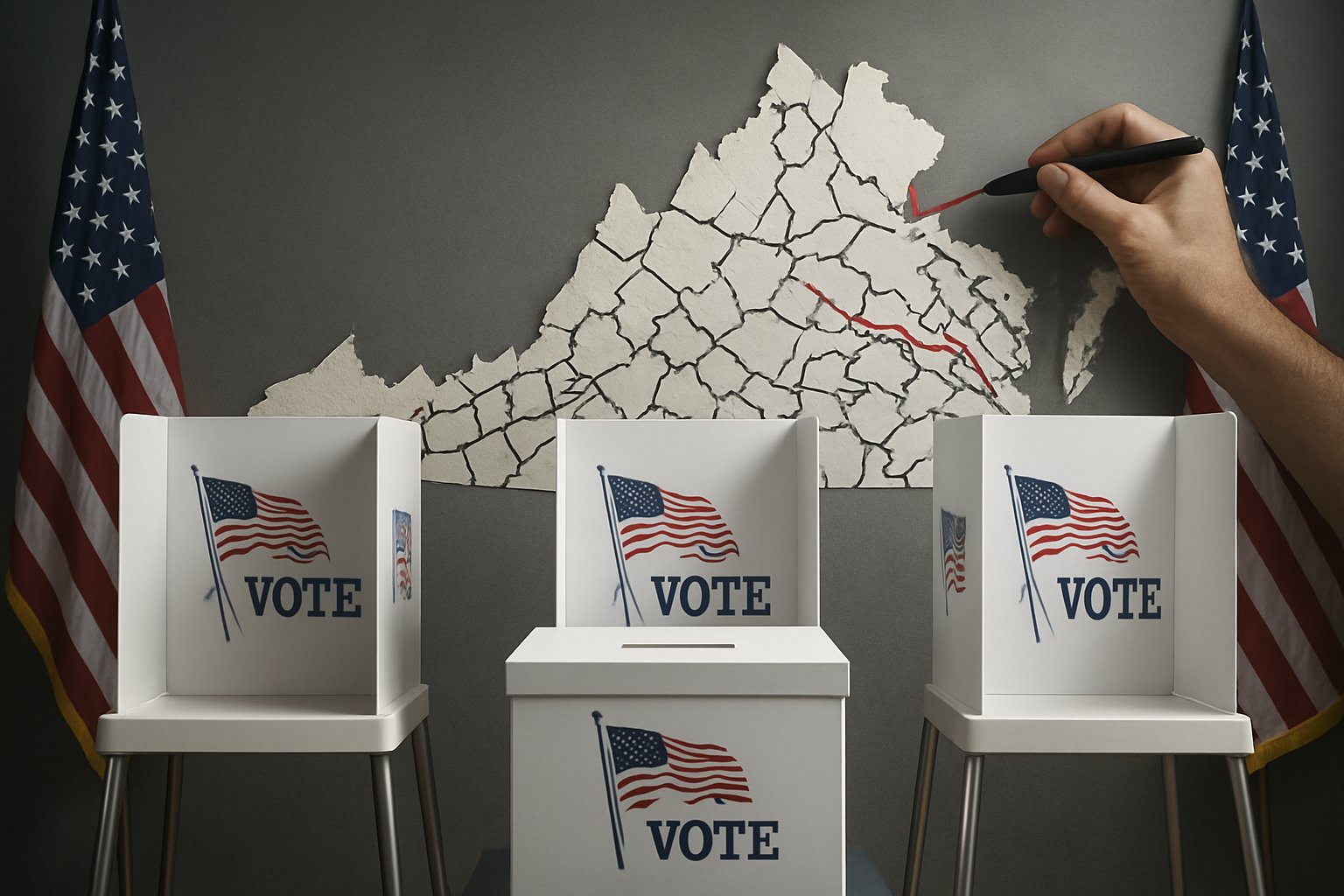
Virginia voters approved a groundbreaking redistricting referendum on Tuesday that could dramatically reshape the state's congressional delegation, potentially delivering Democrats as many as four additional House seats in a move that could tip the balance of power in Congress ahead of November's midterm elections.
The referendum passed with more than 51% of the vote, marking a significant victory for Democratic efforts to counter what they describe as Republican gerrymandering across multiple states. The vote represents a direct response to President Donald Trump's push for mid-decade redistricting and intensifies the national battle over electoral maps that could determine control of the House of Representatives.
Electoral Map Transformation
Under the approved measure, Virginia's 11 congressional seats could shift from the current 6-5 Democratic advantage to as much as a 10-1 split favoring Democrats. The redistricting would redraw district boundaries to create more competitive races while potentially eliminating several safe Republican seats.
The new congressional map specifically targets districts that Republicans have held through what Democrats argue are artificially drawn boundaries designed to maximize partisan advantage. Virginia's current delegation includes six Democrats and five Republicans, but the approved redistricting could fundamentally alter this balance.
"This is about fair representation and ending the gerrymandering that has denied Virginians equal voice in Congress," said a spokesperson for the pro-redistricting campaign.
— Democratic Campaign Official
National Political Context
The Virginia vote occurs amid President Trump's broader campaign encouraging Republican-controlled states to redraw their electoral maps to secure continued congressional majorities. The strategy has faced resistance in multiple states, with Virginia now joining the pushback against what Democrats characterize as partisan manipulation of electoral boundaries.
The redistricting battle extends beyond Virginia, with similar efforts underway in Texas, North Carolina, and Ohio. These states have become focal points in the national struggle over congressional representation, as both parties seek to maximize their electoral advantages through favorable map drawing.
European media coverage has highlighted the international significance of the vote, with observers noting the implications for American democratic institutions and the global perception of U.S. electoral integrity.
Legal and Constitutional Challenges
Despite the referendum's passage, implementation faces potential obstacles. Virginia's state Supreme Court could review the new maps before they take effect, creating uncertainty about whether the redistricting will influence the 2026 midterm elections.
Constitutional experts note that while voters have approved the redistricting concept, the specific boundaries must still be drawn and approved through the state's legal processes. This timeline creates pressure to complete the redistricting before candidate filing deadlines for the November elections.
The legal framework surrounding mid-decade redistricting remains complex, with federal courts having previously intervened in similar cases across multiple states to ensure compliance with voting rights protections.
Impact on Congressional Control
The potential shift of four House seats could prove decisive in determining congressional control. With the House currently divided by narrow margins, Virginia's redistricting alone might provide Democrats with the additional seats needed to secure a majority.
Political analysts emphasize that Virginia's action represents part of a broader national trend, as multiple states reconsider their electoral maps in response to demographic changes and evolving political coalitions. The cumulative effect of these redistricting efforts could reshape the congressional landscape significantly.
The referendum's success also demonstrates the effectiveness of ballot initiatives as tools for electoral reform, potentially inspiring similar efforts in other states where legislative redistricting has become contentious.
Republican Opposition and Response
Republican leaders have criticized the redistricting effort as partisan manipulation designed to benefit Democrats rather than improve electoral fairness. They argue that the current maps reflect legitimate demographic and geographic considerations rather than partisan gerrymandering.
The Trump administration has indicated it may explore federal challenges to state-level redistricting efforts that it views as politically motivated. However, the legal precedent for federal intervention in state electoral processes remains limited, particularly when changes result from voter-approved ballot initiatives.
Some Republican strategists acknowledge that the Virginia vote reflects broader dissatisfaction with current electoral arrangements, potentially signaling challenges for the party in other competitive states where redistricting remains contested.
Implications for Electoral Integrity
The Virginia referendum highlights ongoing debates about electoral fairness and representation in American democracy. Proponents argue that redistricting reform promotes competitive elections and ensures that electoral outcomes reflect voter preferences rather than map manipulation.
Critics, however, contend that partisan redistricting efforts—regardless of which party benefits—undermine democratic principles by prioritizing political advantage over fair representation. This tension reflects broader concerns about the politicization of electoral processes.
International observers have noted the Virginia vote as an example of American voters taking direct action to address perceived electoral inequities, demonstrating democratic resilience in the face of institutional challenges.
Looking Ahead to November
The immediate focus shifts to implementation, as state officials work to finalize new district boundaries before the midterm elections. The compressed timeline requires rapid completion of the redistricting process to allow candidates adequate time for campaign organization.
Political campaigns in potentially affected districts face uncertainty as they prepare for elections under maps that may change significantly. This dynamic could influence candidate recruitment and campaign strategies as both parties adapt to potential new electoral landscapes.
The Virginia redistricting vote ultimately represents a significant moment in the ongoing struggle over American electoral representation, with implications extending far beyond the state's borders as the nation prepares for crucial midterm elections that could reshape the balance of power in Washington.