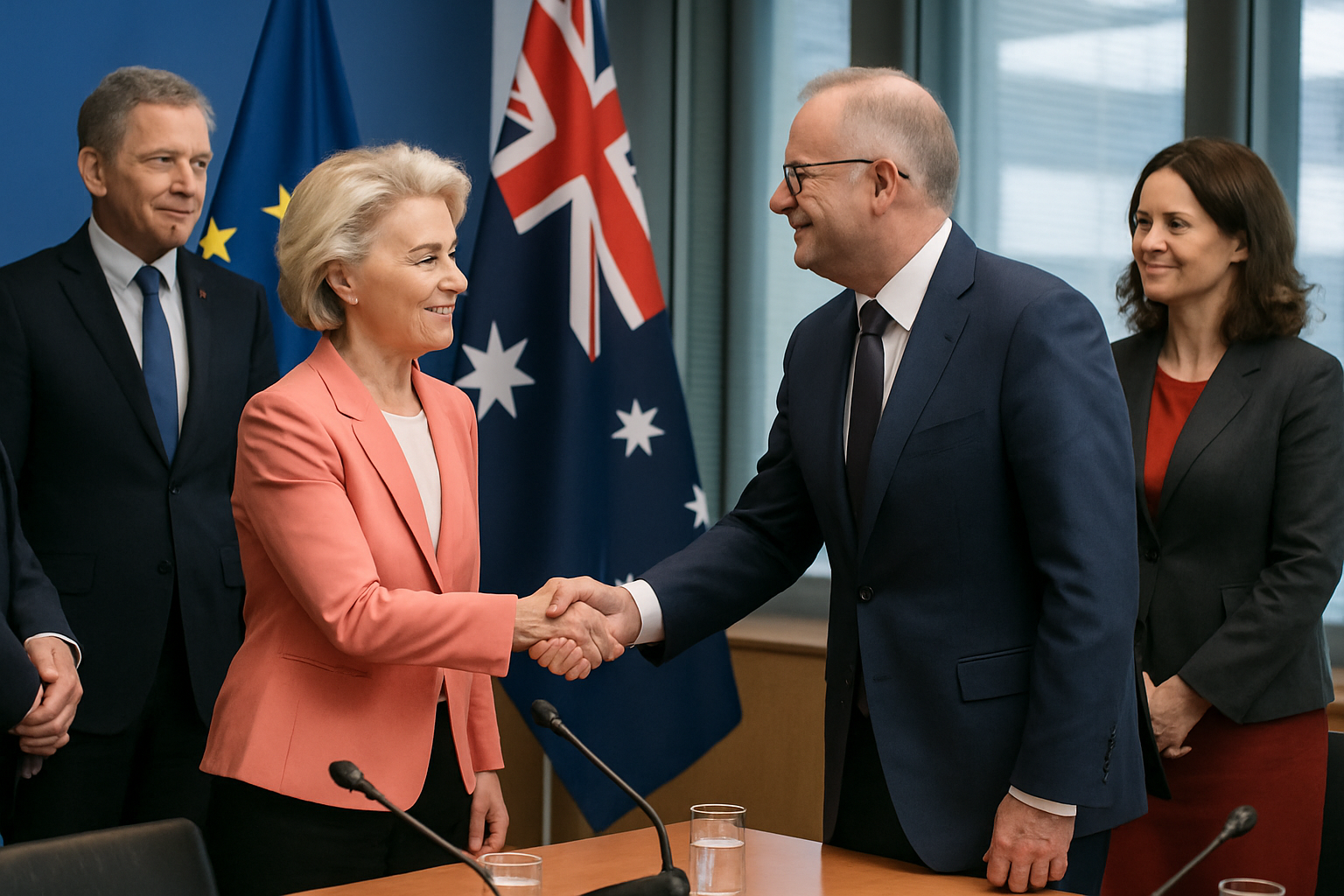
European Commission President Ursula von der Leyen arrived in Australia on Monday for a pivotal diplomatic mission aimed at reviving years-long trade negotiations between the European Union and Australia, as Brussels intensifies efforts to diversify its global trade partnerships amid an increasingly uncertain geopolitical landscape.
The high-stakes visit comes as the EU seeks to strengthen ties with key democratic partners in the Indo-Pacific region, marking a strategic shift in European trade policy that prioritizes bilateral partnerships over traditional multilateral frameworks. Von der Leyen's arrival signals the EU's commitment to finalizing a comprehensive free trade agreement that has been under negotiation for years but has faced repeated setbacks.
Strategic Context of the Trade Mission
This diplomatic initiative unfolds against a backdrop of mounting global trade tensions and the EU's urgent need to reduce economic dependencies on potentially unreliable partners. The timing is particularly significant given the European Union's recent experiences with supply chain vulnerabilities and the ongoing challenges posed by China's dominance in critical materials production, where Beijing controls approximately 60% of global production and 90% of refining capacity for lithium, cobalt, and rare earth elements.
The EU-Australia negotiations represent part of a broader European strategy to establish what officials describe as a "third pole" in global economic competition, positioning Europe as an independent actor alongside the United States and China. This approach reflects lessons learned from recent crises, including the complete breakdown of EU-Mercosur trade agreement negotiations despite achieving "broad agreement on guiding principles" in previous rounds.
"We are seeing the EU step up its global trade push in response to changing geopolitical realities. Australia represents a crucial democratic partner in a region of growing strategic importance."
— Senior European Trade Official
Historical Trade Relationship Challenges
The EU-Australia trade relationship has faced persistent obstacles over the years, with negotiations frequently stalling over agricultural market access, geographical indications, and regulatory standards. Previous attempts to finalize a comprehensive agreement have foundered on disagreements over European agricultural protections and Australian demands for greater market access for its agricultural exports.
Recent developments suggest both sides are now more motivated to reach an agreement. For Australia, securing preferential access to the European market of 450 million consumers represents a significant economic opportunity. For the EU, Australia offers access to critical minerals essential for the green transition, including lithium and rare earth elements, which are currently dominated by Chinese suppliers.
Broader EU Trade Diversification Strategy
Von der Leyen's Australia visit is part of an accelerated European trade diversification campaign that has seen the EU pursue agreements with Southeast Asian nations and the UAE. This strategy represents a fundamental shift from the bloc's traditional approach of comprehensive multilateral frameworks toward more targeted bilateral partnerships that can be negotiated and implemented more rapidly.
The European Commission has learned from recent experiences with trade agreement implementation challenges. The EU-Mercosur agreement, despite creating one of the world's largest free trade zones covering 780 million people and 25% of global GDP, faced severe implementation difficulties due to internal European divisions, particularly fierce French opposition led by President Emmanuel Macron who called the provisional implementation a "bad surprise."
Unlike the Mercosur situation, EU-Australia negotiations benefit from stronger internal European consensus, as Australia is viewed as a reliable democratic partner without the environmental and agricultural competition concerns that plagued the South American agreement.
Economic and Geopolitical Stakes
The potential EU-Australia trade agreement carries significant economic implications for both parties. For European consumers, the deal promises reduced costs for Australian goods, while European exporters would gain preferential access to one of the Asia-Pacific region's most developed economies. The agreement is expected to eliminate tariffs on billions of euros worth of goods annually while establishing frameworks for services trade and investment protection.
Beyond immediate economic benefits, the agreement serves broader geopolitical objectives. For the EU, strengthening ties with Australia reinforces democratic partnerships in the Indo-Pacific region at a time when China's influence continues to expand. For Australia, the EU represents a counterweight to economic dependence on China while providing access to European technology and investment capital.
Implementation Challenges and Timeline
Despite the positive momentum surrounding von der Leyen's visit, significant challenges remain in finalizing the agreement. Technical negotiations continue over complex issues including digital trade provisions, environmental standards, and dispute resolution mechanisms. European negotiators have emphasized the importance of including robust sustainability chapters, learning from criticism of previous trade agreements that lacked adequate environmental protections.
The European Commission faces internal pressure to demonstrate that post-pandemic trade policy can deliver tangible benefits for European businesses and consumers. Recent polling shows 89% of Europeans demand greater EU unity, while 86% want a stronger global voice, providing democratic mandate for ambitious trade initiatives.
However, the EU must also navigate member state concerns about agricultural imports and ensure the agreement complies with European environmental and social standards. The Commission has indicated that any final agreement will require comprehensive parliamentary approval processes, potentially extending implementation timelines.
Critical Minerals and Supply Chain Security
A crucial component of the EU-Australia negotiations involves securing access to critical minerals essential for Europe's green transition. Australia possesses significant reserves of lithium, rare earth elements, and other materials critical for renewable energy technologies and electric vehicle batteries. This aspect of the agreement aligns with the broader US-EU-Japan Critical Minerals Partnership involving 55 countries aimed at reducing dependence on Chinese-controlled supply chains.
Recent supply chain disruptions have highlighted European vulnerabilities in these strategic materials. Memory chip shortages have caused sixfold price increases affecting European technology competitiveness, with shortages expected to persist until 2027. The Australia agreement represents an opportunity to diversify supply sources while strengthening partnerships with like-minded democratic nations.
Regional Security Dimensions
The trade negotiations occur against the backdrop of evolving regional security architecture in the Indo-Pacific. Australia's participation in AUKUS and the Quad, combined with growing tensions over Taiwan and South China Sea disputes, adds strategic dimensions to the EU-Australia relationship beyond pure economic considerations.
European officials have indicated that trade agreements increasingly serve broader foreign policy objectives, supporting democratic partners while reducing dependencies on authoritarian regimes. This approach reflects the EU's evolution toward what Commission President von der Leyen has described as a more "realistic" foreign policy approach.
Looking Ahead: Prospects for Agreement
Von der Leyen's Australia visit represents a critical juncture in EU-Australia relations, with both sides expressing cautious optimism about prospects for breakthrough. The European Commission president's decision to personally lead the negotiations signals the high priority Brussels places on finalizing this agreement.
Success in Australia could provide a template for other EU bilateral trade initiatives in the Asia-Pacific region, including potential agreements with New Zealand, Singapore, and other ASEAN nations. Conversely, failure to reach agreement would represent a significant setback for European trade diversification strategies and could encourage other potential partners to pursue alternative arrangements.
The stakes extend beyond immediate trade benefits to encompass broader questions of democratic partnership, supply chain resilience, and Europe's role in the evolving global order. As von der Leyen begins her crucial diplomatic mission, both European and Australian leaders understand that the outcome of these negotiations will influence not only bilateral relations but also the broader trajectory of international trade cooperation in an increasingly fragmented world.
The coming days will test whether European and Australian negotiators can overcome years of technical obstacles to achieve a breakthrough that serves both immediate economic interests and longer-term strategic objectives in an era of great power competition.