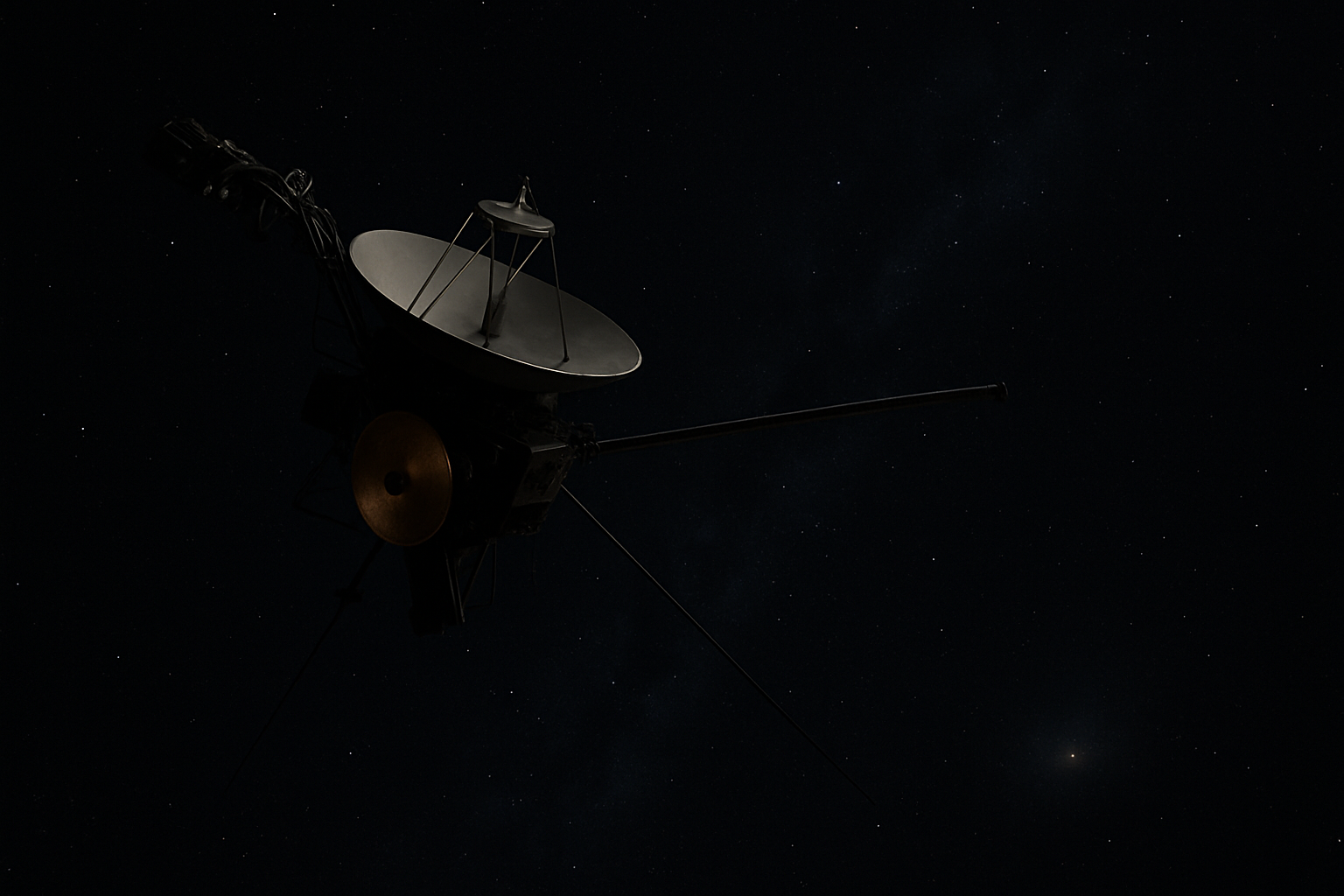
NASA's legendary Voyager 1 spacecraft, humanity's farthest-traveled ambassador to the cosmos, faces an unprecedented power crisis that has forced mission engineers to shut down additional scientific instruments as the 47-year-old probe struggles with declining energy reserves deep in interstellar space.
The spacecraft, which has been flying through space since 1977, has experienced an unexpected drop in energy from its radioisotope thermoelectric generators (RTGs), NASA confirmed in recent mission updates. The power decline has compelled the space agency to make difficult decisions about which instruments to keep operational as Voyager 1 continues its historic journey through the uncharted regions beyond our solar system.
The Power Dilemma Decades in the Making
Voyager 1's power systems were never designed to last this long. The spacecraft's three RTGs, which convert heat from the radioactive decay of plutonium-238 into electricity, have been steadily declining in output for decades. The natural decay of the plutonium fuel means the power output decreases by approximately 4 watts per year, creating an ongoing challenge for NASA's Deep Space Network engineers who must carefully manage the probe's energy budget.
"This is the reality of operating a spacecraft that has far exceeded its original mission parameters," explained NASA officials familiar with the Voyager program. "Every decision we make now is about prioritizing which scientific capabilities are most critical for humanity's continued exploration of interstellar space."
"The spacecraft has been flying through space since 1977, providing unprecedented insights into the outer planets and now interstellar medium. Each instrument shutdown represents both a loss and a testament to the remarkable longevity of this engineering marvel."
— NASA Mission Operations Team
Strategic Instrument Prioritization
The latest round of instrument shutdowns represents a carefully calculated strategy to extend Voyager 1's operational life as long as possible. NASA engineers have prioritized maintaining the spacecraft's communication capabilities and its most scientifically valuable instruments that continue to provide unique data about the interstellar medium—the space between stars where no human-made object has ever ventured before.
The decision-making process involves complex trade-offs between scientific return and mission longevity. Each instrument consumes precious watts of power, and with the RTGs providing increasingly limited energy, every component must justify its continued operation against the backdrop of humanity's desire to maintain contact with our most distant robotic explorer.
Interstellar Space Exploration Continues
Despite the power challenges, Voyager 1 continues to make groundbreaking discoveries in interstellar space. Since crossing the heliopause—the boundary where the solar wind gives way to the interstellar medium—in 2012, the spacecraft has been transmitting invaluable data about cosmic ray densities, magnetic field orientations, and the composition of the space between stars.
This information provides scientists with their first direct measurements of conditions in interstellar space, contributing to our understanding of how our solar system interacts with the broader galaxy. The data has already challenged some theoretical models about the interstellar medium and continues to provide insights that ground-based telescopes and shorter-range spacecraft cannot deliver.
Engineering Marvel's Extended Legacy
The current power crisis underscores both the limitations and remarkable achievements of 1970s space technology. Voyager 1 was originally designed for a four-year mission to study Jupiter and Saturn, yet it has operated continuously for nearly five decades while traveling more than 15 billion miles from Earth—a distance so vast that radio signals take over 22 hours to travel between the spacecraft and ground controllers.
The spacecraft's longevity stems from redundant systems, robust engineering, and the creativity of NASA's mission operations teams, who have repeatedly found ways to extend the probe's operational life far beyond original expectations. Previous power management strategies have included shutting down heaters, adjusting communication protocols, and carefully managing which instruments operate simultaneously.
The Race Against Time
Current projections suggest that Voyager 1 may continue operating some instruments until approximately 2025-2030, depending on the rate of power decline and the success of ongoing conservation measures. The spacecraft's twin, Voyager 2, which is following a different trajectory through interstellar space, faces similar power constraints but may have slightly different operational timelines based on its specific instrument complement and power consumption patterns.
NASA's Deep Space Network continues to track both Voyager spacecraft using massive radio antennas in California, Spain, and Australia. The network's upgraded capabilities have helped maintain communication with the increasingly distant probes, though the weak signal strength and long communication delays make every interaction with the spacecraft a complex technical challenge.
Scientific Value of Final Years
Every additional month of Voyager 1's operation provides scientists with unprecedented data about the deep interstellar environment. The spacecraft is traveling through a region of space that no other human-made object may reach for decades or centuries, making its observations irreplaceable for current and future generations of researchers studying the galaxy's structure and composition.
Recent data from the mission has revealed unexpected variations in interstellar particle densities and magnetic field strengths, suggesting that the space between stars is more dynamic and complex than previously understood. These discoveries have implications for our understanding of stellar formation, galactic structure, and the eventual fate of our own solar system as it moves through the galaxy.
Future of Deep Space Exploration
While Voyager 1's operational lifetime is drawing toward its inevitable conclusion, the mission's success has inspired new generations of deep space exploration concepts. Current space agencies are developing nuclear-powered spacecraft with longer operational lifetimes, including NASA's Space Reactor 1 Freedom program for Mars missions and various concepts for interstellar precursor missions that could eventually surpass Voyager's distance achievements.
The lessons learned from managing Voyager 1's extended mission continue to inform spacecraft design and mission operations for current and future deep space missions. The spacecraft's remarkable longevity demonstrates both the potential and challenges of long-duration space exploration, particularly as humanity begins planning missions to Mars and eventually beyond the solar system.
"Voyager 1 represents humanity's first step toward becoming an interstellar species. Even as we prepare to say goodbye to this remarkable explorer, its legacy lives on in every subsequent mission that ventures into the cosmic ocean."
— Space Exploration Advocates
As NASA engineers work to extract every possible moment of operation from Voyager 1's failing power systems, the spacecraft continues its solitary journey through the cosmos—a testament to human curiosity and engineering ingenuity that has exceeded all expectations while opening new frontiers in our understanding of the universe beyond our solar system's protective boundary.