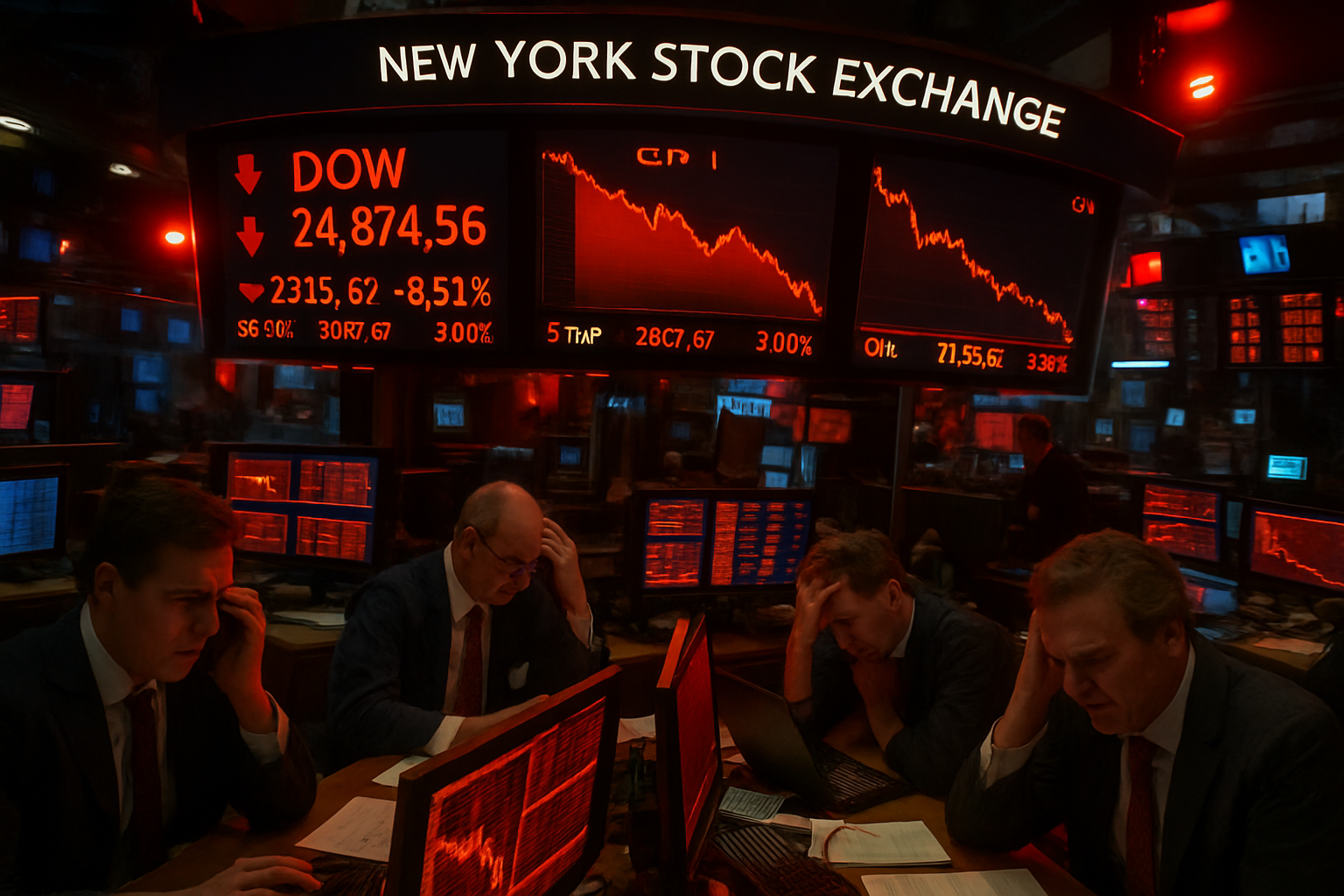
Wall Street suffered its most severe decline since the Iran conflict began, with the Nasdaq falling 10% below its record high as oil prices surged past $100 per barrel for the first time since 2022, creating a perfect storm of market volatility and economic uncertainty across global financial systems.
The crisis deepened Thursday as doubt overtook hope on Wall Street about a possible end to the US-Israeli war with Iran. The dramatic market selloff came as Iran's Revolutionary Guard declared the Strait of Hormuz "unsafe for shipping," effectively blocking 40% of global seaborne oil transit and driving energy prices to levels not seen in years.
Historic Market Decline
The Nasdaq Composite confirmed its entry into correction territory, falling more than 10% from its recent peak as investors fled technology stocks and sought safe havens. The decline marked the worst performance for Wall Street since the Iran war began in early March, with trading volumes surging as panic selling gripped multiple sectors.
Across the globe, the financial carnage was even more severe. Pakistan's KSE-100 index crashed by 8.97%, marking the largest single-day decline in the exchange's history and forcing trading suspensions. South Korea's KOSPI plummeted 12%, triggering circuit breakers as the Korean won hit a 17-year low against the dollar, with foreign investors fleeing AI and memory chip positions en masse.
European markets also suffered significant losses, with Germany's DAX continuing its steep decline and Italy's Milan exchange dropping 4%. The pan-European STOXX 600 fell 1.3% as the crisis spread across continental trading floors.
Oil Market Chaos
The energy sector became the epicenter of the crisis as Brent crude oil peaked at $119.50 per barrel, while West Texas Intermediate (WTI) futures jumped 18.98% to $108.15 - the largest single-day percentage increase on record. The surge pushed oil prices above the psychologically important $100 threshold for the first time since Russia's invasion of Ukraine in 2022.
"We're seeing the most severe energy security crisis in decades, with single-chokepoint vulnerabilities completely exposed."
— Samuel Ciszuk, Energy Security Analyst
Natural gas markets exploded alongside oil, with European prices surging 24% and US natural gas jumping 78%, reaching €47.32 per megawatt-hour - the highest level since February 2025. The dramatic price movements reflected growing fears about global energy supply disruptions.
Supply Chain Breakdown
The closure of the Strait of Hormuz created immediate chaos in global shipping networks. Major companies including Maersk and MSC suspended all Persian Gulf operations, leaving more than 150 oil and LNG tankers stranded in the Persian Gulf carrying billions of dollars worth of cargo.
Qatar, a crucial supplier of liquefied natural gas, halted production at its Ras Laffan and Mesaid facilities following Iranian drone attacks. These facilities represent approximately 20% of global LNG exports, and Qatar Energy Minister Saad Al Kaabi warned that Gulf states may declare force majeure "within weeks" if oil approaches $150 per barrel, threatening to "bring down economies of the world."
Aviation Industry Paralyzed
The crisis extended far beyond energy markets, with the aviation industry experiencing its most comprehensive disruption since the COVID-19 pandemic. More than 18,000 flights were cancelled worldwide as eight Middle Eastern countries - Iran, Iraq, Israel, UAE, Qatar, Syria, Kuwait, and Bahrain - simultaneously closed their airspace.
Dubai International Airport, the world's busiest with over 86 million passengers annually, remained completely shut down after sustaining missile damage. Major carriers including Emirates, Etihad, Air France-KLM, Wizz Air, and Bulgaria Air suspended all Middle East operations indefinitely, affecting hundreds of thousands of passengers globally.
Corporate Impact and Emergency Measures
The market turmoil forced immediate corporate decisions across sectors. PayPay postponed its $1.1 billion US IPO indefinitely due to market volatility. Technology companies began reassessing international expansion plans as supply chain disruptions threatened Gulf-dependent networks.
Central banks moved swiftly to prevent broader financial contagion. The European Central Bank and Bank of Japan led coordinated emergency liquidity provision efforts, though analysts noted that traditional monetary policy tools showed limited effectiveness against structural geopolitical disruptions.
Global Consumer Impact
The crisis quickly translated into real-world impacts for consumers worldwide. Sweden predicted electricity increases of 10-20 öre and gasoline price rises of 1-2 kronor, with the Malmö region identified as most exposed due to continental integration. Ireland saw heating oil approach €2 per liter, prompting accusations of "brazen rip-offs" by consumer groups.
In Asia, Bangladesh implemented fuel rationing for 170 million people, while Pakistan experienced its highest fuel prices in South Asia at Rs321.17 per liter, forcing the government to implement wartime austerity measures including four-day work weeks for government offices.
Diplomatic Breakdown Context
The market chaos stemmed from the complete collapse of US-Iran nuclear negotiations, despite what had been described as a "broad agreement on guiding principles" achieved in Geneva - the most progress since the JCPOA agreement's collapse in 2018. The fundamental disagreement proved insurmountable, with Iran excluding ballistic missiles and regional proxies as "red lines" while the US demanded comprehensive reforms including missiles, armed groups, and human rights issues.
This diplomatic failure led to Operation Epic Fury, described as the largest coordinated US-Israeli military operation since 2003, which in turn triggered Iran's massive retaliation campaign "Operation True Promise 4," with the Islamic Revolutionary Guard Corps declaring that "no red lines remain."
Nuclear Governance Crisis
The crisis occurs against a backdrop of unprecedented nuclear governance uncertainty. The New START treaty between the US and Russia expired on February 5, 2026, marking the first time in over 50 years without nuclear constraints between the superpowers. Meanwhile, Iran continues uranium enrichment at 60% purity with over 400 kilograms of weapons-grade material - sufficient for multiple nuclear weapons.
UN Secretary-General António Guterres warned that nuclear risks are at their "highest in decades," calling the situation the "greatest test of multilateral cooperation and crisis management in the modern era."
Regional Coalition Under Strain
The Iranian retaliation campaign severely strained the unprecedented Saudi-UAE-Qatar-Egypt diplomatic consensus that had been supporting diplomatic solutions. Iranian attacks directly targeted coalition member territories, with casualties including one civilian killed in Abu Dhabi, 32 injured in Kuwait Airport drone strikes, and eight wounded in Qatar despite Patriot missile system interceptions of 65 missiles and 12 drones.
"The situation is going longer than people thought initially. Financial markets are becoming the ultimate constraint on prolonged conflict."
— Damien Boey, Portfolio Strategist
Egyptian President Abdel Fattah al-Sisi condemned the attacks on "sisterly Arab countries" and warned of "comprehensive chaos" if the crisis continues to escalate.
Energy Architecture Transformation Imperative
The crisis exposed fundamental vulnerabilities in global energy systems, particularly the dangerous over-dependence on strategic chokepoints. The 21-mile Strait of Hormuz represents a geographic single-point failure for modern logistics, with no realistic alternatives for the massive volume of oil transit.
Alternative routes through the Arabian Peninsula have inadequate capacity and would involve significant time and cost penalties. The crisis highlights the urgent need for fundamental restructuring of energy architecture to reduce dependence on volatile geopolitical regions.
International Emergency Response
The International Energy Agency announced the largest strategic petroleum reserve release in its 50-year history - 400 million barrels from 32 member countries, more than double the 182.7 million barrels released during the 2022 Ukraine crisis. Japan committed to releasing 80 million barrels starting March 16, marking the first deployment since the 2011 Fukushima disaster.
The scale of international coordination reflects the severity of the crisis, with Energy Secretary Christopher Wright even considering lifting Russian oil sanctions to stabilize markets, potentially making "hundreds of millions of barrels of sanctioned oil" available.
Recovery Timeline Uncertain
Unlike weather-related disruptions that follow predictable patterns, recovery from this crisis depends entirely on military operations resolution and diplomatic normalization. Aviation industries cannot make long-term scheduling decisions with multiple airspaces closed, while energy markets remain volatile with critical transit routes blocked.
Traditional monetary policy tools have proven limited in effectiveness against structural geopolitical disruptions that affect physical infrastructure and international relationships. The crisis represents a template-setting moment for 21st-century conflict resolution approaches.
Historical Significance
March 2026 represents the most dangerous international crisis since the end of the Cold War, affecting regional war prevention, global energy security, nuclear governance credibility, and international law enforcement simultaneously. The rapid transition from diplomatic breakthrough to military escalation demonstrates the fragility of modern crisis management in a multipolar era.
Success in containing the escalation could provide a framework for future nuclear crisis resolution and strengthen diplomatic precedents. However, failure may accelerate military solutions over diplomatic engagement, potentially reshaping Middle Eastern geopolitics for decades while encouraging nuclear proliferation globally and undermining diplomatic credibility worldwide.
As markets continue to grapple with this unprecedented combination of energy, financial, and geopolitical crises, the coming days will determine whether this becomes a contained regional confrontation or expands into broader Middle Eastern warfare with implications extending far beyond current events, affecting international approaches to conflict resolution, energy market evolution, and diplomatic precedents for the 21st century.