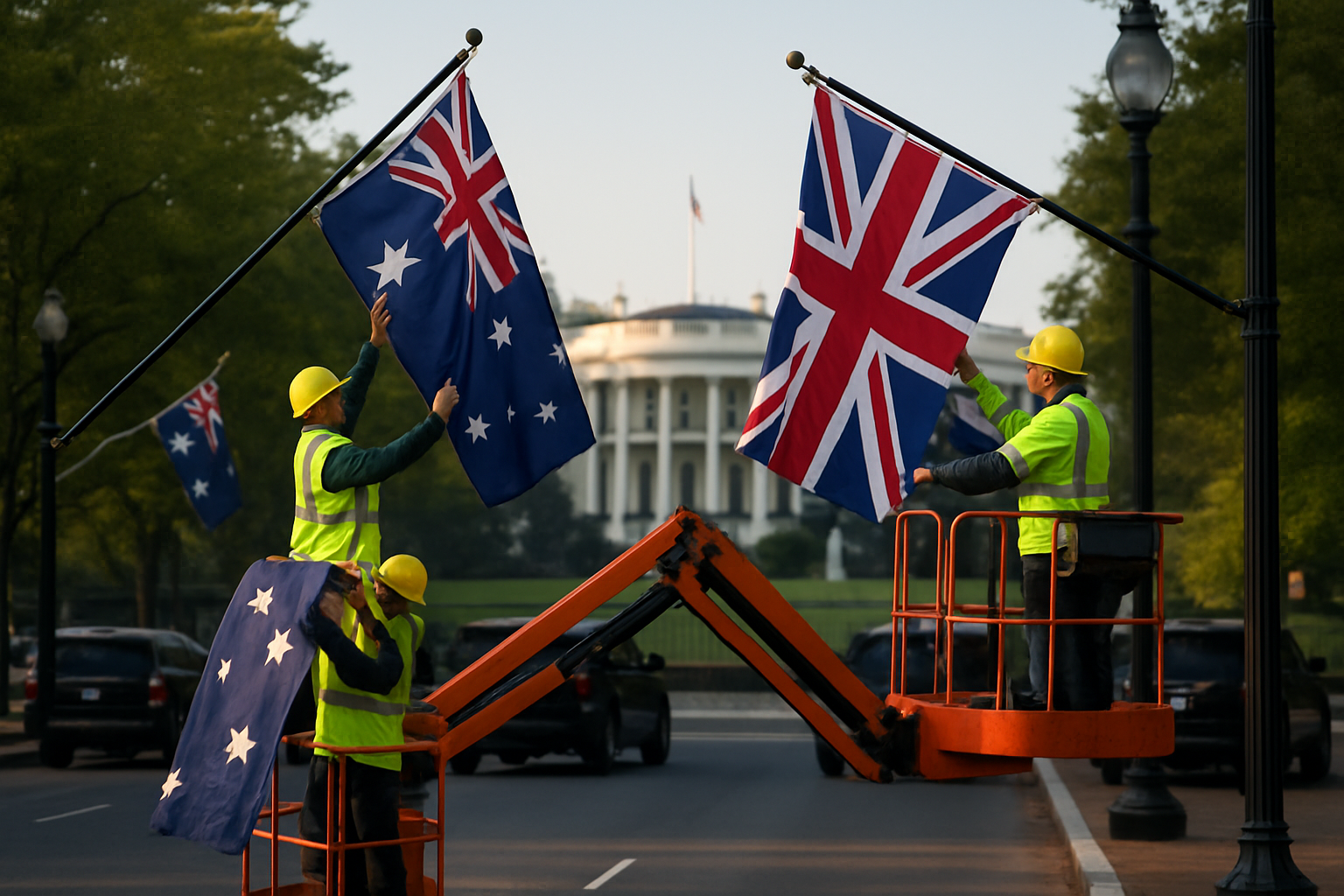
Washington D.C. officials swiftly corrected a diplomatic protocol error Friday, replacing several Australian flags with British Union Jack flags near the White House just days before King Charles III's historic state visit on April 27-28, 2026.
The District of Columbia Department of Transportation confirmed that Australian flags had been mistakenly placed along 17th Street adjacent to the White House in preparation for the monarch's arrival. Workers using boom lifts were photographed Friday afternoon carefully removing the incorrect flags and installing proper British flags, ensuring the ceremonial route would display appropriate national colors.
Critical Timing for Historic Visit
The flag correction comes during one of the most challenging periods in US-UK relations since the Iraq War. King Charles III and Queen Camilla will proceed with their state visit despite mounting diplomatic tensions over Britain's refusal to support Operation Epic Fury, the Trump administration's military campaign against Iran.
This marks the first visit by a British monarch to the United States since Queen Elizabeth II's 2007 trip, making the ceremonial details particularly significant. The visit will commemorate the 250th anniversary of American independence while attempting to repair the frayed "special relationship" between the two nations.
"The D.C. government mistakenly placed both flags around the White House in preparation of King Charles visit to Washington on April 27, 2026."
— D.C. Department of Transportation Official
Diplomatic Stakes and Royal Resilience
The flag error, though quickly corrected, underscores the meticulous attention to protocol required for royal visits, especially during periods of political tension. President Trump has openly criticized Prime Minister Keir Starmer's government for refusing to support Iran military operations, declaring the relationship "obviously not what it was."
Despite calls from some Labour politicians for postponement, King Charles III has maintained his commitment to the visit. The Palace emphasized that the trip proceeds "on advice of the British government" and celebrates "historic connections and modern bilateral relationship," even as critics describe the timing as potentially humiliating for the monarchy during an active war.
Royal Family Under Unprecedented Pressure
The state visit occurs during a period of extraordinary challenges for the British Royal Family. Prince Andrew's arrest in February 2026 on misconduct charges related to Jeffrey Epstein connections represents the first royal arrest since King Charles I in 1647. The government is actively considering legislation to remove Andrew from the line of succession, requiring parliamentary action and Commonwealth consultations.
King Charles III has taken the unprecedented step of publicly supporting the investigation against his brother, declaring "law must take its course" to preserve institutional integrity over family loyalty. This decision demonstrates the monarchy's commitment to operating within rather than above the law, even at significant personal cost.
Protocol Precision in Crisis Management
The swift correction of Washington's flag display reflects the sophisticated diplomatic protocols surrounding royal visits. Every ceremonial detail carries symbolic weight, particularly when the monarchy faces domestic crises while attempting to maintain international relationships during policy disagreements.
D.C. officials' quick response to the error demonstrates professional competence in managing high-stakes diplomatic events. The incident was contained Friday without affecting the broader visit preparations, allowing focus to remain on the substantive diplomatic agenda rather than ceremonial mishaps.
Constitutional Monarchy in the Modern Era
The forthcoming visit represents a critical test of constitutional monarchy's ability to navigate partisan political disagreements while preserving long-term alliance structures. King Charles's role in maintaining democratic relationships despite temporary policy tensions serves as a symbolic anchor for US-UK relations during unprecedented disagreement.
The monarchy's current approach prioritizes institutional relationships over political alignment, potentially strengthening democratic institutions by demonstrating continuity beyond electoral cycles. This strategy faces its greatest test during the Iran crisis, where fundamental policy differences threaten to undermine decades of alliance cooperation.
Alliance Under Strain
The flag correction occurs against the backdrop of severe US-UK tensions over Iran policy. European allies, including Britain, have collectively rejected Trump administration demands for naval coalition support in the Strait of Hormuz. German Defense Minister Boris Pistorius led resistance asking "What does Trump expect a handful of European frigates to do that the powerful US Navy cannot?"
Trump's response has been characteristically blunt, declaring "Go get your own oil" to European allies and stating the US "no longer needs NATO assistance." This represents a complete policy reversal from coalition-building to unilateral approach, fundamentally challenging traditional alliance frameworks.
Global Context and Implications
The state visit unfolds during multiple simultaneous international crises. The Iran conflict has reached unprecedented scales with oil prices exceeding $100 per barrel, over 18,000 flights cancelled worldwide, and the Strait of Hormuz effectively closed to 40% of global oil transit. Nuclear governance has collapsed with New START treaty expiration, eliminating 50+ years of US-Russia nuclear constraints.
European allies have demonstrated "strategic autonomy" by defending their own territories while rejecting American military adventures. The Iranian attack on Cyprus prompted unprecedented European naval cooperation, while simultaneously declining Gulf operations support. This selective cooperation model challenges traditional alliance frameworks and may define 21st-century international relationships.
Looking Ahead: Diplomatic Innovation Required
The corrected flags now flying properly near the White House symbolize both attention to protocol and the possibility of repairing damaged relationships through careful diplomacy. The April 27-28 visit represents an opportunity to demonstrate that alliance relationships can transcend temporary policy disagreements while maintaining democratic accountability.
Success will be measured not by policy alignment but by institutional relationship preservation during fundamental disagreement. The monarchy's ability to maintain constitutional relationships regardless of political tensions could provide a template for democratic alliance management in an era of increasing partisan divisions.
As workers completed the flag replacement Friday evening, the corrected display stands ready to welcome King Charles III for what may prove to be a defining moment in both royal diplomacy and transatlantic relations. The precision required for protocol details reflects the broader challenge of maintaining alliance integrity while navigating unprecedented political turbulence.