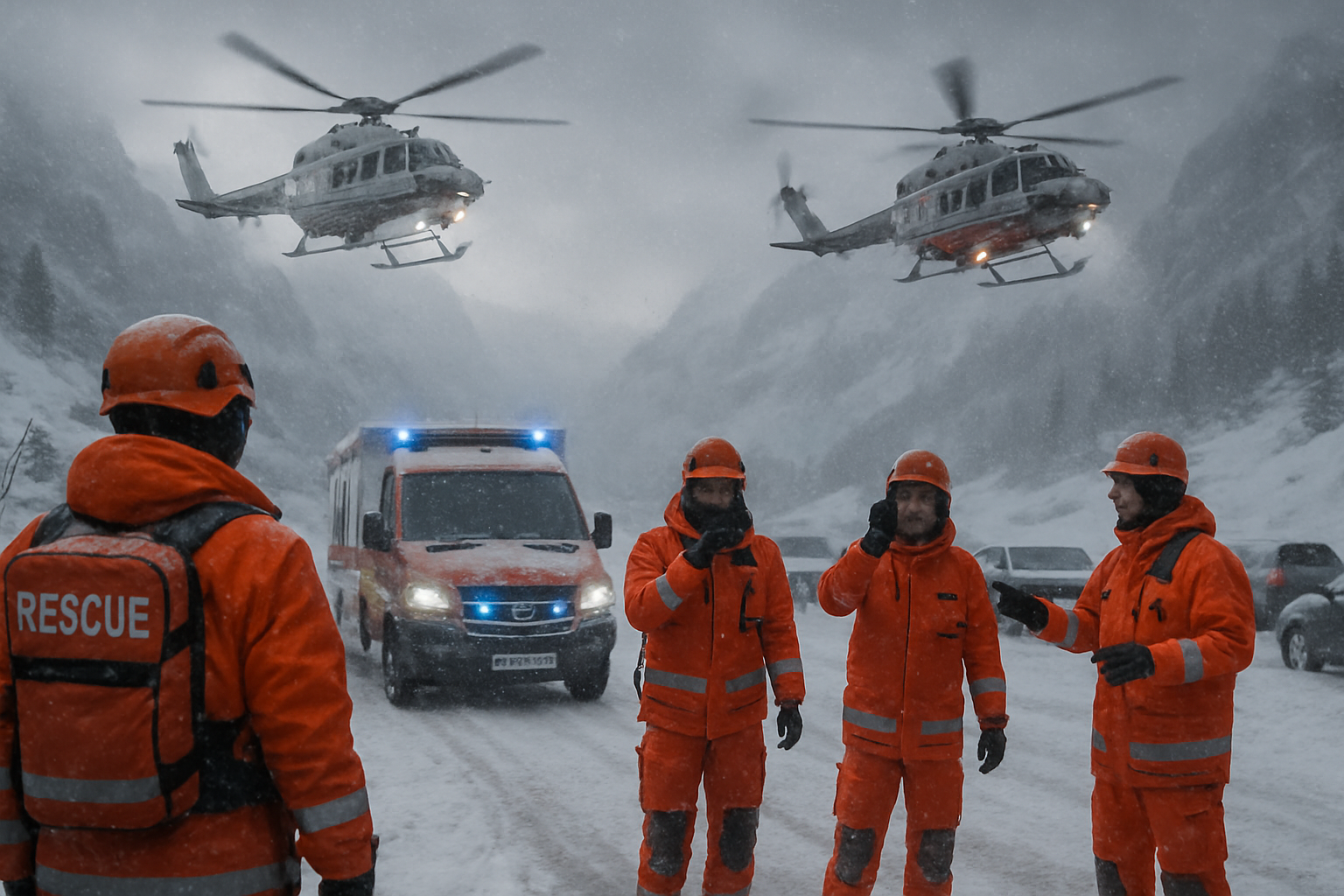
Emergency services across Algeria and Norway mobilized massive rescue operations Sunday as severe winter weather trapped vehicles in snow-blocked roads and triggered search efforts for missing persons, adding to a growing global crisis that has seen emergency response systems overwhelmed by simultaneous extreme weather events.
Algeria's Civil Protection forces successfully rescued a family of four trapped by heavy snowfall on National Route 30 in Bouira province, according to official reports. The rescue operation in the Tizi Nkouan area of Saharidje municipality came as the country faced what meteorologists described as a "dangerous triple threat" of extreme weather conditions.
The Algerian emergency unfolded amid thunderstorms delivering over 50mm of rainfall across 14 provinces including Blida, Boumerdès, Tizi Ouzou, and Béjaïa, combined with mountain snowfall exceeding 20cm above 1,100 meters elevation and winds surpassing 100 km/h. Dust storms accompanying the severe weather posed additional respiratory hazards for vulnerable populations.
Norwegian Search Operation Challenges
Simultaneously, Norwegian authorities launched a complex search and rescue operation for a missing skier in the Midt-Telemark region, where deteriorating weather conditions forced a helicopter to abort its mission. The dangerous conditions highlighted the challenging circumstances facing emergency responders across multiple countries dealing with severe weather simultaneously.
Norway also experienced a separate emergency as a landslide blocked Fylkesvei 5418 in Osterøy kommune, Vestland, though authorities confirmed no casualties in the Skaftå area incident. The road closure added to transportation disruptions already affecting the region due to harsh winter conditions.
Infrastructure Under Extreme Pressure
The simultaneous emergencies in Algeria and Norway reflect broader patterns that have emerged during what climate scientists confirm is the 21st consecutive month of global temperatures exceeding 1.5°C above pre-industrial levels—the longest sustained warming period in recorded human history.
Emergency services in both countries found their traditional response capabilities tested by the intensity and scope of the weather events. In Algeria, the combination of heavy snow, flooding rains, and dangerous winds created multiple concurrent emergencies requiring coordinated responses across different terrain and weather conditions.
"The scale and simultaneity of these weather emergencies is creating unprecedented challenges for emergency response systems designed for sequential rather than concurrent disasters."
— European Emergency Response Analyst
Transportation networks in both countries experienced significant disruptions. Algeria's mountainous regions saw multiple road closures beyond the National Route 30 incident, while Norway's challenging terrain complicated rescue efforts and forced authorities to rely on ground-based operations when aerial support became impossible.
Global Context of Emergency System Strain
The Algeria-Norway emergencies occurred within a broader pattern of global weather disasters that have overwhelmed traditional mutual aid mechanisms. Recent months have seen emergency services across multiple continents simultaneously engaged in major operations, preventing the typical regional assistance that has historically supported international disaster response.
Previous major weather events this year have included the devastating February 2026 European storm succession that claimed over 30 lives across Portugal, Spain, and France, requiring Portugal's largest peacetime rescue operation with 26,500 personnel. The European Union's Civil Protection Mechanism has been activated repeatedly, with Sweden and Denmark providing €246 million in assistance representing the largest coordinated European weather response on record.
Emergency management experts note that traditional response frameworks assume sequential disasters allow unaffected regions to assist those experiencing emergencies. However, the increasing frequency and geographic spread of extreme weather events has created scenarios where multiple countries face simultaneous crises, straining international cooperation mechanisms.
Climate Volatility and Emergency Response Evolution
The current crisis demonstrates what scientists term the "climate volatility paradox," where sustained global warming enables both heat records and extreme regional weather events through disrupted atmospheric circulation and polar vortex patterns. This volatility has created conditions where emergency services must prepare for unprecedented weather combinations and intensities.
Algeria's experience of snow, flooding, and dangerous winds simultaneously exemplifies how emergency response systems designed for traditional weather patterns struggle with the complex, multi-hazard scenarios increasingly common under climate change. Emergency personnel must now coordinate responses across different types of disasters occurring simultaneously rather than addressing isolated weather events.
Norwegian authorities face similar challenges as search and rescue operations must adapt to rapidly changing conditions that exceed historical norms for the region. The inability to deploy helicopter support due to weather conditions illustrates how extreme weather can limit the very resources needed for emergency response.
International Cooperation Under Pressure
The timing of the Algeria-Norway emergencies highlights growing pressure on international emergency response coordination. As weather systems increasingly affect multiple countries simultaneously, traditional bilateral assistance becomes more difficult to provide when donor nations are managing their own weather emergencies.
This pattern has become evident throughout 2026, with emergency services across Europe, Africa, and other regions repeatedly stretched beyond capacity. The result has been a fundamental challenge to emergency response assumptions and the need for enhanced preparedness systems designed for concurrent rather than sequential disasters.
Infrastructure Adaptation Imperatives
Both Algeria and Norway's experiences underscore the urgent need for infrastructure adaptation to climate volatility. Transportation networks, communication systems, and emergency service deployment must be redesigned for the "new normal" of extreme weather frequency and intensity.
The successful rescue of the trapped family in Algeria demonstrates that emergency services can adapt to challenging conditions, but the strain on resources and personnel highlights the need for enhanced preparedness. Similarly, Norway's continued search efforts despite helicopter limitations show the importance of maintaining multiple response capabilities.
"We're moving from a model of emergency response designed for exceptional weather events to systems that must handle extreme weather as a routine operational reality."
— International Emergency Management Specialist
Recovery from both emergencies is expected to take days to weeks, with ongoing weather monitoring required to prevent additional incidents. The broader pattern suggests that emergency services worldwide must prepare for sustained periods of high alert rather than traditional crisis-recovery cycles.
Looking Forward: Permanent Preparedness
As additional weather systems continue developing across global regions, authorities maintain high alert levels recognizing that extreme weather has become a permanent operational challenge rather than an exceptional circumstance. The March 2026 events in Algeria and Norway may represent a watershed moment forcing fundamental reconsideration of emergency response capabilities for an era of permanent climate volatility.
The success of emergency operations depends increasingly on international cooperation, enhanced technological capabilities, and infrastructure designed for future rather than historical climate conditions. The choice between reactive crisis management and transformative adaptation approaches has become critical as extreme weather events continue to test global response systems.
Emergency services in both countries continue monitoring conditions as additional weather systems develop, with authorities emphasizing the importance of public preparedness and early warning systems in managing the challenges of climate-driven emergency response in the coming decades.