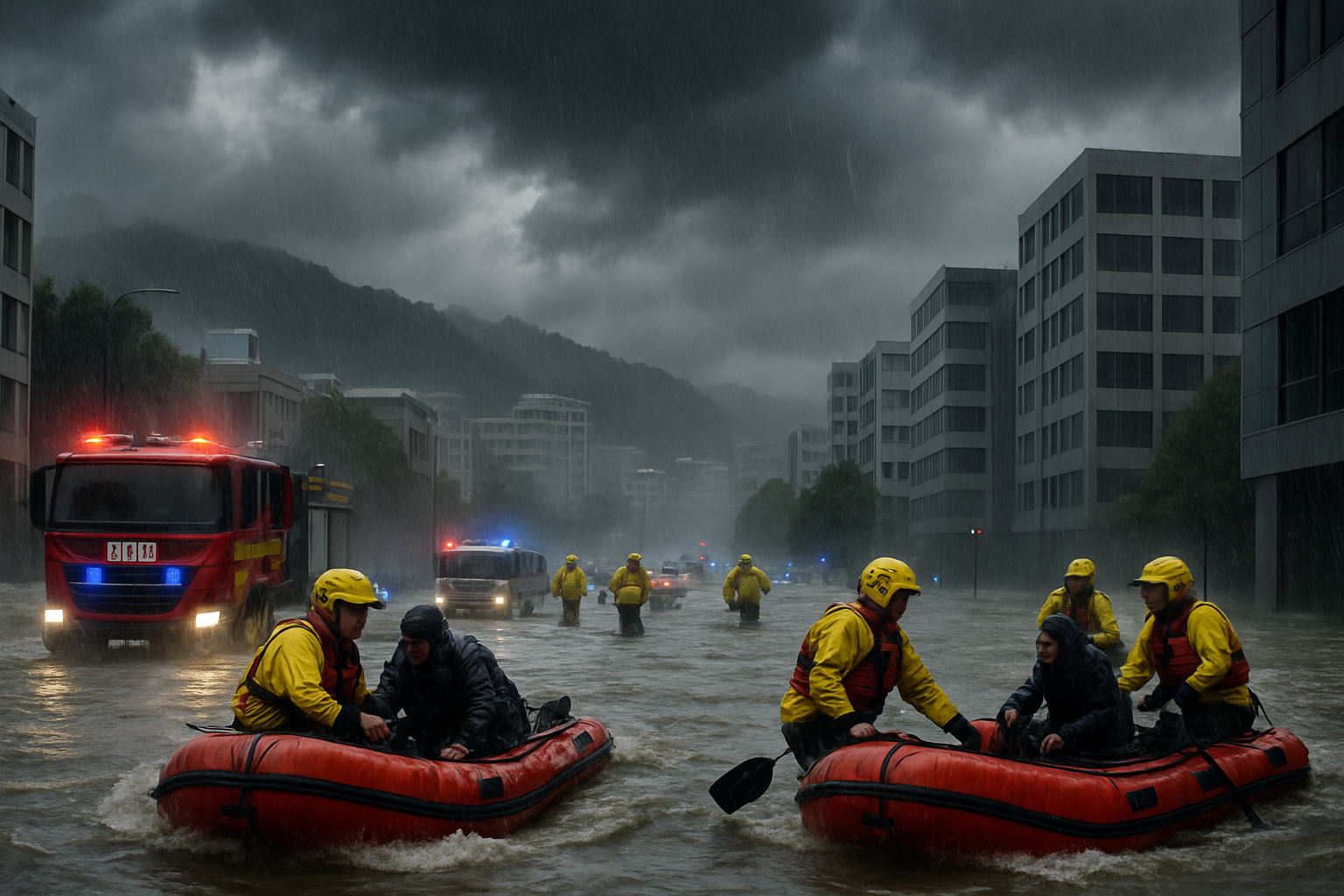
Wellington Region Emergency Management has declared a state of emergency as record-breaking rainfall triggered life-threatening flash floods across New Zealand's capital, forcing mass evacuations and overwhelming emergency services during what meteorologists describe as the worst flooding emergency in the region's recent history.
The crisis unfolded overnight Monday when 77mm of rainfall fell within a single hour, creating catastrophic flash flooding conditions that caught residents off-guard during the dangerous 2-3 AM timeframe. MetService has upgraded its heavy rain warning to red - the highest alert level - indicating an immediate threat to life from dangerous river conditions, significant flooding, and widespread landslides.
Catastrophic Overnight Conditions
The timing of the emergency proved particularly perilous, with the most severe conditions occurring in the early morning hours when visibility was poor and evacuation options limited. Residents described scenes of chaos as chest-deep floodwaters forced families to carry children across rail bridges to reach safety.
A massive landslip crashed into residential areas, with emergency officials describing it as "definitely a big event...you wouldn't have wanted to be under it, it wouldn't have been survivable." The Mount Cook suburb witnessed extraordinary scenes of half a dozen cars floating on Wright Street, prompting resident descriptions of "water everywhere."
"The landslide was massive - it crashed right into the residential area. You definitely wouldn't have wanted to be under it."
— Emergency Official
Emergency Response Overwhelmed
Wellington Region Emergency Management Office issued immediate evacuation orders for residents in flood-prone areas of Wairarapa, Hutt Valley, Kāpiti, and Wellington that had previously experienced flooding. Police launched search operations for a missing person amid the severe weather conditions, while multiple landslides and slips occurred across the region due to ground already saturated from previous extreme weather events.
Mayor Andrew Little acknowledged the unprecedented nature of the emergency, emphasizing the critical need for enhanced warning systems given the overnight timing of the most dangerous conditions. Emergency services deployed helicopters for rescue operations as traditional response methods proved insufficient for the scale of the disaster.
The capital's southern suburbs bore the brunt of the storm's impact, with residents sharing harrowing accounts of the disaster. Jimmy McLauchlan, a Vogeltown resident, watched helplessly as floodwaters damaged his collection of vintage 1920s Chevrolets and valuable stamp collection, representing years of personal history lost to the rising waters.
Historical Context of Climate Extremes
This emergency occurs during what scientists describe as the 24th consecutive month of global temperatures exceeding 1.5°C above pre-industrial levels - the longest sustained extreme warming period in recorded human history. The Wellington flooding represents part of a devastating pattern of extreme weather events that have repeatedly struck New Zealand throughout 2026.
The crisis builds upon previous disasters including the February Ōtorohanga flooding that claimed at least one life, and the March Banks Peninsula isolation where communities received 10 times their monthly rainfall in just 48 hours. Emergency Minister Mark Mitchell has acknowledged that emergency response capabilities are stretched to their limits, managing recovery efforts from previous disasters while simultaneously preparing for new threats.
Infrastructure Vulnerabilities Exposed
The flooding has exposed critical vulnerabilities in Wellington's infrastructure systems, which were designed for historical climate patterns rather than current extreme weather conditions. Drainage systems proved inadequate for the unprecedented rainfall intensity, while transportation networks faced complete paralysis and power outages affected thousands of residents.
Traditional seasonal patterns that guided infrastructure planning for centuries have become unreliable frameworks in what experts describe as a permanent climate volatility era. The National Emergency Management Agency (NEMA) has warned that "later on is too late" for preparation, as communities must now maintain constant readiness for extreme weather events.
"This demonstrates the urgent need for transformative infrastructure adaptation rather than reactive crisis management."
— Climate Adaptation Expert
Community Resilience and Response
Despite the overwhelming challenges, the emergency has demonstrated enhanced community resilience compared to previous years. Many households were better equipped with backup communications, including Starlink satellite internet, generators, and strengthened community networks developed through successive weather events.
Social media platforms became essential for emergency communication when traditional systems were overwhelmed, with residents coordinating rescue efforts and sharing critical safety information. However, mental health services report increased demand for climate anxiety support, as families face the prospect of losing generational homes multiple times within a single decade.
Economic and Social Impact
The economic implications extend far beyond immediate emergency response costs. Agricultural communities face mounting crop and livestock losses during critical growing seasons, while the tourism industry confronts cancellations and infrastructure damage during peak revenue periods.
Recovery timelines have fundamentally shifted from weeks to months or years, representing a permanent change in disaster response approaches. Families are losing generational properties, with some businesses facing extinction due to recurring disruptions from extreme weather events.
Global Climate Crisis Context
The Wellington emergency occurs within a broader pattern of extreme weather disasters affecting multiple continents simultaneously, overwhelming traditional international mutual aid mechanisms. The World Meteorological Organization reports a 50-60% probability of El Niño conditions developing between July and September 2026, which could drive temperatures to unprecedented levels by combining baseline warming with natural cycle amplification.
Emergency management experts have identified a paradigm shift toward "compound disasters" - multiple emergency types occurring concurrently across vast geographic areas, fundamentally challenging traditional resource allocation and mutual aid mechanisms designed for isolated regional emergencies.
Adaptation Strategies and Future Preparedness
Climate experts describe April 2026 as a watershed moment requiring a critical choice between reactive crisis management and transformative infrastructure adaptation. The current conditions provide a preview of routine 2030s circumstances without comprehensive climate adaptation investment.
Successful adaptation strategies require sophisticated integration of cutting-edge technology with traditional ecological knowledge and community-based management systems. Advanced monitoring using satellite imagery, environmental DNA sampling, and artificial intelligence must combine with community engagement and local expertise for maximum effectiveness.
The concept of "building back better" has evolved from an optional enhancement to an essential survival strategy for communities facing permanent climate volatility. Traditional engineering approaches must be fundamentally reassessed for extreme weather conditions that consistently exceed historical design parameters.
Looking Forward
As Wellington continues emergency response operations, the crisis underscores the urgent need for unprecedented international cooperation on climate adaptation. Environmental challenges transcend national boundaries, as atmospheric and ocean systems transport climate effects globally, making unilateral adaptation efforts insufficient for comprehensive resilience.
The window for effective climate action continues to narrow as ecological systems approach critical thresholds that could trigger irreversible changes affecting global food security, climate stability, and human settlements. Current emergency responses must evolve beyond managing individual disasters to addressing permanent climate volatility as the new operational baseline.
Wellington's state of emergency serves as both a warning and a call for transformative action during what scientists describe as Earth's most environmentally challenging period in recorded history. The tools, knowledge, and cooperation frameworks for comprehensive environmental protection exist - success depends on unprecedented speed of coordination and sustained international cooperation during this decisive decade for climate action.