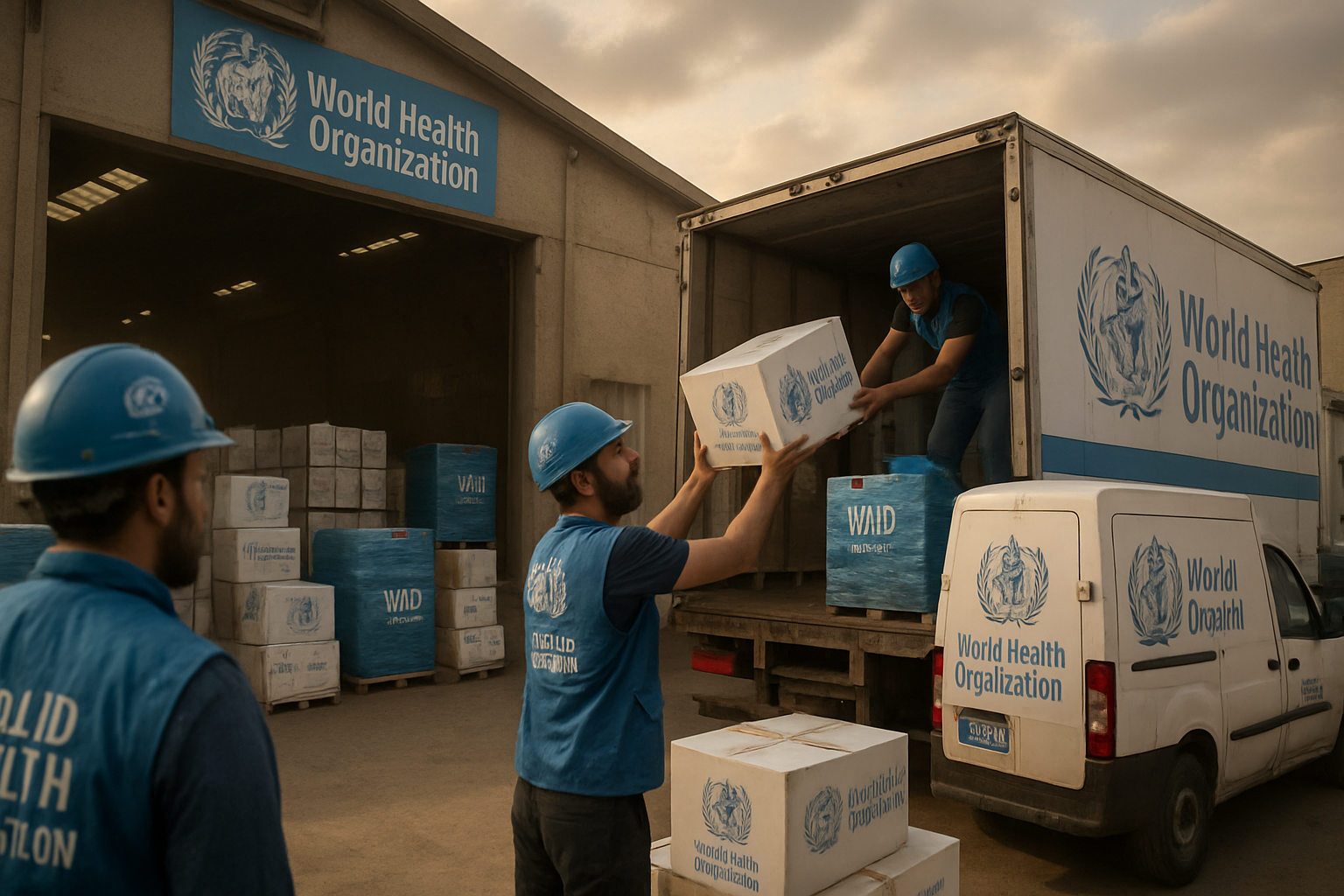
The World Health Organization (WHO) has launched a $30.3 million emergency appeal to support health systems in five conflict-affected Middle East countries, warning they are "under severe strain" after weeks of intensified violence that has created one of the region's worst humanitarian crises since the Cold War.
WHO Director-General Tedros Adhanom Ghebreyesus announced Friday that the appeal, covering March to August 2026, will target Lebanon, Iran, Iraq, Syria and Jordan to sustain essential health services, strengthen disease surveillance systems, and provide critical trauma care amid escalating regional conflicts.
Crisis Reaches Breaking Point
The emergency appeal comes as the region faces its most severe humanitarian crisis in decades, with multiple conflicts creating overlapping emergencies across the Middle East. The situation has been dramatically worsened by the collapse of diplomatic frameworks and the expansion of military operations beyond traditional boundaries.
In Lebanon alone, over 800,000 people have been displaced since March 2026, representing nearly 20% of the country's population. The Lebanese Health Ministry reports more than 1,200 civilian casualties since the current escalation began, with emergency shelters overwhelmed and thousands forced to sleep on the streets of Beirut.
Perhaps most concerning for WHO officials has been the systematic targeting of medical personnel and facilities. Since March 2, at least 26 paramedics have been killed and 51 wounded in Lebanon, marking what international observers describe as a deliberate assault on healthcare infrastructure. The deadliest single attack occurred at the Burj Qalaouiyah primary healthcare center in the Bint Jbeil district, where 12 medical workers including doctors, nurses, and paramedics were killed.
"Attacks on healthcare are attacks on humanity itself. Medical workers must be protected under all circumstances."
— Tedros Adhanom Ghebreyesus, WHO Director-General
Iran Faces Unprecedented Displacement
Iran is experiencing its largest internal displacement crisis since the 1979 revolution, with UN estimates suggesting up to 3.2 million people have been forced from their homes since late February 2026. This represents the most severe population movement in the Middle East since the Arab Spring of 2011.
The Iranian Red Crescent reports over 787 civilian casualties from ongoing military operations, including a devastating school attack in Minab that killed between 53-85 students and staff members. Such incidents have prompted calls for Geneva Conventions investigations into potential war crimes.
Healthcare facilities across Iran are struggling to cope with the massive influx of displaced families while also treating casualties from military strikes. Many medical centers report operating beyond capacity, with critical supply shortages threatening their ability to provide basic care.
Regional Health Systems Under Attack
The crisis extends far beyond Iran and Lebanon. In Iraq, the complete collapse of the national power grid has affected hospitals and medical facilities nationwide, forcing many to rely on backup generators while treating increased casualties from regional spillover violence.
Syria's already fragile health system, weakened by years of civil war, faces additional strain from treating casualties and displaced populations fleeing neighboring conflicts. Medical facilities report severe shortages of essential supplies and medications.
Jordan, hosting hundreds of thousands of refugees, has seen its healthcare infrastructure stretched thin as evacuation flights from across the region bring additional casualties and displaced persons seeking medical treatment.
"The scale and complexity of this crisis requires an unprecedented international response. Health systems that were already fragile are now at the breaking point."
— Dr. Ahmed Al-Mandhari, WHO Regional Director for the Eastern Mediterranean
International Law Violations Mount
WHO officials have expressed grave concern about the systematic targeting of medical personnel and facilities, which violates fundamental protections under international humanitarian law. The Geneva Conventions explicitly protect medical workers, facilities, and vehicles during armed conflicts.
Israeli military officials have controversially threatened strikes against ambulances and medical facilities, claiming without evidence that they are being used for military purposes. Hezbollah has categorically denied these allegations. International legal experts warn that deliberate targeting of protected humanitarian assets constitutes potential war crimes requiring investigation.
The attacks on healthcare infrastructure threaten to create long-lasting damage that could affect civilian populations for years to come. WHO estimates that rebuilding destroyed medical facilities and training replacement personnel could take decades in some areas.
Global Response Efforts
The $30.3 million WHO appeal is part of a broader international effort to address the humanitarian crisis. Several European nations have pledged additional support, with Sweden providing €65 million in humanitarian aid and France offering to host direct peace talks in Paris.
However, the scale of need far exceeds current funding commitments. The Flemish government's €100,000 contribution to the Lebanese Red Cross, while welcome, represents the massive mismatch between available resources and urgent humanitarian needs across the region.
Cyprus has activated its ESTIA evacuation plan for the first time in the EU's history, while multiple nations have ordered mass evacuations from the region. Australia alone has 115,000 nationals trapped in various Middle Eastern countries, while Germany is working to evacuate 30,000 stranded tourists.
Broader Context of Regional Collapse
The humanitarian crisis occurs against the backdrop of the most serious Middle Eastern conflict since the Cold War. The March 1 death of Iranian Supreme Leader Ali Khamenei triggered a cascade of events that has led to the complete collapse of regional diplomatic frameworks and the expansion of military operations across multiple countries.
The November 2024 US-French brokered ceasefire between Israel and Hezbollah, which had held for over a year, completely collapsed when Hezbollah faced an "impossible choice" between maintaining the ceasefire and showing solidarity with Iran following Khamenei's death. The organization ultimately chose Iranian solidarity, declaring that "resistance is the only option."
Nuclear diplomacy has also broken down despite what negotiators described as "broad agreement on guiding principles" - the most significant progress since the 2018 collapse of the Joint Comprehensive Plan of Action (JCPOA). Fundamental disagreements over Iran's ballistic missile programs and regional proxy groups proved insurmountable.
Economic and Infrastructure Impact
The humanitarian crisis has been exacerbated by widespread economic disruption. Iran's closure of the Strait of Hormuz, through which 40% of global oil transit passes, has sent energy prices soaring and created supply chain disruptions worldwide.
Over 18,000 flights have been cancelled globally, making this the most severe aviation crisis since the COVID-19 pandemic. Eight Middle Eastern countries have simultaneously closed their airspace, creating what aviation experts call an "aviation black hole" that has severed critical Europe-Asia flight corridors.
The Dubai International Airport, normally the world's busiest with over 86 million passengers annually, remains shuttered due to missile damage. This has eliminated a critical hub for international medical evacuations and humanitarian supply deliveries.
Climate Factor Compounds Crisis
The humanitarian emergency is occurring during the 18th consecutive month of global temperatures above 1.5°C, exacerbating conditions in displacement camps and affecting the ability to provide adequate shelter for displaced populations.
Medical experts warn that overcrowded displacement facilities, combined with damaged water and sanitation infrastructure, create ideal conditions for disease outbreaks as warmer weather approaches. Gaza, in particular, faces a public health emergency with reports of rat and insect infestations in displacement camps.
Long-term Implications
UN Secretary-General António Guterres has described the current situation as "the greatest test of multilateral cooperation and crisis management in the modern era." The systematic destruction of healthcare infrastructure threatens to create generational impacts on civilian populations across the region.
WHO officials emphasize that rebuilding destroyed medical systems will require sustained international engagement extending far beyond the current conflict. The organization's $30.3 million appeal represents just the immediate emergency response, with much larger commitments needed for long-term reconstruction.
The crisis also highlights the vulnerability of healthcare systems during modern conflicts and the urgent need for stronger international mechanisms to protect medical facilities and personnel.
Urgent Action Needed
As diplomatic efforts struggle to contain the expanding crisis, humanitarian organizations stress that immediate action is needed to prevent further deterioration of health systems across the region. The WHO appeal specifically targets emergency medical supplies, trauma care equipment, and support for healthcare workers operating under extreme conditions.
French President Emmanuel Macron's offer to host direct Israel-Lebanon talks in Paris represents one of the few remaining diplomatic initiatives, though the window for negotiated solutions appears to be rapidly closing as military operations continue to expand.
The coming weeks will be crucial in determining whether the international community can mobilize sufficient resources to address the humanitarian crisis while working to prevent its further expansion across the Middle East.
"Every day of delay costs lives. The international community must act now to support these health systems before they collapse entirely."
— Dr. Rick Brennan, WHO Director of Emergency Operations
The WHO's emergency appeal represents a critical test of the international community's commitment to humanitarian principles during one of the most dangerous periods in Middle Eastern history. With health systems under unprecedented strain and civilian casualties mounting daily, the response to this appeal may determine the trajectory of the humanitarian crisis for years to come.