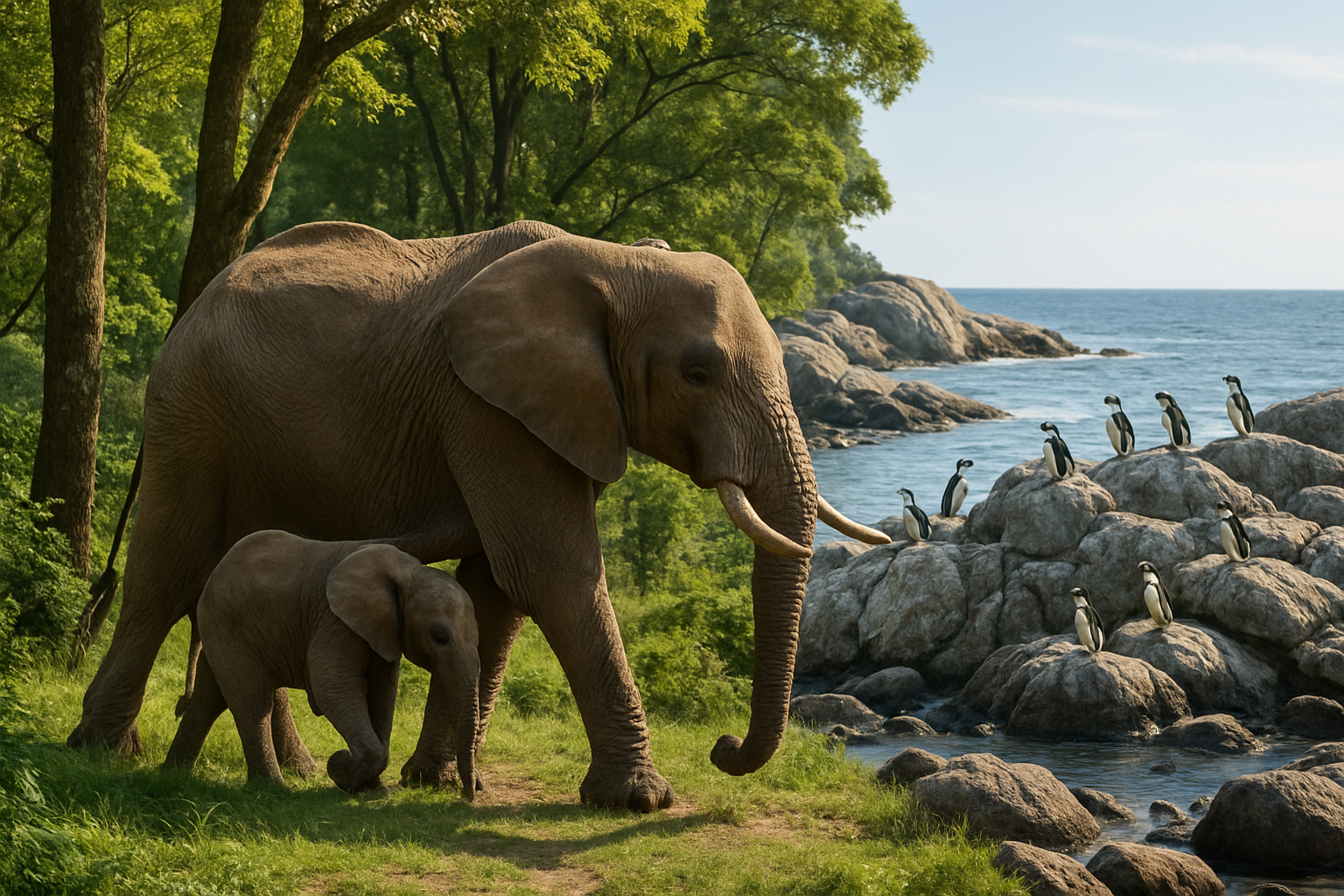
In an unprecedented coordinated effort spanning continents, Thailand has launched the world's first systematic elephant birth control program while Chile has declared the Humboldt penguin a protected National Monument, marking a revolutionary shift toward innovative human-wildlife coexistence strategies amid intensifying global conservation pressures.
These groundbreaking initiatives, announced within hours of each other on February 14, 2026, represent the evolution of conservation science from traditional barrier-based approaches to sophisticated reproductive management and legal protection frameworks that address the root causes of human-wildlife conflict.
Thailand's Pioneering Elephant Contraception Program
Thailand has begun deploying contraceptive vaccines on wild elephants in an ambitious attempt to mitigate escalating human-animal conflicts that have turned increasingly deadly. As agricultural expansion continues to fragment elephant habitats, the innovative program represents a humane alternative to traditional relocation or barrier methods that have proven inadequate.
The initiative addresses a critical conservation challenge: as farmers clear forests to create additional farmland, elephant populations are increasingly forced from their shrinking natural habitats in search of food sources. These desperate foraging expeditions onto agricultural land have resulted in dangerous confrontations, crop destruction, and fatalities on both sides of the conflict.
"This represents a fundamental shift from reactive crisis management to proactive ecosystem service management," observes Dr. Sarah Chen, a wildlife management specialist at the International Union for Conservation of Nature. "Rather than simply building barriers, we're addressing population pressure at its source."
— Dr. Sarah Chen, IUCN Wildlife Management Specialist
The contraceptive vaccine program utilizes sophisticated veterinary science to temporarily reduce elephant fertility rates in conflict zones while maintaining the social structure and behavioral patterns essential to elephant wellbeing. Unlike sterilization procedures, the reversible contraception allows for adaptive management as habitat conditions change.
Thailand's tourism industry, which generates substantial revenue from elephant-related attractions, strongly supports the initiative as it provides a sustainable solution that protects both agricultural communities and the wildlife populations that attract millions of international visitors annually.
Chile's Historic Penguin Protection Declaration
Simultaneously, Chile's Council of Ministers declared the Humboldt penguin a National Monument, granting the species unprecedented legal protection throughout the country's territory and prohibiting capture, mistreatment, or extraction. The designation represents the strongest possible conservation status under Chilean law and reflects growing international recognition of penguin vulnerability to climate change impacts.
The Humboldt penguin population has experienced significant decline due to multiple threats including climate change, overfishing of prey species, coastal development, and ocean acidification. The National Monument status provides comprehensive legal protection while establishing framework for enhanced conservation efforts along Chile's extensive coastline.
The declaration specifically prohibits any activities that could harm penguin populations, their breeding sites, or feeding areas. Chilean authorities are developing enforcement mechanisms to ensure protection extends throughout the species' range, which spans from Peru to central Chile.
Global Context of Conservation Innovation
These initiatives emerge during a critical period for global wildlife conservation. January 2026 marked the 18th consecutive month of global temperatures exceeding 1.5°C above pre-industrial levels, creating additional stress on wildlife populations already facing habitat loss, pollution, and human encroachment.

The timing of these announcements reflects broader momentum in global conservation efforts. Recent months have witnessed unprecedented international cooperation including marine partnership programs, renewable energy expansion supporting wildlife protection, wetland restoration projects, and innovative agricultural programs that reduce pressure on natural habitats.
Bhutan's revolutionary environmental DNA technology program demonstrates how modern science can enhance traditional conservation approaches. The kingdom's 24 forest officials now use cutting-edge eDNA sampling techniques to monitor species distribution without disturbing wildlife, supporting Bhutan's constitutional mandate to maintain over 60% forest coverage.
Technology-Tradition Integration
Both the Thai and Chilean initiatives exemplify the sophisticated integration of modern technology with traditional ecological knowledge. Thailand's contraceptive program combines advanced veterinary science with community-based wildlife management systems that have existed for generations. Local communities play essential roles in identifying conflict zones, monitoring elephant populations, and implementing protective measures.
Chile's legal framework builds upon indigenous knowledge systems that have recognized penguin conservation importance for centuries while utilizing modern environmental impact assessment and monitoring technologies to ensure protection effectiveness.
"Success in modern conservation requires synthesis of cutting-edge scientific innovation with traditional ecological wisdom and community engagement," notes Dr. Maria Gonzalez, director of the Latin American Conservation Alliance.
— Dr. Maria Gonzalez, Latin American Conservation Alliance
Economic Dimensions of Conservation
Both programs demonstrate the evolution of conservation thinking toward recognizing environmental protection as economic prosperity foundation rather than growth constraint. Thailand's elephant management supports tourism revenue generation while addressing agricultural productivity needs. The program creates employment opportunities in veterinary services, wildlife monitoring, and eco-tourism development.
Chile's penguin protection enhances the country's international environmental leadership reputation, potentially attracting sustainable development investment and eco-tourism revenue. The designation aligns with global trends toward ecosystem service valuation and climate adaptation cost avoidance strategies.
Countries implementing comprehensive environmental protection increasingly demonstrate economic resilience and attract international cooperation partnerships. Costa Rica's decades-long conservation leadership, for example, has generated substantial eco-tourism revenue while positioning the nation as a global environmental policy innovator.
Implementation Challenges and Success Factors
Both initiatives face significant implementation challenges requiring sustained political commitment, community engagement, and international cooperation. Thailand's contraceptive program requires ongoing veterinary expertise, community training, and adaptive management as elephant populations and habitat conditions evolve.
Chile's penguin protection demands comprehensive enforcement capabilities along thousands of kilometers of coastline, international coordination with Peru where Humboldt penguins also reside, and continued research to understand climate change impacts on penguin populations.
- Sustained funding mechanisms for long-term program implementation
- Technical capacity building in local communities
- International cooperation and knowledge sharing
- Integration of traditional ecological knowledge with modern science
- Adaptive management responding to changing environmental conditions
Success factors include transparent governance, community ownership of conservation outcomes, economic viability creation for local populations, and international partnership development. The diversity of approaches provides resilience against single-solution dependencies while offering multiple pathways for addressing environmental challenges.
Strategic Significance for Global Conservation
February 2026 represents a critical juncture demonstrating both the urgency of environmental challenges and human capacity for innovative responses. The Thailand elephant contraception and Chile penguin protection programs provide templates for comprehensive protection addressing multiple challenges while building local capacity and international cooperation.
These initiatives occur as conservation strategies worldwide evolve from species-focused approaches to ecosystem service management addressing climate adaptation, community resilience, and sustainable development simultaneously. Key priorities include scaling community-based approaches, enhancing international cooperation, developing financing mechanisms that recognize ecosystem service value, and accelerated implementation as climate urgency intensifies.
The success of these coordinated conservation efforts may determine whether environmental protection can keep pace with accelerating climate change and habitat destruction. As the window for effective action narrows rapidly, the tools and knowledge demonstrated through these innovative programs offer hope for coordinated responses combining immediate protection with long-term sustainability strategies.
Future Implications and Replication Potential
The innovative approaches pioneered by Thailand and Chile offer replicable models for addressing human-wildlife conflicts globally. Southeast Asian nations facing similar elephant-human conflicts are closely monitoring Thailand's contraceptive program outcomes, while Pacific coastal countries are examining Chile's legal protection framework for potential adaptation to their own endangered marine species.
International conservation organizations are developing knowledge-sharing networks to accelerate the transfer of successful techniques across geographical and cultural contexts. The United Nations Environment Programme has indicated interest in featuring both programs in upcoming global conservation strategy documents.
As climate change continues to intensify pressures on wildlife populations worldwide, the combination of innovative reproductive management, comprehensive legal protection, community engagement, and international cooperation demonstrated by these programs may become essential components of 21st-century conservation strategy. The success or failure of these initiatives will likely influence conservation approaches for decades to come.