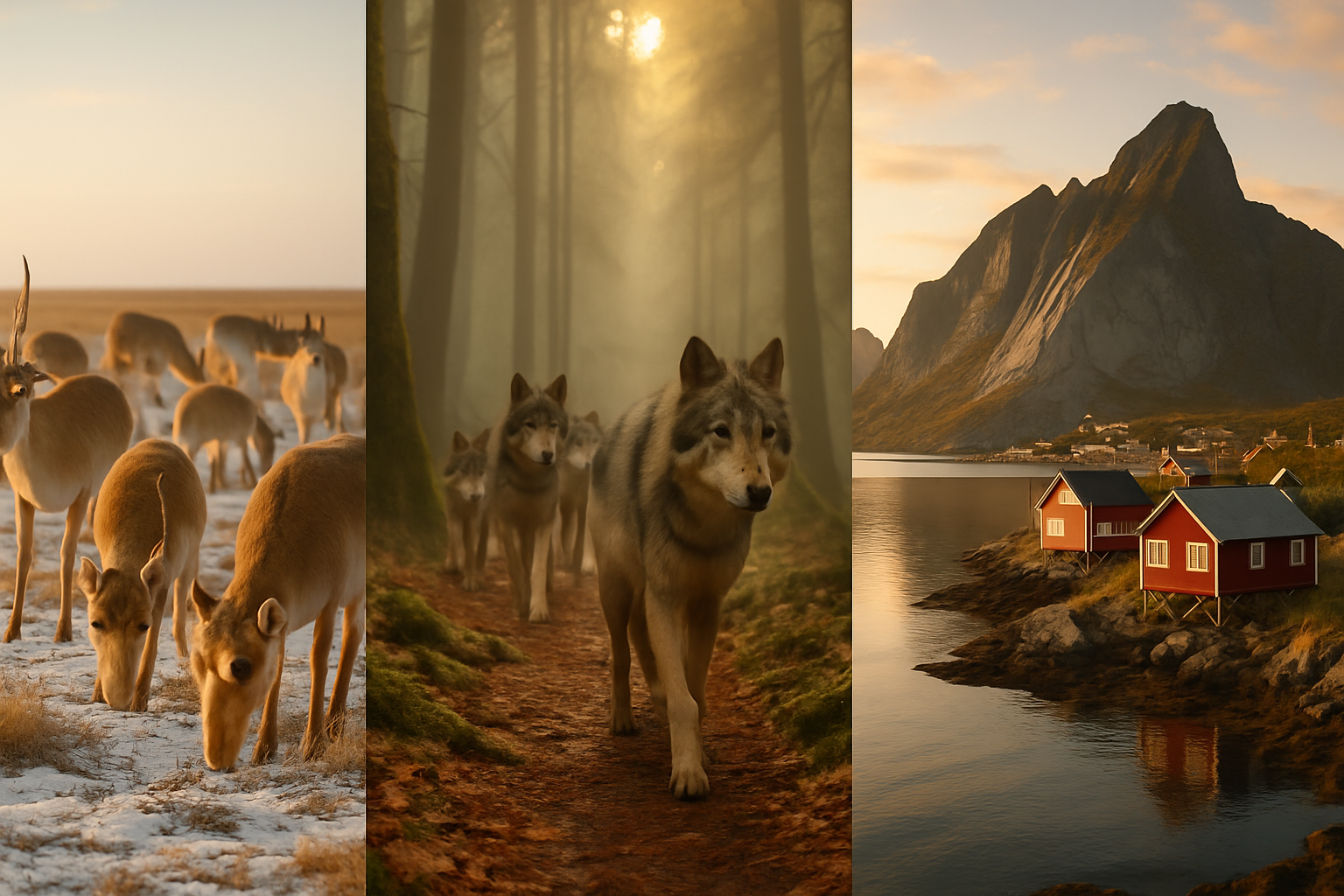
Wildlife populations across three continents are exhibiting unprecedented behavioral changes and conservation challenges as environmental pressures intensify during the hottest January on record, with Kazakhstan's saiga antelopes forced into unusual winter migrations, Slovenia celebrating wolf population recovery, and Norway's construction industry creating unexpected environmental protection opportunities.
The convergence of wildlife crisis and conservation successes emerges against the backdrop of January 2026 being confirmed as the hottest month in recorded history—the 18th consecutive month exceeding 1.5°C above pre-industrial levels. This unprecedented warming trend is overriding natural climate variability patterns, including La Niña cooling effects, fundamentally altering ecosystem dynamics worldwide.
Saiga Antelopes Signal Environmental Emergency
Large herds of critically endangered saiga antelopes have migrated into Kazakhstan's Aral district in Kyzylorda Region since late December, drawing urgent attention from wildlife officials who confirm this represents an unusual winter migration pattern driven by extreme snow depth and diminished food availability in traditional habitats.
Inspectors from the Kyzylorda regional branch of state enterprise Okhotzooprom have documented the unprecedented movement, emphasizing that while winter migrations are natural, the scale and timing indicate severe environmental stress. The saiga, characterized by their distinctive inflated nose structure that helps filter dust and regulate temperature, are considered an indicator species for Central Asian steppe ecosystem health.
"The movement is natural winter migration driven by snow depth and food availability, but the scale suggests environmental pressures beyond normal patterns."
— Okhotzooprom Wildlife Inspector, Kyzylorda Region
These migrations occur within the broader context of Kazakhstan's conservation efforts, where saiga populations have faced decades of decline due to hunting, habitat loss, and climate change. The species, which once numbered in millions across Central Asian steppes, now exists in fragmented populations requiring intensive protection measures.
Slovenia's Wolf Recovery Success Story
In stark contrast to Kazakhstan's wildlife crisis, Slovenia is celebrating a remarkable conservation success with wolves returning to the Pohorje mountain range in the country's northern region. A pack of seven adults accompanied by several pups has established territory in the forested hills near Maribor, marking the species' return to an area from which they had been absent for decades.
Forest Service experts describe the wolf pack's presence as a critical indicator of ecosystem health, demonstrating that biodiversity protection measures implemented since the early 1990s are yielding tangible results. Slovenia's wolf population, which had dwindled to just a few packs in the south-central Notranjska region and Kočevsko area, has gradually expanded into Alpine territories in the northwest over the past decade.
The wolves' return to Pohorje represents a significant milestone in European wildlife recovery efforts. These apex predators play crucial roles in maintaining ecological balance by controlling herbivore populations and supporting biodiversity through complex trophic interactions that benefit entire forest ecosystems.
"Wolves help maintain balance and support biodiversity. They are considered an indicator of a healthy ecosystem."
— Slovenia Forest Service Expert
However, the successful wolf recovery also presents challenges as communities adapt to coexistence with large predators. Forest officials acknowledge ongoing concerns about human-wildlife conflict, particularly regarding livestock protection and public safety, requiring sophisticated management approaches balancing conservation with community needs.
Norway's Unexpected Environmental Opportunity
Norway's cabin construction industry faces its weakest building year in 25 years, creating an unexpected environmental protection opportunity that conservationists are celebrating as a critical "pause" for the country's natural ecosystems. The dramatic downturn in cabin development has led to widespread layoffs among cabin manufacturers while providing relief to habitats that have experienced intense development pressure.
Environmental groups, led by Naturvernforbundet (Norwegian Society for the Conservation of Nature), describe the construction decline as an "utterly destructive" development pattern finally receiving a necessary halt. The organization emphasizes that Norway's wilderness areas, already constrained by existing development, require time to recover from decades of intensive cabin construction that has fragmented habitats and disturbed wildlife migration corridors.
The cabin industry's struggles reflect broader economic pressures affecting outdoor recreation and rural development sectors. However, environmental advocates argue that the temporary construction pause offers an opportunity to reassess sustainable development policies and implement more stringent environmental protections for sensitive habitats.
Global Climate Context Intensifies Conservation Challenges
These wildlife developments occur within the critical context of accelerating climate change impacts. January 2026's record temperatures represent the continuation of an unprecedented warming trend that has seen 18 of the past 19 months exceed the 1.5°C threshold established in international climate agreements as a critical limit for avoiding catastrophic environmental changes.
The persistence of extreme warming despite La Niña conditions—typically associated with global cooling—demonstrates that human-induced climate change has fundamentally altered Earth's atmospheric systems beyond natural recovery mechanisms. This warming acceleration creates compound environmental effects that simultaneously pressure wildlife populations while complicating conservation efforts.
For saiga antelopes, changing precipitation patterns and temperature extremes are altering traditional grazing areas and migration routes developed over millennia. Slovenia's wolf populations face climate-induced changes in prey distribution and forest composition that could affect long-term habitat viability. Norway's ecosystems experience modified seasonal patterns that disrupt traditional biological cycles.
Conservation Technology and Community Integration
Modern conservation approaches increasingly emphasize the integration of cutting-edge technology with traditional ecological knowledge and community-based management systems. Advanced monitoring techniques, including environmental DNA sampling, satellite tracking, and artificial intelligence-powered analysis, provide real-time data supporting strategic conservation planning.
In Kazakhstan, wildlife monitoring relies on satellite imagery and ground-based tracking to document saiga movements and habitat conditions. Slovenia employs genetic analysis and radio-collar technology to monitor wolf pack dynamics and territorial patterns. Norway utilizes comprehensive environmental impact assessments and digital mapping to evaluate development pressures on sensitive ecosystems.
However, technological solutions require combination with community environmental knowledge, economic incentives making protection financially viable, and international cooperation coordinating responses across national boundaries. Traditional ecological wisdom, developed over generations of human-wildlife coexistence, provides essential context for interpreting modern scientific data and implementing effective conservation strategies.
Economic Dimensions of Environmental Protection
The economic implications of wildlife conservation extend far beyond direct costs, encompassing tourism revenue, agricultural productivity, public health expenditures, and infrastructure stability. Environmental degradation costs often exceed investments required for proactive conservation, making protection efforts economically beneficial over long-term periods.
Kazakhstan's saiga conservation supports eco-tourism development and international scientific collaboration while maintaining traditional pastoral livelihoods that depend on healthy steppe ecosystems. Slovenia's wolf recovery enhances the country's international environmental reputation, potentially attracting sustainable development investment and supporting nature-based tourism sectors.
Norway's reduced cabin construction, while causing short-term economic disruption, may provide long-term benefits through preserved ecosystem services, enhanced tourism appeal of pristine wilderness areas, and reduced infrastructure maintenance costs in environmentally sensitive regions.
International Cooperation and Future Challenges
Transnational environmental challenges demand unprecedented international cooperation as wildlife migration patterns, climate systems, and ecosystem services cross political boundaries, making unilateral conservation efforts insufficient for addressing global-scale environmental changes.
The success of conservation initiatives depends increasingly on knowledge sharing, innovative financing mechanisms, and coordinated policy frameworks that address both immediate wildlife protection needs and long-term climate adaptation requirements. International cooperation opportunities through research partnerships, technology transfer, and shared conservation protocols offer pathways for scaling successful approaches across similar contexts worldwide.
Implementation challenges remain significant, particularly regarding funding sustainability for developing nations undertaking conservation efforts, technical capacity building requirements, and the need for adaptive management approaches responding to rapidly changing environmental conditions accelerated by climate change.
Critical Conservation Window Narrowing
The convergence of wildlife migration disruptions, conservation successes, and environmental protection opportunities in February 2026 represents a critical juncture demonstrating both the urgency of environmental challenges and the capacity for effective human responses when resources and political will align appropriately.
The window for effective conservation action is narrowing rapidly as climate impacts accelerate and ecological systems approach critical thresholds beyond which recovery may become impossible. However, the tools, knowledge, and international cooperation frameworks exist for comprehensive environmental protection if implemented with sufficient speed and coordination.
Success stories like Slovenia's wolf recovery demonstrate that well-designed conservation programs can achieve remarkable results even under challenging conditions. Environmental protection opportunities such as Norway's construction pause show how economic disruptions can create unexpected conservation benefits when properly managed. Crisis responses like Kazakhstan's saiga monitoring provide templates for rapid scientific intervention during environmental emergencies.
The strategic significance of February 2026's wildlife and environmental developments may prove decisive for conservation approaches in the coming decades, as choices made in response to current challenges will influence environmental protection strategies and outcomes for generations. The evolution from reactive crisis management to proactive ecosystem service management represents a fundamental shift in human relationships with natural systems, emphasizing community participation, technological integration, and economic viability as essential components of sustainable conservation efforts.