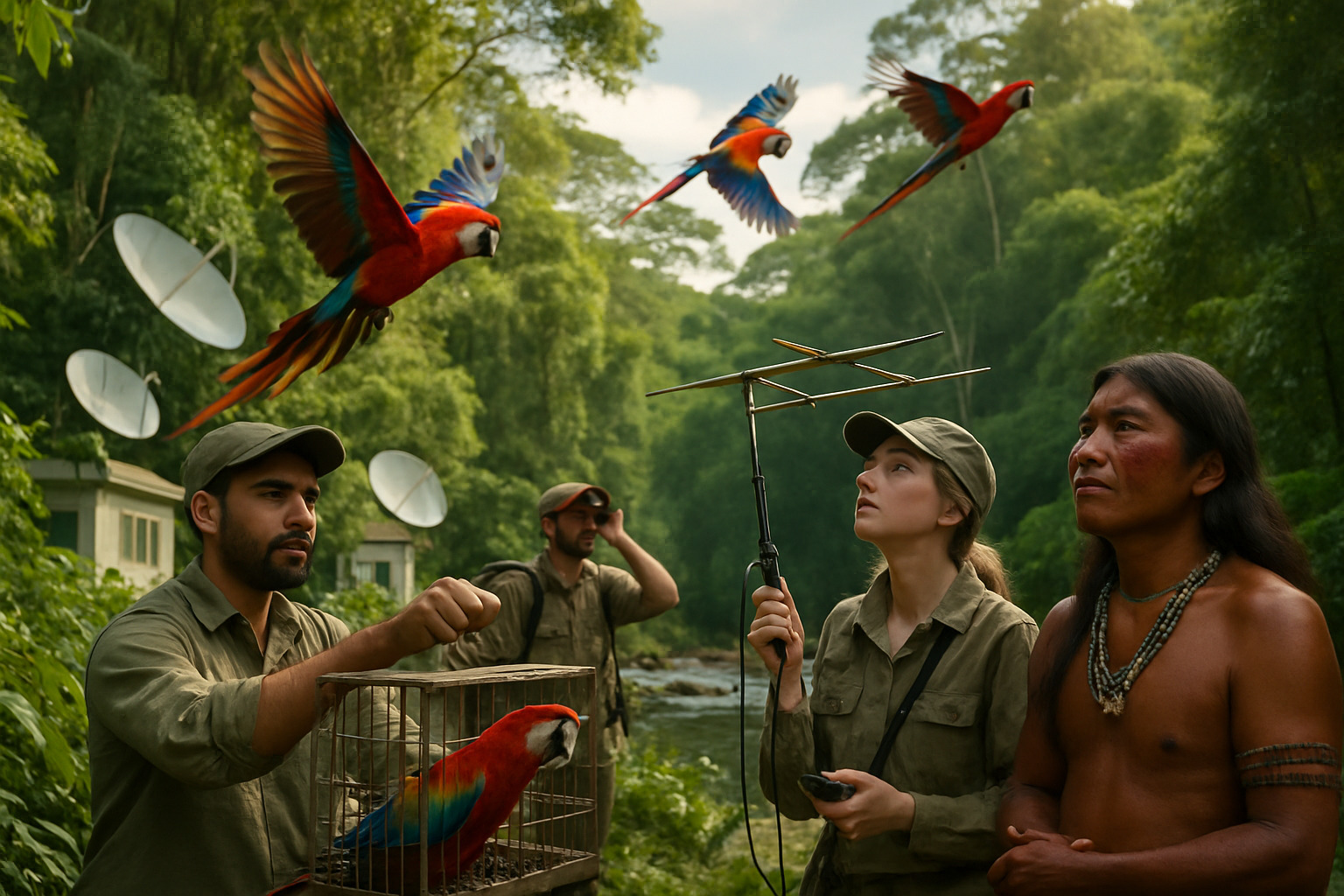
A remarkable surge in wildlife conservation and environmental protection initiatives across Bolivia, Uganda, and Nicaragua demonstrates humanity's growing capacity to protect essential natural systems during the most challenging environmental period in recorded history, as global temperatures exceed critical thresholds for the 24th consecutive month.
From the successful rehabilitation and relocation of six endangered parrots in Bolivia to groundbreaking chimpanzee census work in Uganda's biodiverse parks, these coordinated conservation efforts represent what environmental scientists are calling a "global conservation renaissance" – an unprecedented integration of cutting-edge technology with traditional ecological knowledge that is transforming wildlife protection worldwide.
Bolivia's Parrot Recovery Success
In Santa Cruz, Bolivia, six parabas (macaws) have found new hope after months of dedicated care at the Centro de Atención y Derivación de Fauna Silvestre (CAD) in Cochabamba. The birds, rescued from various illegal trafficking operations by environmental authorities and Pofoma (Forestry and Forest Police), have now been successfully transferred to the Centro de Custodia de Vida Silvestre Curucusi in Santa Cruz department.
"All the parabas have different origins. Some arrived through Pofoma confiscations, others were seized by Environmental personnel. Now we are happy that they are going to a more suitable place," explained Dennis Soux, responsible for the CAD facility.
The coordination between the Autonomous Municipal Government of Cochabamba (GAMC) and Boliviana de Aviación (BOA) enabled these magnificent birds to reach their permanent home, which provides all the appropriate conditions for their species. Remarkably, during their recovery period at CAD, the parabas formed a family unit, demonstrating the resilience and social nature of these highly intelligent birds.
This success story reflects Bolivia's broader commitment to combating the illegal wildlife trade, which threatens the country's extraordinary biodiversity. The sophisticated rehabilitation protocols employed represent a fundamental evolution from reactive rescue operations to proactive ecosystem service management.
Uganda's Scientific Conservation Breakthrough
Meanwhile, in Uganda's Bwindi Impenetrable National Park, the Jane Goodall Institute has completed a groundbreaking achievement: the first-ever dedicated chimpanzee census, confirming 426 chimpanzees sharing this unique habitat with the famous mountain gorillas. This partnership with the Uganda Wildlife Authority provides crucial scientific evidence that is reshaping management strategies for one of the world's most biodiverse parks.
The census employed sophisticated methodologies including environmental DNA sampling, camera trap networks, and traditional tracking techniques refined by local expertise. This represents a fundamental shift in conservation methodology – moving beyond simple species counting toward comprehensive ecosystem monitoring that provides early warning systems for environmental threats.
The significance of this work extends far beyond population numbers. Bwindi's unique ecological status as one of the few places on Earth where chimpanzees and mountain gorillas coexist makes this research invaluable for understanding complex ecosystem relationships under mounting climate pressures.
For over 27 years, the Environmental Conservation Trust of Uganda (ECOTRUST) has demonstrated how environmental protection can function as an economic development strategy rather than a regulatory burden. By working closely with communities through conservation and nature-based financing approaches, ECOTRUST shows that when people benefit from nature, they are more willing to protect it.
Nicaragua's Biodiversity Leadership
Nicaragua has emerged as a regional biodiversity leader, harboring an remarkable 7% of global biodiversity within its borders. With more than 20,000 species of fauna and flora, the country has positioned itself as a key player in global conservation efforts, with a clear mandate to promote environmental conservation and guarantee a sustainable ecosystem for future generations.
This extraordinary biodiversity concentration makes Nicaragua a critical partner in international conservation networks. The country's commitment to environmental protection represents the evolution of developing nations from aid recipients to environmental solution providers, leveraging local innovations and indigenous knowledge systems that can be scaled globally.
Technology-Tradition Integration: The New Conservation Paradigm
What unites these diverse conservation successes across three nations is a sophisticated synthesis of cutting-edge technology with traditional ecological knowledge and community-based management systems. This represents a fundamental departure from purely technological or traditional approaches toward comprehensive frameworks that combine scientific rigor with cultural sensitivity and community ownership.
In Bolivia, parrot rehabilitation combines advanced veterinary protocols with traditional bird-handling expertise developed over generations. Uganda's chimpanzee research integrates environmental DNA analysis with indigenous tracking methods. Nicaragua's biodiversity management leverages satellite monitoring with centuries-old sustainable resource practices.
This technology-tradition integration addresses a critical challenge in scaling conservation efforts globally while respecting local cultural autonomy and traditional management systems that have sustained ecosystems for generations.
Economic Development Through Environmental Protection
These conservation initiatives demonstrate that environmental protection increasingly functions as an economic development strategy rather than a regulatory burden. Countries implementing comprehensive wildlife protection consistently show greater economic resilience and attract sustainable investment across multiple sectors.
Uganda's conservation research enhances its positioning as a global eco-tourism destination, generating substantial revenue for local communities while funding ongoing conservation work. Bolivia's wildlife protection capabilities attract international partnerships and position the country as a regional environmental leader. Nicaragua's biodiversity wealth supports eco-tourism, scientific collaboration, and sustainable development opportunities.
Economic analyses consistently show that ecosystem services from intact natural systems often deliver greater long-term economic value than resource extraction activities. Forests regulate water and climate patterns, wetlands prevent billions in flood damage, and biodiversity hotspots support pharmaceutical research and premium eco-tourism worth hundreds of billions annually.
Climate Crisis Context: Conservation During Unprecedented Warming
These conservation victories emerge during the most challenging environmental period in recorded history. The 24th consecutive month of global temperatures exceeding 1.5°C above pre-industrial levels represents the longest sustained warming streak on record, completely overriding natural climate variability including La Niña cooling effects.
This sustained warming demonstrates that human-induced climate change has fundamentally altered atmospheric systems beyond natural recovery mechanisms, creating compound environmental effects that traditional conservation approaches struggle to address. Rising sea levels threaten coastal ecosystems, changing precipitation patterns affect forest regeneration, and extreme weather increasingly disrupts marine food chains and terrestrial habitats.
Conservation strategies must now account for rapidly changing baseline conditions while maintaining long-term sustainability goals. This requires adaptive management approaches that respond to environmental changes occurring faster than many species can naturally adapt.
International Cooperation: Essential for Global Success
The success of these diverse conservation initiatives highlights the critical importance of unprecedented international cooperation. Environmental challenges transcend political boundaries through ocean currents, atmospheric systems, and species migrations that connect ecosystems globally, making unilateral conservation efforts insufficient.
Knowledge sharing between nations creates global networks that provide resilience against single-solution dependencies, offering multiple adaptation pathways for complex environmental challenges. The evolution from traditional North-South aid relationships toward peer-to-peer cooperation recognizes that developing nations are increasingly becoming environmental solution providers rather than aid recipients.
Success depends on coordinated policy frameworks, shared monitoring systems, collaborative enforcement, and innovative financing that recognizes the economic value of ecosystem services. Diversity in conservation approaches provides crucial resilience, demonstrating that effective environmental protection requires multiple strategies adapted to local conditions while maintaining global connectivity.
Critical Action Window: A Decisive Moment
Environmental scientists warn that the window for effective conservation action is narrowing rapidly as ecological systems approach critical thresholds that could trigger potentially irreversible changes affecting global food security, climate stability, and human settlements.
The choice facing the international community is between reactive crisis management and proactive ecosystem service management. The conservation successes in Bolivia, Uganda, and Nicaragua demonstrate that the tools, knowledge, and cooperation frameworks exist for comprehensive environmental protection, but success depends on implementing solutions with sufficient speed and coordination to match the pace of environmental change.
This represents a critical juncture in the decisive climate action decade ahead. Current conservation initiatives may prove decisive in determining conservation approaches for decades to come, influencing global biodiversity protection, climate adaptation, and sustainable development strategies for generations.
Implementation Success Factors
The success factors emerging from these three nations' conservation work consistently include community ownership and engagement, transparent governance frameworks, economic incentives that make protection financially viable for local communities, and sophisticated integration of traditional ecological knowledge with modern conservation science.
However, significant challenges remain. Funding sustainability is particularly difficult for developing nations where immediate economic pressures can override long-term environmental considerations. Technical capacity building requires sustained investment in education, training, and institutional development. Climate change continues to disrupt project timelines, requiring adaptive management approaches that can respond to rapidly changing conditions.
Despite these challenges, the diversity of successful approaches provides hope and practical guidance for the massive coordinated effort required to maintain planetary habitability during this unprecedented environmental challenge period.
Strategic Significance for Global Conservation
The environmental developments across Bolivia, Uganda, and Nicaragua represent potentially decisive conservation approaches that could influence global biodiversity protection, climate adaptation, and sustainable development strategies for generations to come.
The integration of cutting-edge technology with traditional ecological wisdom creates adaptable frameworks that respect cultural diversity while leveraging global technological capabilities for maximum conservation impact. This synthesis offers pathways for maintaining planetary habitability, but success depends on humanity's ability to organize and implement solutions rapidly enough to protect the natural systems upon which human prosperity depends.
These conservation initiatives provide practical templates for scaling environmental protection globally through coordinated approaches that address multiple challenges while building local capacity and fostering international cooperation. They demonstrate that remarkable achievements are possible through scientific excellence, community engagement, and international cooperation, even during the most environmentally challenging period in recorded history.
The window for effective environmental action continues to narrow, but the convergence of innovation, cooperation, and political commitment demonstrated by these three nations offers hope for maintaining planetary habitability through coordinated global action with maximum urgency during this decisive climate action decade.