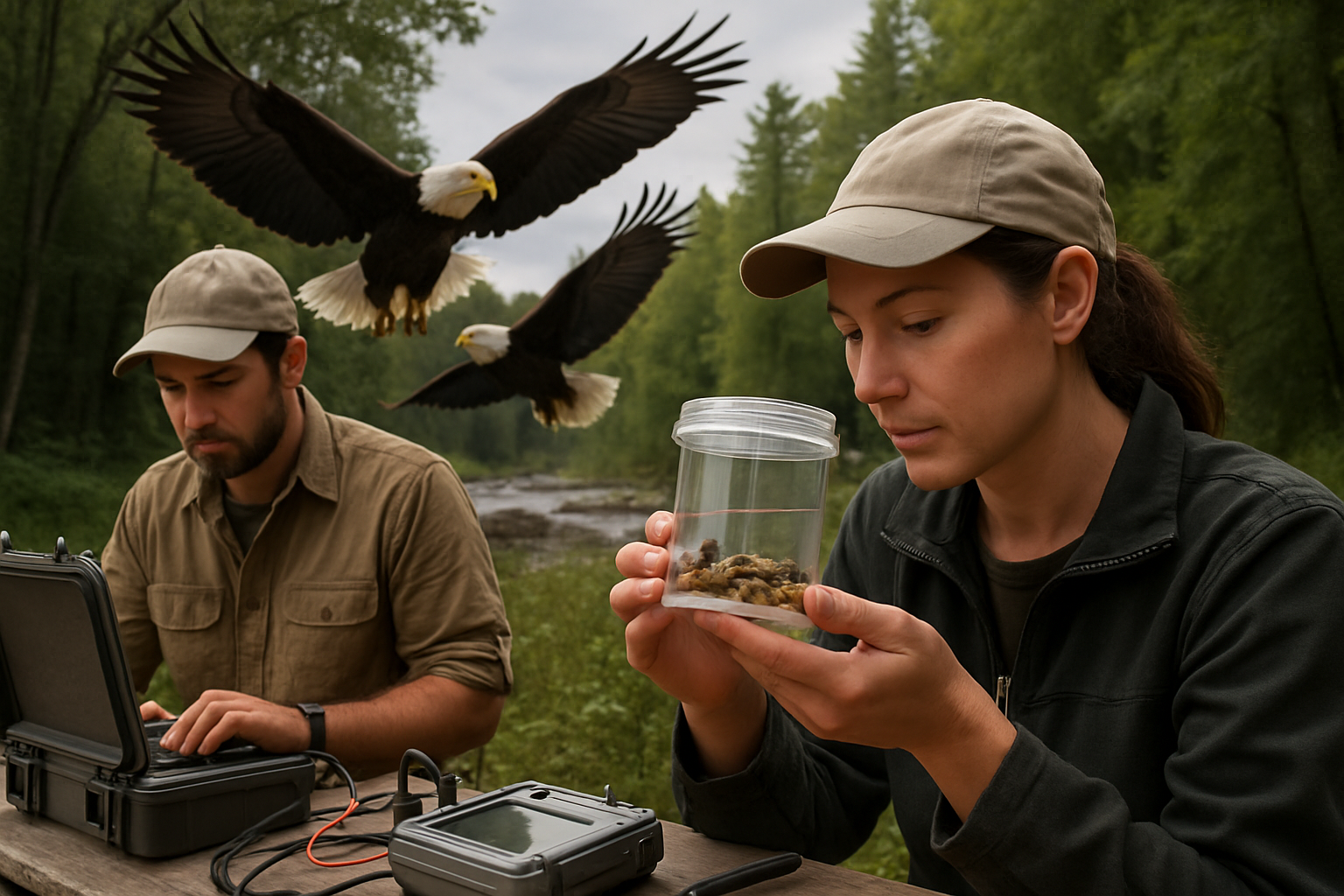
Wildlife conservation efforts are achieving remarkable success across North America and Europe as programs demonstrate unprecedented species recovery during the 22nd consecutive month of global temperatures exceeding 1.5°C above pre-industrial levels.
From dramatic bald eagle rescue operations in British Columbia to delicate rare snail restoration programs in Latvia, conservation initiatives are proving that coordinated international efforts can reverse decades of environmental decline even amid accelerating climate change.
Bald Eagle Rescue Demonstrates Advanced Wildlife Response
A remarkable rescue operation in Surrey, British Columbia, showcased the sophistication of modern wildlife conservation when two fighting bald eagles became entangled in power lines. The incident, which occurred on April 6, 2026, required coordination between power crews, fire departments, and the Orphaned Wildlife Rehabilitation Society to safely free the birds.
The eagles had engaged in territorial combat that resulted in both birds becoming trapped in electrical infrastructure. According to conservation experts, such incidents highlight the growing intersection between wildlife recovery and urban development pressures as eagle populations continue their remarkable comeback from near-extinction in the 1970s.
"Every successful rescue represents not just individual animal welfare but the preservation of genetic diversity crucial for species recovery."
— Wildlife rehabilitation specialist, Orphaned Wildlife Rehabilitation Society
The rescue operation employed specialized equipment and protocols developed over decades of wildlife rehabilitation experience. Power and fire crews worked in coordination to create safe access points while wildlife specialists prepared emergency veterinary care and transportation to rehabilitation facilities.
Latvian Zoo Pioneers Rare Snail Conservation
Simultaneously, the Rīga Zoo in Latvia has emerged as a critical partner in one of conservation's most delicate challenges: restoring populations of the Partula snail, a species that measures just two centimeters but holds enormous significance for Pacific Island ecosystems.
These remarkable mollusks, native to French Polynesia, represent a conservation success story spanning international cooperation. Once completely extinct in the wild, Partula snails survived only in zoos worldwide, including Rīga Zoo, which has maintained breeding populations for ecosystem restoration efforts.
The snails serve as a vital component of Polynesian island ecosystems and hold deep cultural significance for indigenous communities. Their near-extinction resulted from habitat destruction and the introduction of invasive species that disrupted delicate ecological balances developed over millennia.

Technology Integration Revolutionizes Conservation
Modern conservation efforts demonstrate sophisticated integration of cutting-edge technology with traditional ecological knowledge. Bald eagle rescue operations now employ GPS tracking, environmental DNA sampling, and satellite monitoring to track population recovery and individual bird movements.
The Partula snail program utilizes genetic screening to ensure maximum population diversity while environmental monitoring provides insights into ecosystem recovery patterns. This technology-tradition synthesis represents a fundamental evolution in conservation methodology beyond purely technological or traditional approaches.
Conservation programs increasingly combine advanced veterinary protocols, digital tracking systems, and AI-powered threat detection with generations of traditional ecological knowledge and community-based stewardship practices.
Economic Benefits Drive Conservation Investment
Environmental protection increasingly functions as an economic development strategy rather than a regulatory burden. Countries implementing comprehensive wildlife protection demonstrate greater economic resilience and attract sustainable investment across eco-tourism, environmental technology, and green services sectors.
Bald eagle recovery supports multi-billion-dollar nature tourism industries throughout North America. The species serves as a flagship for broader ecosystem health that supports fisheries, forestry, and recreational economies worth hundreds of billions annually.
Latvia's participation in international conservation programs enhances the country's environmental credentials, positioning it as a regional leader in biodiversity protection while attracting research partnerships and sustainable development investment.
"Economic analysis consistently shows that ecosystem services from intact natural systems provide greater long-term value than resource extraction."
— Conservation economist specializing in biodiversity valuation
Climate Change Adds Urgency to Conservation Efforts
Conservation victories emerge during an unprecedented environmental period. January 2026 marked the hottest month in recorded history, extending a 22-month streak of temperatures exceeding critical climate thresholds and completely overriding natural cooling mechanisms.
This sustained warming creates compound environmental effects that traditional conservation approaches struggle to address. Rising sea levels threaten coastal ecosystems, changing precipitation patterns affect forest regeneration, and increased extreme weather disrupts marine food chains and terrestrial habitats.
The success of current programs demonstrates that coordinated international conservation efforts can achieve remarkable results even under these challenging conditions. However, the environmental action window continues to narrow as ecological systems approach critical thresholds that could trigger potentially irreversible changes.
International Cooperation Essential for Success
The global nature of environmental challenges demands unprecedented international cooperation. Wildlife migrations, ocean currents, and atmospheric systems connect ecosystems globally, making unilateral conservation efforts insufficient.
The Partula snail program exemplifies this cooperation, involving zoos across North America, Europe, and Asia working together to maintain genetic diversity and prepare species for reintroduction. Knowledge sharing creates global networks that strengthen local capacity while contributing to planetary sustainability.
Success factors consistently include community ownership and engagement, transparent governance frameworks, economic incentives that make protection financially viable, and sophisticated integration of traditional ecological knowledge with modern conservation science.
Conservation Renaissance Emerges
These achievements represent part of a broader "conservation renaissance" characterized by scientific innovation, community engagement, economic viability, and international cooperation. Recent successes include Ecuador's reintroduction of 158 giant tortoises to the Galápagos after 150 years, Zimbabwe's world-first DNA forensic wildlife prosecution, and Croatia's record griffon vulture populations.
The fundamental shift from reactive crisis management to proactive ecosystem service management emphasizes community participation, technological integration, and economic sustainability as essential conservation components.
Looking Forward: Critical Action Window
April 2026 represents a critical juncture in global environmental protection, with choices between reactive crisis management and proactive ecosystem service management potentially determining whether conservation efforts can keep pace with accelerating environmental change.
Tools, knowledge, and cooperation frameworks exist for comprehensive environmental protection, as demonstrated by diverse international initiatives achieving remarkable results during Earth's most challenging environmental period. Success depends on sustained international cooperation, enhanced coordination, and financial commitments recognizing environmental protection as essential infrastructure for human prosperity and planetary sustainability.
The convergence of emergency response capabilities, long-term species management, community engagement, and international cooperation provides adaptable templates that can be scaled across geographical and cultural contexts while respecting local conditions and priorities.
As conservation efforts continue expanding globally, the integration of cutting-edge technology with traditional ecological wisdom creates robust frameworks for maintaining planetary habitability during this unprecedented environmental challenge period.