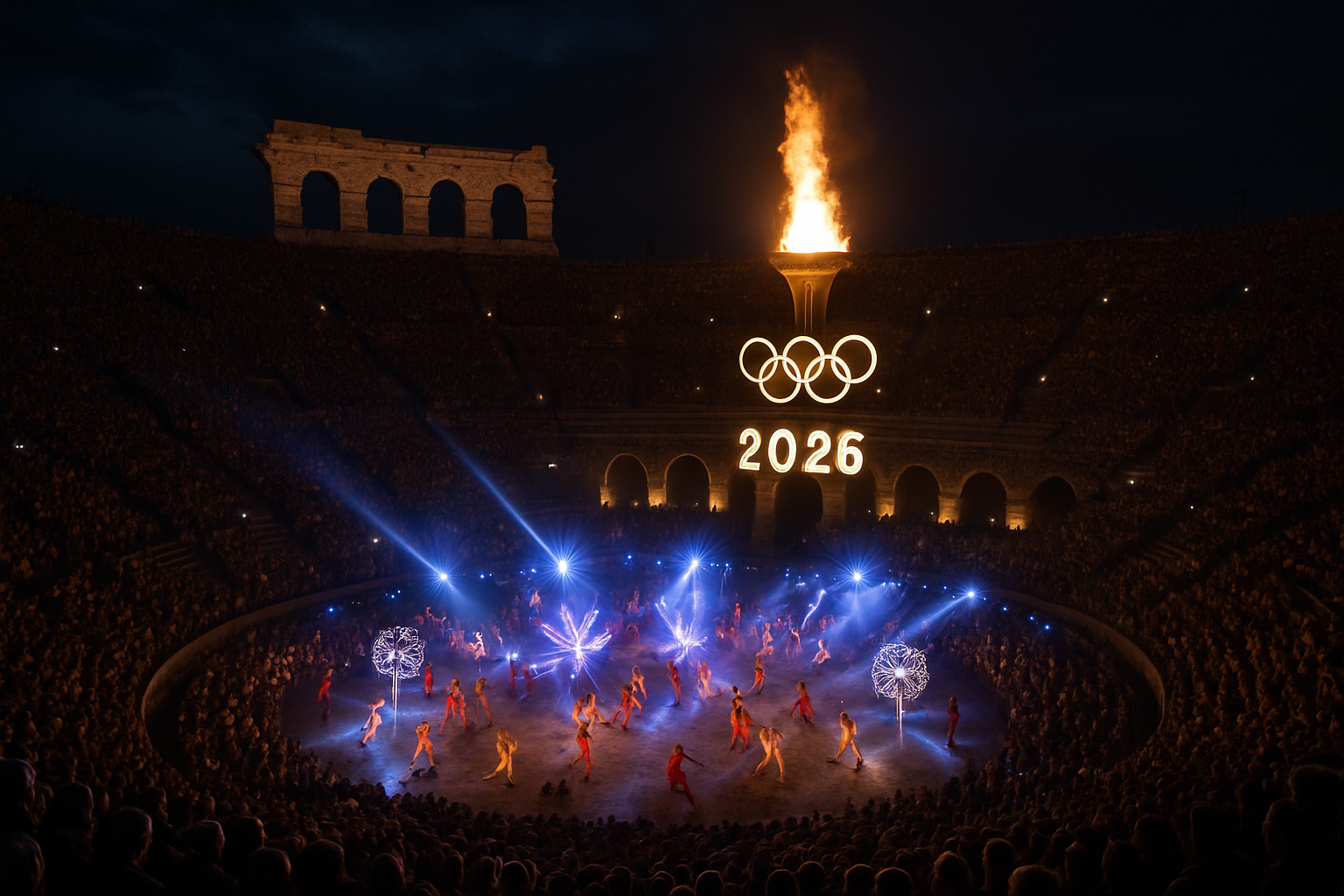
The Milano-Cortina 2026 Winter Olympics officially concluded today with a breathtaking closing ceremony held at the historic Arena di Verona, marking the end of the most geographically dispersed Winter Olympic Games in history with unprecedented global participation and record-breaking performances.
The 2,000-year-old Roman amphitheater provided a majestic backdrop as the XXV Winter Olympic Games came to a close after 16 days of competition that redefined Olympic hosting and witnessed extraordinary athletic achievements across 400+ kilometers of northern Italian venues.
Norwegian Dominance Reaches Historic Heights
Norway's winter sports supremacy reached unprecedented levels at Milano-Cortina 2026, achieving a historic 17 gold medals and 33 total medals—both new Winter Olympic records. The achievement was anchored by Johannes Høsflot Klæbo's extraordinary campaign, which saw him win six gold medals at a single Olympics, breaking Eric Heiden's 46-year-old record of five golds.
"This has been an incredible journey. To win six golds at one Olympics and become the most decorated Winter Olympian ever with 11 career golds—it feels surreal."
— Johannes Høsflot Klæbo, Norwegian cross-country skier
Klæbo's historic achievement included victories in all six cross-country events, making him the first athlete ever to accomplish such a feat. His final gold came in the men's 50km mass start classic, where Norway completed a podium sweep with Martin Loewstroem Nyenget and Andreas Skoglund joining their teammate.
Figure Skating Gala Delivers Powerful Messages
The figure skating exhibition gala, held before the Games concluded, provided some of the most emotionally resonant moments of Milano-Cortina 2026. American skater Ilia Malinin, who had suffered a devastating collapse to eighth place in the men's individual competition despite being the overwhelming favorite, delivered a powerful performance addressing the dangers of social media and the pressures facing young athletes.
The gala also highlighted the mental health challenges faced by Olympic competitors, with several skaters using their performances to advocate for better support systems and awareness of psychological pressures in elite sport. These performances resonated globally, particularly given the intense scrutiny and pressure athletes faced throughout the Games.
Canada Reclaims Curling Gold
Among the final events completed before the closing ceremony, Canada's men's curling team, led by Brad Jacobs, defeated Great Britain 8-7 in a thrilling final to claim the country's fourth Olympic curling title and their first since Sochi 2014. The team, including Marc Kennedy, Brett Gallant, and Ben Hebert, overcame early controversies including the heated "double-touching" allegations that had dominated headlines earlier in the Games.
Japan's Figure Skating Legacy Secured
Despite veteran Kaori Sakamoto's departure from competitive skating, Japan demonstrated the strength and depth of their figure skating program throughout the Games. The emergence of younger Japanese skaters, combined with continued excellence in pairs and ice dance, ensures Japan's position as a figure skating powerhouse for years to come.
"Even as we say farewell to champions like Sakamoto, the future of Japanese figure skating has never looked brighter."
— Japan Skating Federation spokesperson
Revolutionary Hosting Model Proves Successful
The Milano-Cortina 2026 Games established a new paradigm for Olympic hosting through their revolutionary dual-city model spanning over 400 kilometers across northern Italy. Despite early infrastructure challenges, including incomplete cable cars and venue construction delays, the Games proceeded successfully across seven venues from Milan to Cortina d'Ampezzo.
The technological innovations introduced at these Games—including the first Olympic integration of Alibaba's Qwen AI system and OMEGA's AI-powered figure skating analysis—enhanced both the competitive experience and spectator engagement while maintaining the essence of Olympic competition.
Global Winter Sports Democratization
Perhaps the most significant legacy of Milano-Cortina 2026 was the unprecedented global participation and competitiveness witnessed across all disciplines. Australia achieved its most successful Winter Olympics ever, with breakthrough golds in moguls and snowboard cross challenging traditional winter sports hierarchies.
Historic debuts from Saudi Arabia, with alpine skier Fayik Abdi and cross-country competitor Rakan Aliriza, alongside first-time Olympic appearances by Caribbean bobsled teams from Jamaica and Trinidad & Tobago, demonstrated that winter sports excellence is no longer geographically confined.
Kazakhstan's Mikhail Shaidorov delivered one of the Games' biggest upsets by winning men's figure skating gold, while Brazil's Lucas Pinheiro Braathen claimed South America's first-ever Winter Olympic gold medal in alpine skiing.
Environmental and Cultural Innovations
The Games successfully balanced competitive excellence with environmental responsibility, utilizing existing venues where possible and introducing sustainable practices including Olympic villages with greenhouse spaces. Cultural innovations such as bilingual place names in Alto Adige/South Tyrol and the popular Gen Z mascots Milo and Tina resonated globally while maintaining authentic Italian character.
Europe's harshest winter in decades provided ideal natural snow conditions, reducing the need for artificial snow production and demonstrating how climate-adapted hosting can work in partnership with natural conditions.
Final Medal Standings and Records
The final medal standings reflected the most competitive Winter Olympics in recent memory:
- Norway: 17 gold, 8 silver, 8 bronze (33 total)
- Italy: 9 gold, 26 total medals
- United States: 24 total medals
Beyond Norway's historic dominance, the Games saw numerous records fall and breakthrough performances that rewrote winter sports history. France achieved their best-ever Winter Olympic performance with 19 medals, while the Netherlands' speed skating "gold rush" lived up to expectations.
Olympic Flame Extinguished in Verona
The closing ceremony in Verona's Arena di Verona provided a fitting conclusion to these groundbreaking Games. The ancient amphitheater, with its 2,000-year history, served as a symbol of endurance and continuity as the Olympic flame was extinguished and the Games were officially handed over to France, hosts of the 2030 Winter Olympics.
The ceremony blended music, art, and the pure spirit of sport, celebrating the unity achieved through 16 days of competition while honoring all 3,000 athletes from 92 countries who participated in 116 medal events across 16 sports.
"Milano-Cortina 2026 has shown us that Olympic excellence can coexist with environmental responsibility and true global participation. These Games will be remembered not just for the records broken, but for the new pathways opened."
— IOC President Kirsty Coventry
Legacy for Future Olympics
As the Olympic flame was extinguished in Verona, Milano-Cortina 2026's legacy was already clear: these Games proved that Olympic hosting can be both environmentally sustainable and competitively excellent. The dual-city model, technological innovations, and unprecedented global participation established templates for future Olympic hosting that balance tradition with 21st-century realities.
The Games demonstrated that winter sports excellence transcends geographic boundaries, with breakthrough performances from six continents challenging traditional powerhouses and inspiring a new generation of athletes worldwide. From the ancient stones of the Arena di Verona to the cutting-edge AI systems enhancing competition, Milano-Cortina 2026 successfully bridged Olympic history with future possibilities.
As attention now turns to the 2030 Winter Olympics in France, the bar has been set remarkably high for combining athletic excellence, environmental responsibility, technological innovation, and true global inclusivity in Olympic competition.