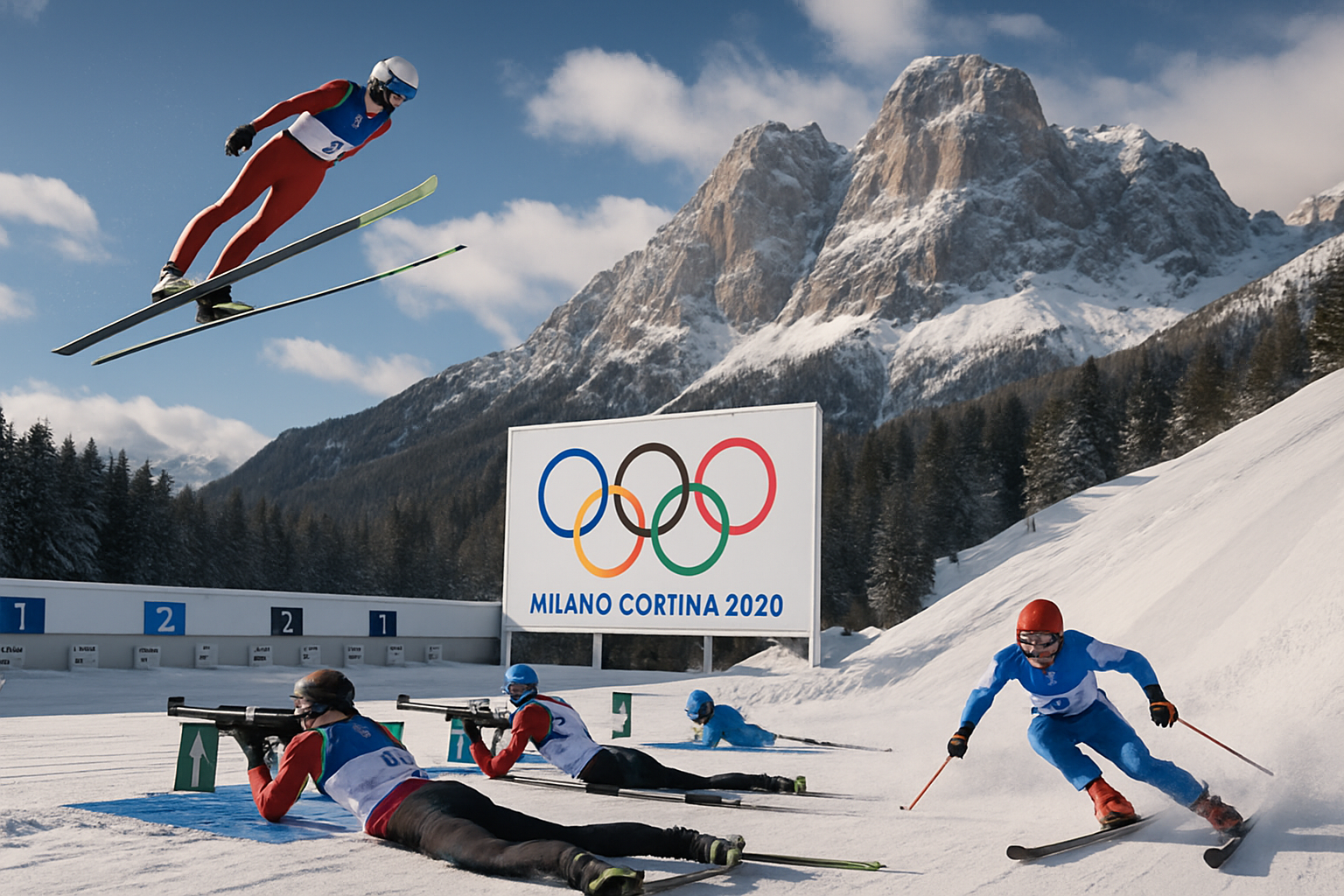
Day 4 of the Milano-Cortina 2026 Winter Olympics delivered stunning upsets, emotional controversies, and promising medal prospects as competition intensified across the Italian Dolomites, with Germany celebrating an unexpected ski jumping triumph while Ukraine faced restrictions on commemorating war victims.
German Breakthrough at Predazzo
Germany's Philipp Raimund produced the shock of the day with a commanding victory in the men's normal hill ski jumping competition at Predazzo, claiming his first-ever World Cup victory at the Olympics. The 24-year-old defeated Poland's Kacper Tomasiak by just 3.4 points in a thrilling finale that saw traditional powerhouses struggle.
Austria's dominance in ski jumping suffered a significant blow as their best performer, Stephan Embacher, could only manage seventh place. The result marked a continuation of the surprising outcomes that have defined these Games, with established favorites consistently falling short of expectations.
"This victory represents years of dedication and perseverance paying off on the biggest stage,"
— Philipp Raimund, Gold Medalist
The bronze medal was shared between Japan's Ren Nikaido and Switzerland's Gregor Deschwanden, highlighting the global competitiveness of modern ski jumping. The joint bronze represented Switzerland's third ski jumping Olympic medal in history, following Walter Steiner and Simon Ammann.
Ukrainian Memorial Helmet Controversy
The day's most emotionally charged story centered around Ukrainian skeleton athlete Vladyslav Heraskevych, who was prohibited by the International Olympic Committee from competing with a special memorial helmet honoring Ukrainian athletes killed in the ongoing war with Russia.
Heraskevych's helmet featured photographs of approximately six Ukrainian athletes who died in Russian attacks, which he had worn during official training sessions on Monday. However, IOC officials determined the helmet violated Olympic neutrality rules and banned its use in competition.
The decision sparked immediate international reaction, with Ukrainian President Volodymyr Zelensky intervening to support his athlete's tribute. "This remembers the price of our struggle," Zelensky stated, emphasizing the symbolic importance of the memorial.
"The IOC's decision breaks my heart. These were my friends and colleagues who gave their lives,"
— Vladyslav Heraskevych, Ukrainian Skeleton Athlete
The controversy highlights the ongoing tension between Olympic political neutrality and athletes' desires to acknowledge real-world conflicts. Heraskevych, who serves as Ukraine's flag bearer, expressed disappointment but confirmed he would compete using regulation equipment.
Swedish Medal Prospects Brighten
Sweden emerged as a significant storyline for Day 4 with multiple medal opportunities across cross-country skiing and biathlon. Jonna Sundling entered as the favorite for women's cross-country sprint gold, while biathlete Sebastian Samuelsson sought redemption in the men's distance events.
Swedish experts identified both distance biathlon races as major medal chances, though they acknowledged the challenge posed by the high-altitude venues. "You can crash and burn at this altitude," warned former biathlon star Anna Magnusson, referring to the physiological demands of competition in the Italian Alps.
In curling, the Swedish siblings Rasmus and Isabella Wranå positioned themselves for potential medal contention at the Cortina venue, adding to Sweden's growing medal hopes across multiple disciplines.
Cross-country skiing expert Anna J. Haag conducted a detailed analysis of the sprint course, identifying key tactical points where races could be decided. Her assessment suggested the course favored technical skiers capable of making strategic moves on the challenging uphill sections.
Altitude Challenges
The elevation of several Milano-Cortina venues continues to present unique challenges for athletes accustomed to sea-level training. Swedish coaches have implemented specialized preparation protocols to address the reduced oxygen availability, but acknowledge that race-day performance remains unpredictable.
Rising Stars and Olympic Debuts
Nineteen-year-old Swedish cross-country skier Alvar Myhlback prepared for his Olympic debut with characteristic confidence, even targeting Norwegian superstar Johannes Høsflot Klæbo. The young Swede suggested Klæbo might struggle on the final downhill section of the sprint course, demonstrating the fearless attitude that has marked his rapid ascent in international competition.
Greek alpine skier Apostolos Angelis also entered competition on Day 4, representing his nation's continuing efforts to expand winter sports participation beyond traditional Alpine countries.
Day 4 Competition Overview
The day featured four medal events spanning multiple disciplines, with German athletes Emma Aicher and Kira Weidle-Winkelmann positioned as medal contenders in alpine skiing's team combination event. Their prospects added to Germany's growing medal tally after earlier successes in luge and speed skating.
Biathlon, cross-country skiing, and alpine events dominated the schedule, showcasing the technical precision and physical endurance that define winter Olympic competition. The diverse geographical spread of Milano-Cortina 2026 continued to present logistical challenges while delivering world-class competitive venues.
Looking Forward
As the Games approach their midpoint, several storylines have emerged that will define the Milano-Cortina legacy. The ongoing tension between political expression and Olympic neutrality, exemplified by the Ukrainian helmet controversy, reflects broader global conflicts intersecting with sport.
Germany's breakthrough performances across multiple sports demonstrate the increasing depth of winter sports competition, while Scandinavian nations continue their traditional dominance in Nordic events. The success of these most geographically dispersed Olympics proves that innovative hosting models can maintain competitive excellence while addressing sustainability concerns.
With thirteen days of competition remaining, Milano-Cortina 2026 continues to deliver the compelling combination of athletic excellence, human drama, and international cooperation that defines the Olympic movement at its finest.