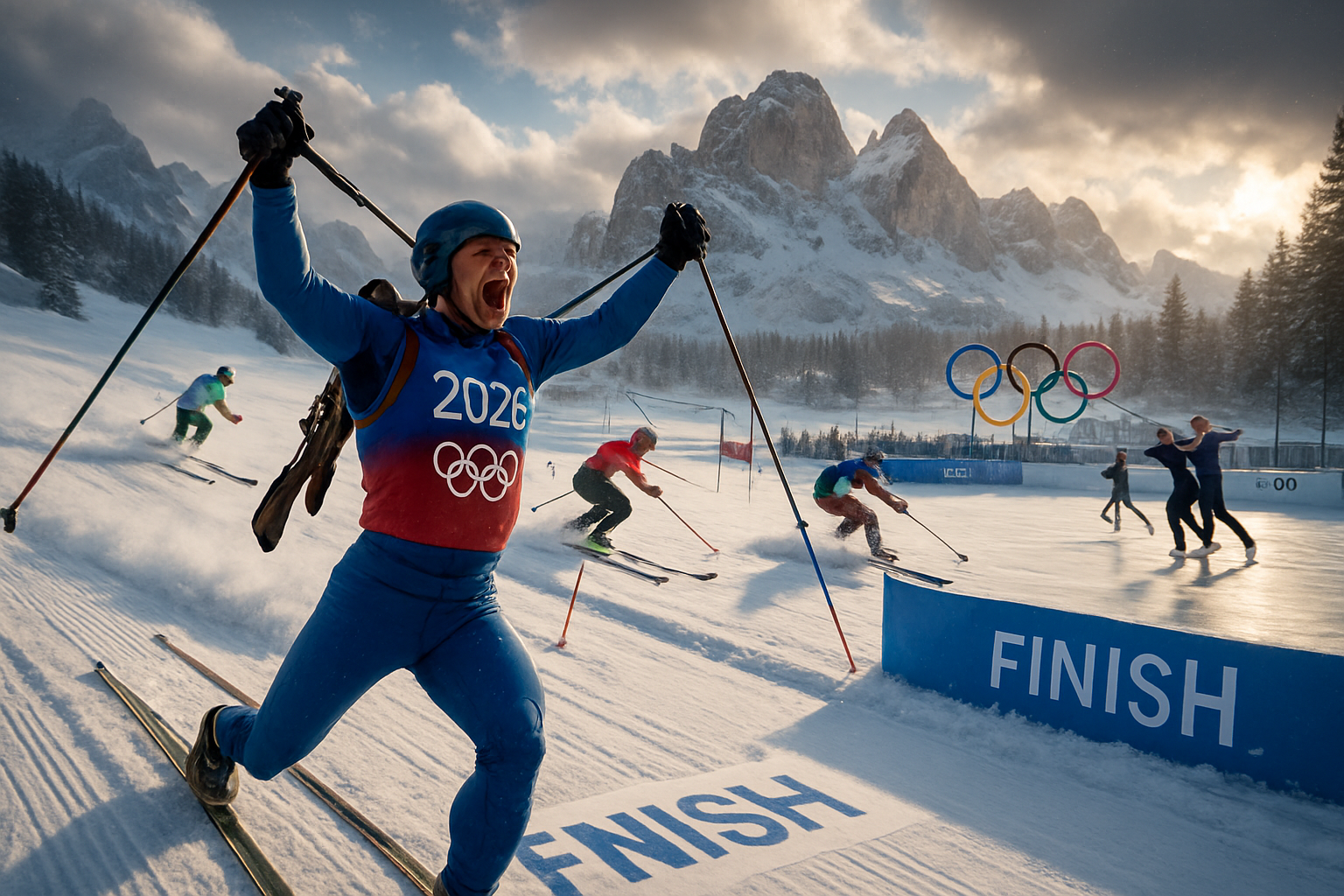
Day 15 of the Milano-Cortina 2026 Winter Olympics delivered spectacular drama across multiple disciplines, with Norway's Johannes Dale-Skjevdal securing biathlon mass start gold while Germany's Daniela Maier triumphed in women's skicross, marking another milestone in these historically competitive Games.
The biathlon mass start proved to be the day's marquee event, with Dale-Skjevdal from Fetsund capturing his first individual Olympic gold medal at age 28. The victory represents Norway's 17th gold medal at these historic Winter Games, setting a new Norwegian Olympic record and reinforcing the Nordic nation's dominance in winter sports.
German Breakthrough in Skicross
Germany's Daniela Maier delivered a commanding performance in women's skicross at Livigno, claiming Olympic gold four years after her bronze medal triumph in Beijing. The 29-year-old's victory adds to Germany's impressive medal haul at Milano-Cortina 2026, demonstrating the depth of German winter sports talent across multiple disciplines.
Switzerland's Fanny Smith captured silver in the skicross event, extending her remarkable Olympic medal streak. The 33-year-old veteran now holds medals from three consecutive Winter Olympics (2018, 2022, and 2026), cementing her status as one of skicross's most consistent performers.
"This victory means everything to me after the disappointment four years ago. The course was perfect today, and I felt in complete control throughout the final."
— Daniela Maier, Olympic Skicross Champion
Australian Olympic Debuts
Australia's Olympic journey continued with notable debuts from Kyra Wheatley in skicross and Reilly Flanagan in aerials. Wheatley, making her Olympic debut after 12 years of dreaming about this moment, reflected on the experience with characteristic optimism despite minor mistakes during her performance.
Flanagan, competing in his first Olympic Games, delivered an impressive showing with a beautiful back double full that earned him a score of 87.57. While missing the final, the Australian acquitted himself well on the Olympic stage, representing the growing strength of Australia's winter sports program.
Australia's emergence as a winter sports power has been one of the defining narratives of Milano-Cortina 2026, with the nation already securing multiple gold medals through Cooper Woods (moguls), Jakara Anthony (dual moguls), and Josie Baff (snowboard cross).
France Approaches Historic Milestone
The French delegation positioned itself to reach the symbolic 20-medal mark, with four male biathletes competing in the mass start event. France has already achieved a record-breaking Winter Olympic performance with 19 podium finishes, placing fourth in the overall medal standings.
The achievement represents France's best Winter Olympic performance in decades, with particular strength in biathlon where French athletes have secured an impressive 10 medals alone. Quentin Fillon Maillet added to this tally by winning bronze in the men's mass start, bringing his career Olympic medal count to nine.
Scandinavian Struggles
The day also highlighted unexpected struggles for traditional winter sports powers. Swedish biathletes faced significant challenges in the men's mass start, with the team recording 18 missed shots total. Martin Ponsiluoma managed seven misses while Sebastian Samuelsson had four, representing a disappointing end to Sweden's biathlon campaign at these Games.
Danish curling also experienced heartbreak as their women's team was eliminated from medal contention. Veteran player Madeleine Dupont made an emotional assessment of their Olympic experience, which included the personal trauma of her mother-in-law suffering a heart attack during the tournament.
Revolutionary Hosting Model Success
The diverse competition venues across Milano-Cortina's revolutionary dual-city hosting model continued to function seamlessly. Spanning over 400 kilometers across seven venues, these Games have proven that geographically dispersed Olympics can maintain the highest competitive standards while embracing environmental sustainability.
The integration of artificial intelligence technology, including Alibaba's Qwen AI system and OMEGA's advanced analysis tools, has enhanced both the competitive experience and broadcast coverage. Cultural innovations such as bilingual Alto Adige/South Tyrol place names and the popular Gen Z mascots Milo and Tina have resonated with global audiences.
Medal Race Intensifies
Norway maintains its commanding lead in the medal standings despite facing unprecedented global competition. Italy continues to leverage its home advantage effectively, while the United States holds third position with strong multi-sport performances.
The Games have demonstrated remarkable winter sports democratization, with breakthrough nations from six continents challenging traditional powerhouses. This global competitiveness has made Milano-Cortina 2026 one of the most democratically competitive Winter Olympics in recent memory.
Looking Ahead
As the Games approach their February 22 conclusion, the competition remains intense across all remaining events. The revolutionary hosting model has established new paradigms for Olympic organization, combining athletic excellence with environmental responsibility and cultural authenticity.
Estonia's continued strong showing with athletes like figure skater Niina Petrõkina advancing in women's competition demonstrates the global reach of these Games. Meanwhile, traditional winter sports nations face their strongest international competition in recent Olympic history.
With 3,000 athletes from 92 countries competing across 116 medal events in 16 sports, Milano-Cortina 2026 continues to showcase the Olympic movement's adaptation to 21st-century realities while preserving core values of international cooperation and athletic excellence.