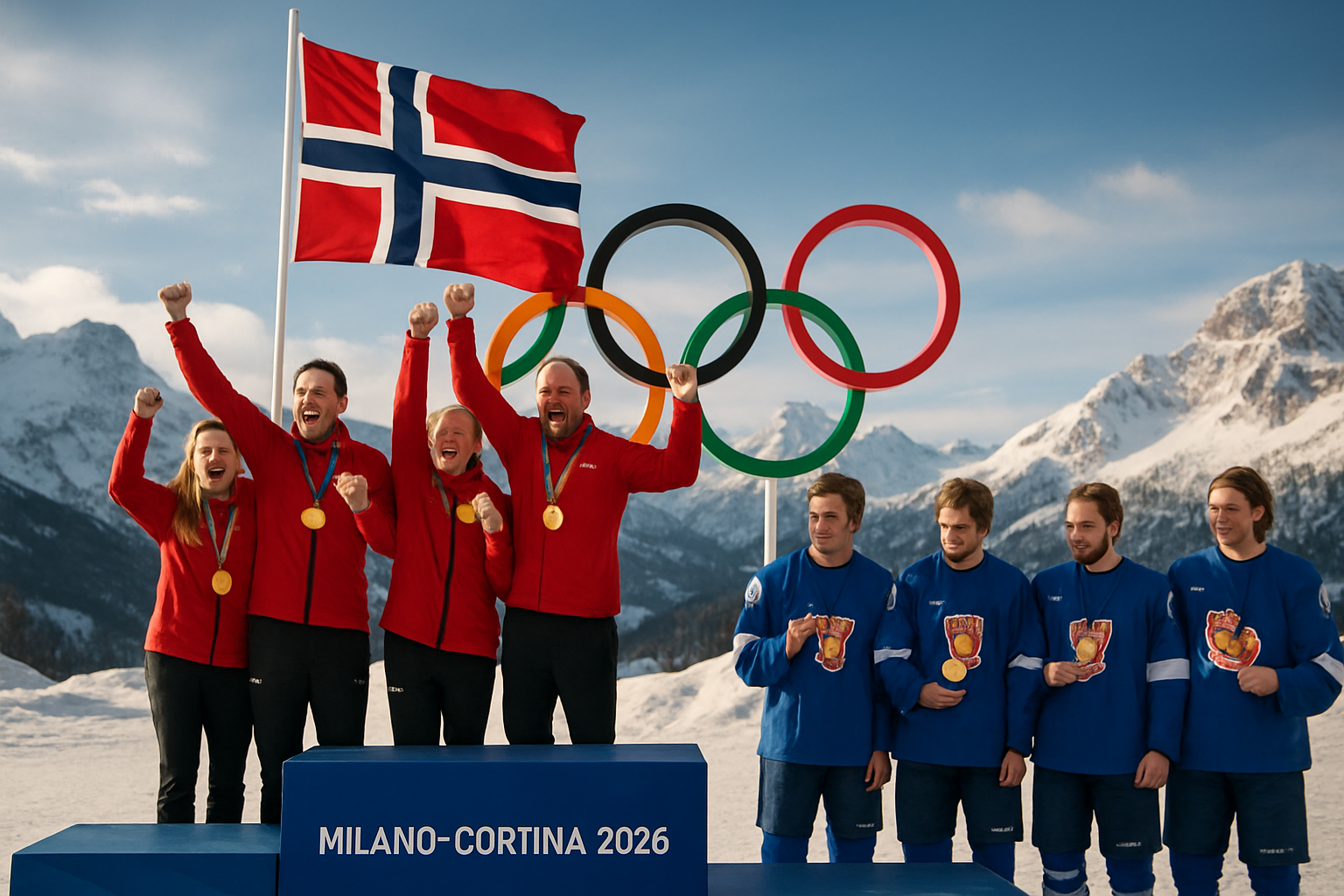
Norway achieved the most dominant Winter Olympics performance in history, capturing a record-breaking 17 gold medals and 33 total medals at the Milano-Cortina 2026 Games, while Canada claimed men's curling gold, Finland secured hockey bronze, and Germany's Laura Nolte defended her bobsled title in the most geographically dispersed Olympics ever held.
The revolutionary dual-city hosting model spanning over 400 kilometers across northern Italy concluded on February 22, 2026, with Johannes Høsflot Klæbo becoming the first athlete in Winter Olympic history to win six gold medals at a single Games. His victory in the men's 50km cross-country mass start classic capped an unprecedented Norwegian dominance that shattered multiple Olympic records.
Norway's Historic Domination
Norway's 17 gold medals surpassed their own previous Winter Olympic record, with Klæbo leading the charge by claiming all six cross-country skiing events he entered. The 29-year-old Norwegian achieved what no Winter Olympian had accomplished before, breaking Eric Heiden's 46-year record of five golds from the 1980 Lake Placid Games.
"Now I feel complete," Klæbo declared after his record-setting performance, having accumulated 11 career Olympic golds to become the most decorated Winter Olympian in history.
— Johannes Høsflot Klæbo, Norwegian Cross-Country Skiing Legend
The Norwegian team completed an all-Norwegian podium sweep in the final men's 50km race, with Martin Löwström Nyenget claiming silver and Emil Iversen bronze, embodying the nation's systematic excellence in Nordic sports.
Canada's Curling Triumph
Canada's men's curling team, led by skip Brad Jacobs, captured Olympic gold with a dramatic 8-7 victory over Great Britain in the final. The victory marked Canada's return to the top of men's curling for the first time since Sochi 2014, with Jacobs claiming his second Olympic gold medal twelve years after his first triumph.
The Canadian team of Jacobs, Marc Kennedy, Brett Gallant, and Ben Hebert overcame early tournament struggles and controversy surrounding "double-touching" allegations to claim their fourth Olympic title in men's curling, more than any other nation in the sport.
The gold medal match proved to be a classic encounter between two curling powerhouses, with Great Britain settling for silver despite being the world champions and Beijing 2022 silver medalists.
Finland Claims Hockey Bronze
Finland's men's ice hockey team captured bronze medals with a commanding 6-1 victory over Slovakia in the third-place playoff at the Milano arena. The comprehensive victory provided redemption for the Finns after their disappointing semifinal loss, marking their fifth Olympic bronze medal in men's hockey.
Sebastian Aho opened the scoring in the eighth minute, and Finland never looked back, outscoring Slovakia 4-0 in the final period to secure a convincing victory. The result represented sweet revenge for Finland, who had lost 1-4 to Slovakia in the group stage of the tournament.
Germany's Bobsled Excellence
Laura Nolte and Debora Levi successfully defended their Olympic title in women's bobsled, becoming only the second pair to accomplish back-to-back victories in the discipline. The German duo dominated the competition at the Cortina track, finishing with a total time of 3:48.46 minutes.
Germany's excellence in bobsled was further demonstrated by their teammates Lisa Buckwitz and Neele Schuten claiming silver, giving Germany a 1-2 finish. The victory extended Germany's remarkable season record of winning 23 out of 24 World Cup medals in bobsled events.
"We rock the two-man bob," Nolte celebrated, emphasizing the technical excellence and pushing power that separated the German sleds from their competitors.
— Laura Nolte, German Bobsled Pilot
Revolutionary Olympic Format
The Milano-Cortina 2026 Games established new paradigms for Olympic hosting, successfully proving that a geographically dispersed model spanning seven venues across 400+ kilometers could maintain competitive excellence while emphasizing environmental sustainability.
The Games featured groundbreaking technological innovations, including the first Olympic integration of AI systems with Alibaba's Qwen AI providing enhanced broadcasting experiences and OMEGA's AI-powered figure skating analysis offering unprecedented insights for judges and viewers.
Cultural authenticity was maintained through bilingual place names in Alto Adige/South Tyrol, sustainable Olympic villages featuring greenhouse spaces, and the popular Gen Z mascots Milo and Tina that resonated globally with younger audiences.
Global Winter Sports Democratization
The Games showcased unprecedented global participation, with breakthrough performances from nations across six continents challenging traditional winter sports powerhouses. Australia achieved their most successful Winter Olympics ever with multiple gold medals, while Kazakhstan's Mikhail Shaidorov delivered one of the biggest upsets in Olympic history with his figure skating gold.
Brazil's Lucas Pinheiro Braathen won South America's first Winter Olympic gold medal in alpine skiing, while historic participations from Saudi Arabia, Caribbean bobsled teams from Jamaica and Trinidad & Tobago, and Latvia's record 68-athlete delegation demonstrated the sport's truly global reach.
France achieved their best Winter Olympic performance in decades with 19 total medals, including a remarkable 10 medals in biathlon alone, highlighting the increasing competitive depth across traditional Nordic disciplines.
Final Medal Standings
Norway's dominance was reflected in the final medal count, with 17 gold, 8 silver, and 8 bronze medals for a total of 33 medals. Italy leveraged home advantage effectively to finish second with 9 gold medals among their 26 total medals, while the United States claimed third place with 24 total medals.
The medal distribution across 92 participating nations demonstrated the most democratically competitive Winter Olympics in history, with breakthrough nations from every continent except Antarctica challenging the established hierarchy of winter sports excellence.
Legacy and Future Impact
The Milano-Cortina 2026 Games established a template for future sustainable Olympic hosting, proving that environmental responsibility and geographic distribution could coexist with athletic excellence and international cooperation values.
The successful dual-city hosting model, combined with AI technology integration and cultural innovations, created new possibilities for climate-adapted Olympic hosting that addressed 21st-century realities while preserving the Olympic spirit.
As the flame was extinguished on February 22, 2026, the Milano-Cortina Games concluded as a watershed moment in Olympic history, combining record-breaking athletic achievements with revolutionary hosting concepts that will influence future mega-events for years to come.