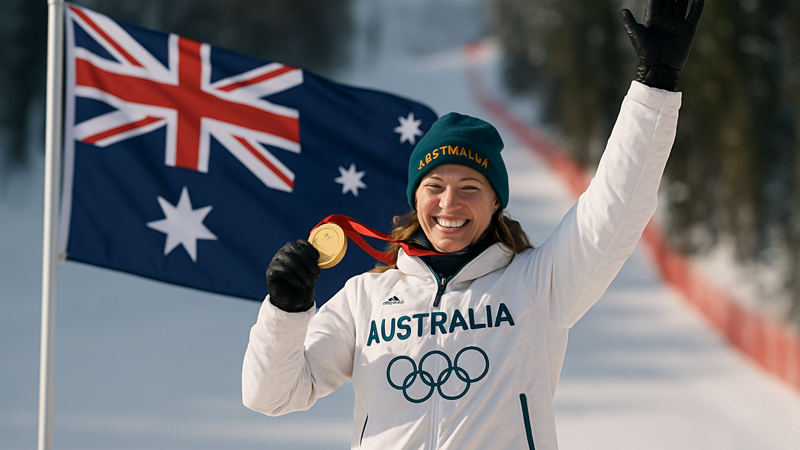
Australia's Jakara Anthony bounced back from devastating disappointment to capture her second Olympic gold medal, leading her nation to unprecedented success at the Milan-Cortina 2026 Winter Olympics, while dramatic upsets and historic breakthroughs continue to reshape the global winter sports landscape.
The 27-year-old moguls specialist demonstrated extraordinary resilience after crashing in the singles event, coming back to dominate the dual moguls competition and cementing Australia's position as an emerging winter sports powerhouse. Anthony's triumph represents just one chapter in what has become Australia's most successful Winter Olympics in history.
Anthony's Remarkable Recovery
Following her "mortifying" crash in the singles moguls, Anthony faced the daunting task of regrouping for the dual moguls event. Her coach Peter McNiel worked tirelessly to restore her confidence after the emotional setback that left the defending Olympic champion devastated.
"I was completely mortified after the singles crash," Anthony reflected after her gold medal victory. "But my team never gave up on me, and this gold medal proves that setbacks can become comebacks."
— Jakara Anthony, Australian Olympic Champion
The victory makes Anthony Australia's first-ever two-time Winter Olympic gold medallist, a milestone that underscores the nation's dramatic emergence in winter sports. Her teammate Scotty James praised her "incredible character" throughout what he described as an "emotional rollercoaster" preparation.
Australia's Historic Winter Olympics Performance
Anthony's success is part of a broader Australian breakthrough at Milan-Cortina 2026. The nation has already secured multiple gold medals, with Cooper Woods claiming victory in men's moguls and Josie Baff stunning the snowboard cross field with her own gold medal performance.
This remarkable run has positioned Australia ahead of traditional winter sports nations in certain medal categories, despite having fewer total medals than some competitors. The achievement represents a fundamental shift in global winter sports participation and competitiveness.
Global Winter Sports Revolution
The Milan-Cortina 2026 Games have witnessed unprecedented global expansion of winter sports excellence. Brazil's Lucas Pinheiro Braathen made history by winning the nation's first-ever Winter Olympic gold medal in alpine skiing, while Kazakhstan's Mikhail Shaidorov delivered one of the biggest upsets in Olympic figure skating history by defeating heavily favored American Ilia Malinin.
The 21-year-old Shaidorov's stunning victory, achieved with 291.58 points, marked Kazakhstan's first-ever Olympic figure skating medal. Meanwhile, Malinin's collapse from overwhelming favorite to eighth place represented one of the most dramatic falls from grace in Olympic competition.
"Maybe I was too confident," admitted Malinin after his devastating performance. "I messed up when it mattered most."
— Ilia Malinin, USA Figure Skater
Traditional Powers Face New Challenges
The Games have demonstrated the increasing democratization of winter sports, with athletes from six continents reaching podium positions. Norway continues to lead the overall medal standings, but faces unprecedented challenges from emerging nations that have invested heavily in winter sports development.
Japan has positioned itself to break its previous Winter Olympic medal record of 18, currently sitting at 15 medals with competition still ongoing. The depth of international competition has created the most competitive Winter Olympics in recent memory.
Revolutionary Hosting Model
Milan-Cortina 2026 represents the most geographically dispersed Winter Olympics in history, spanning over 400 kilometers across seven venues. Despite initial infrastructure challenges, including incomplete cable car systems and power outages, the revolutionary dual-city hosting model has proven successful.
The Games have showcased groundbreaking technology integration, including the first Olympic deployment of AI systems through Alibaba's Qwen platform and OMEGA's AI-powered figure skating analysis. Cultural innovations include bilingual place names in the German-speaking Alto Adige/South Tyrol region and sustainable Olympic villages featuring greenhouse spaces.
Ongoing Controversies and Challenges
The Games have not been without controversy. Ukrainian skeleton racer Vladyslav Heraskevych was banned from competing with a memorial helmet honoring Ukrainian athletes killed in the war, sparking international debate about Olympic neutrality versus political expression. Ukrainian President Volodymyr Zelensky awarded Heraskevych the Order of Freedom in support of his tribute.
Additionally, a medal manufacturing crisis emerged when Olympic medals began literally breaking apart during athlete celebrations, with ribbons detaching and medals cracking when dropped. Italian organizers acknowledged the widespread defect and promised repairs, but the unprecedented quality control failure has threatened to overshadow athletic achievements.
Looking Ahead
As competition continues through February 22, the Milan-Cortina 2026 Olympics have already established new paradigms for Olympic hosting, combining environmental sustainability with geographic distribution while maintaining the highest levels of athletic competition.
The breakthrough performances by athletes like Jakara Anthony, Lucas Pinheiro Braathen, and Mikhail Shaidorov demonstrate that excellence in winter sports now truly knows no geographic boundaries. Their achievements represent not just personal triumphs, but symbols of the global expansion and democratization of Olympic winter sports.
With over a week of competition remaining, these Games continue to deliver the drama, inspiration, and international cooperation that define the Olympic spirit, while establishing new models for sustainable mega-event hosting in the 21st century.