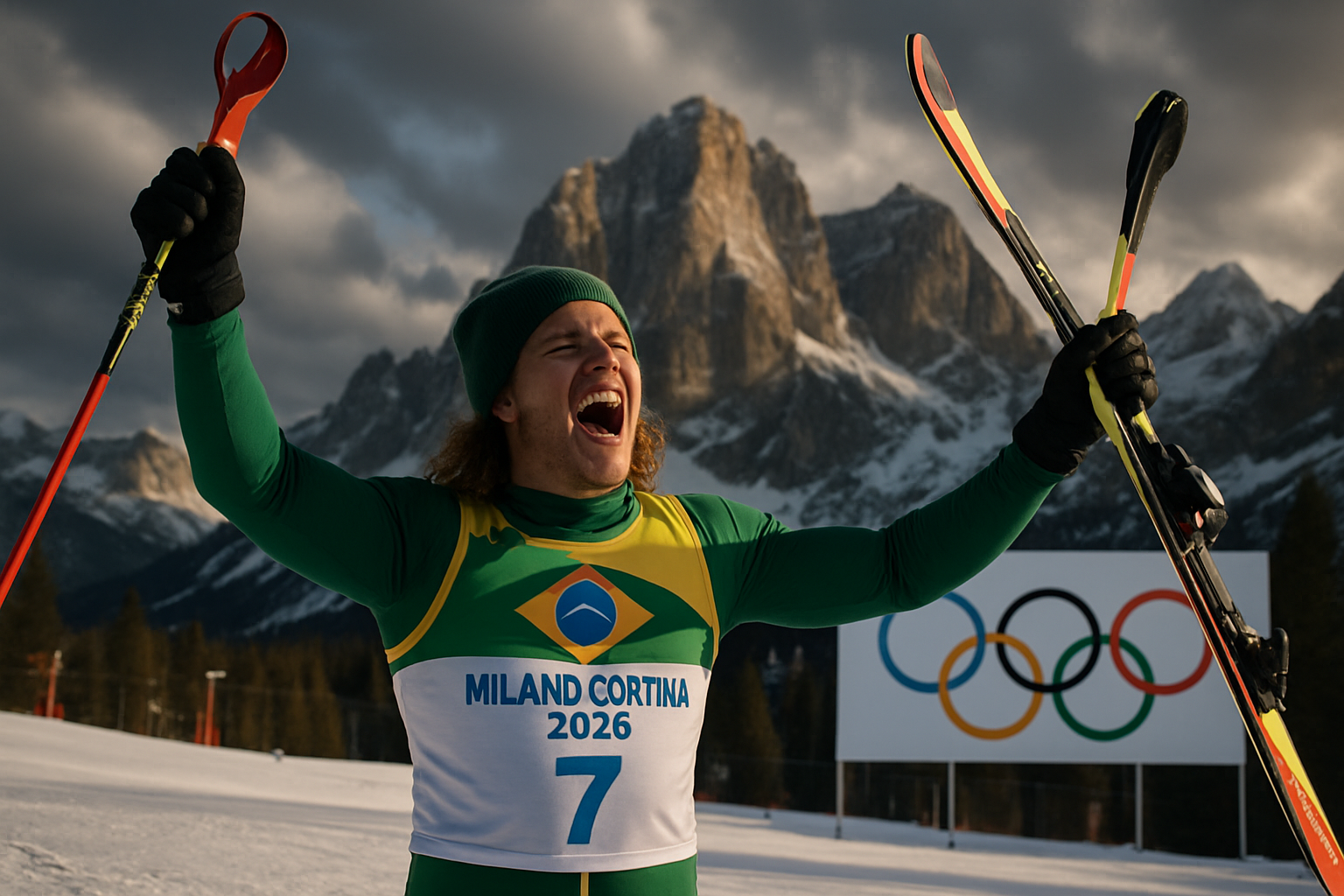
Brazil has achieved its first-ever Winter Olympic gold medal through Lucas Pinheiro Braathen's stunning giant slalom victory, marking a watershed moment at the midpoint of the Milano-Cortina 2026 Games that has redefined global winter sports participation.
The 25-year-old Pinheiro Braathen, who competed for Norway until 2023, delivered a commanding performance on the treacherous Stelvio course in Bormio, finishing with a total time that put him well ahead of the field despite challenging conditions featuring heavy snowfall, fog, and severely reduced visibility in the upper sections of the course.
Historic Brazilian Breakthrough
Pinheiro Braathen's victory represents more than just an individual triumph—it signals the dramatic expansion of winter sports beyond traditional powerhouses. The Norwegian-Brazilian skier's decision to represent his father's homeland has paid dividends in spectacular fashion, delivering Brazil's maiden winter Olympic medal in the most prestigious possible form: gold.
"This means everything to Brazil," Pinheiro Braathen said after his victory. "To bring our first Winter Olympic gold medal home is beyond my wildest dreams."
— Lucas Pinheiro Braathen, Brazilian Alpine Skier
The victory came despite Pinheiro Braathen starting 40th after the first run, showcasing remarkable resilience and technical mastery in the second descent. His triumph has been celebrated across Brazil, with the achievement representing a breakthrough moment for winter sports development in South America.
Australia's Winter Sports Renaissance
Australia continues to shatter expectations at Milano-Cortina 2026, with the nation recording its most successful Winter Olympics in history. Jakara Anthony's emotional victory in dual moguls—capturing Australia's third gold medal—came after what she described as an "emotional rollercoaster" leading up to the Games.
Anthony's redemption story has captivated audiences, with the 26-year-old bouncing back from earlier disappointment to claim Australia's first-ever Olympic dual moguls gold medal in what was the inaugural Olympic competition in the discipline. Her teammate Scotty James praised Anthony's "incredible character" after witnessing her transformation from tears to triumph.
The Australian success story extends beyond individual achievements, representing a fundamental shift in global winter sports participation. With multiple medal prospects still in contention, Australia is positioned to surpass several traditional winter sports nations in the final medal tally.
Unprecedented Geographic Challenges
The Milano-Cortina 2026 Games continue to prove that revolutionary hosting models can work, despite being the most geographically dispersed Winter Olympics in history. Spanning over 400 kilometers across seven venues from Milan to Cortina d'Ampezzo, the Games have successfully maintained competitive excellence while implementing sustainable practices.
Competition has proceeded smoothly across alpine venues despite infrastructure challenges including the incomplete Apollonio-Socrepes cable car system that has forced school closures in Cortina. The harsh European winter, with temperatures reaching -30°C, has created ideal natural snow conditions while presenting logistical complications.
Kazakhstan's Figure Skating Sensation
In one of the Games' most shocking upsets, Kazakhstan's Mikhail Shaidorov won the men's figure skating gold medal, delivering his country's first-ever Olympic figure skating medal. The 21-year-old's victory came at the expense of heavily favored American Ilia Malinin, who suffered a devastating collapse to finish eighth despite entering as the reigning world champion.
Shaidorov's triumph represents another example of winter sports democratization, with athletes from non-traditional powerhouses breaking through at the highest level. His flawless free skate performance under Olympic pressure demonstrated the depth and unpredictability of modern figure skating competition.
Controversy and Politics
The Games have not been without controversy, particularly surrounding Ukrainian skeleton racer Vladyslav Heraskevych's banned memorial helmet honoring Ukrainian athletes killed in Russia's war. The International Olympic Committee's decision to prohibit the helmet under Rule 50 has sparked international debate about Olympic neutrality versus war remembrance.
Despite a lengthy Court of Arbitration for Sport hearing, Heraskevych was unable to compete with his memorial tribute, leading to criticism from Ukrainian President Volodymyr Zelensky and international observers questioning the boundaries of athlete expression during wartime.
Technology and Innovation
Milano-Cortina 2026 has pioneered Olympic technology integration with Alibaba Cloud's Qwen AI system providing the first Olympic Large Language Model implementation. The AI-powered broadcasting and spectator services represent a significant technological leap, while OMEGA's AI-enhanced figure skating analysis offers unprecedented insights into athletic performance.
Cultural innovations have enhanced the Olympic experience, including bilingual place names in Alto Adige/South Tyrol for the German-speaking population and the introduction of "Gen Z" mascots Milo and Tina. Sustainable Olympic villages featuring greenhouse spaces demonstrate environmental responsibility alongside competitive excellence.
Medal Race Dynamics
Norway maintains its traditional position atop the medal standings despite facing unexpected challenges from emerging winter sports nations. The Nordic powerhouse continues to dominate cross-country skiing and biathlon, with Johannes Høsflot Klæbo approaching all-time Winter Olympic gold medal records.
However, the global competitiveness has never been higher, with breakthrough performances from countries across six continents. Italy has leveraged home advantage effectively, while Germany, Sweden, and the United States continue to battle for podium positions across multiple disciplines.
Looking Toward the Finish
With competition continuing through February 22, Milano-Cortina 2026 has already established itself as a transformative Olympics that has redefined what Winter Games hosting can achieve. The successful implementation of dual-city hosting across such geographic distances provides a template for future sustainable Olympic events while maintaining the highest competitive standards.
The human stories emerging from these Games—from Pinheiro Braathen's historic Brazilian gold to Anthony's emotional Australian triumph—exemplify the Olympic spirit's power to inspire and unite across cultural boundaries. As winter sports continue their global expansion, Milano-Cortina 2026 represents a watershed moment demonstrating that Olympic dreams truly have no geographic limits.
The Games have successfully balanced athletic excellence with environmental responsibility, technological innovation with cultural authenticity, and international cooperation with individual achievement. As the second week of competition unfolds, Milano-Cortina 2026 continues to write Olympic history while establishing new paradigms for future Winter Games.