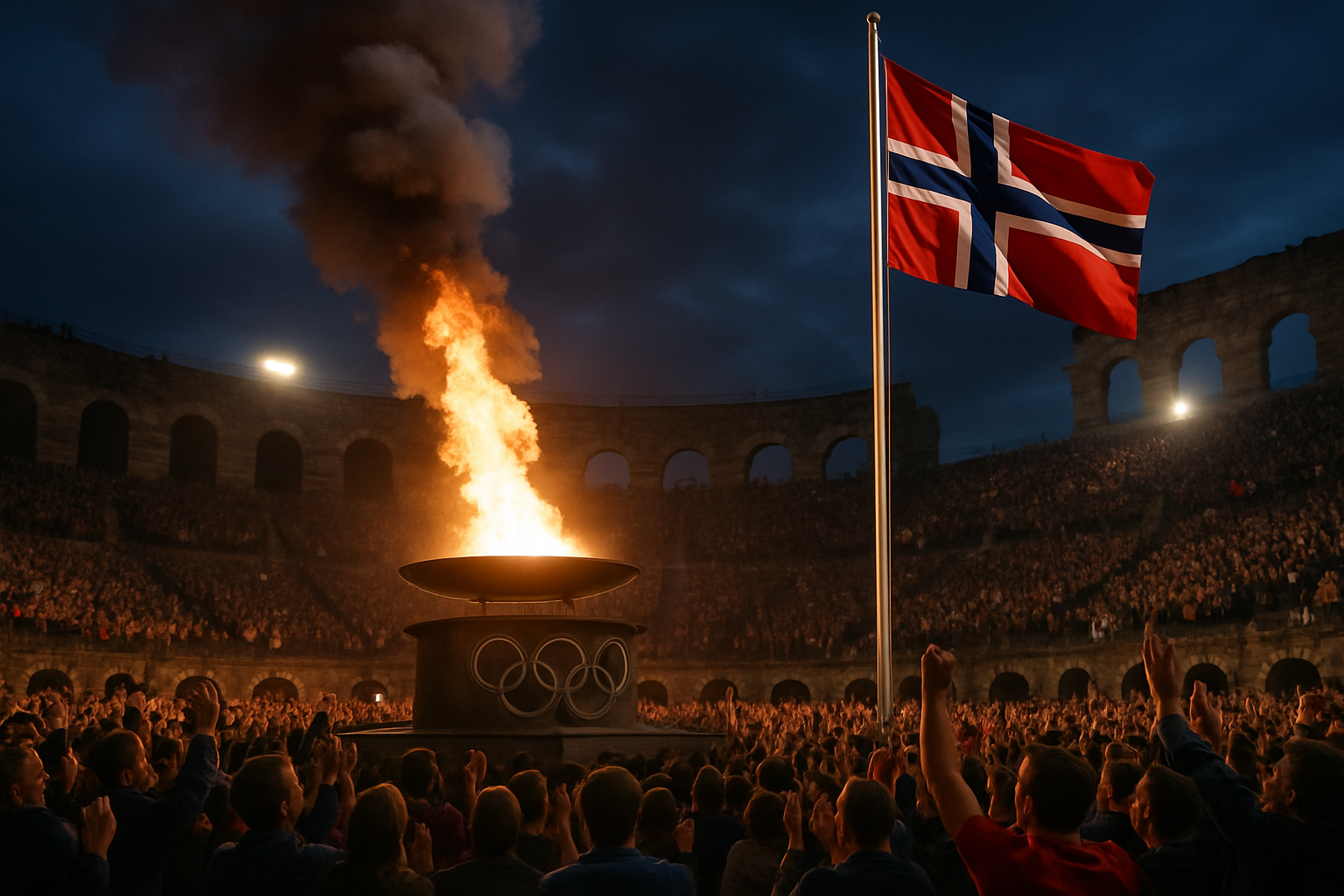
The 2026 Winter Olympics in Milan-Cortina concluded on February 22 with Norway achieving unprecedented dominance, capturing a record-breaking 18 gold medals and 41 total medals in what became the most geographically dispersed and globally competitive Winter Games in Olympic history.
The historic closing ceremony at the 2,000-year-old Arena di Verona brought to an end 17 days of competition that redefined Olympic hosting and witnessed extraordinary athletic achievements across northern Italy's spectacular Alpine venues.
Norwegian Dominance Reaches New Heights
Norway's performance at Milan-Cortina 2026 shattered multiple Winter Olympic records. The Scandinavian nation's 18 gold medals surpassed their previous best of 16 set at Lillehammer 1994, while their total of 41 medals (18 gold, 12 silver, 11 bronze) eclipsed the previous Winter Olympic record of 39 set by Germany in 2018.
The undisputed star of Norway's campaign was cross-country skiing legend Johannes Høsflot Klæbo, who rewrote the record books by capturing all six available cross-country gold medals. His historic achievement of six golds at a single Olympics broke Eric Heiden's 46-year-old record of five, while his career total of 11 Olympic golds established him as the most decorated Winter Olympian in history.
"This feels like a dream. To win all six cross-country events at one Olympics and break records that have stood for decades – it's beyond what I imagined possible."
— Johannes Høsflot Klæbo, Norway
Revolutionary Dual-City Hosting Model
The Milan-Cortina Games proved that sustainable, geographically distributed hosting could maintain the highest competitive standards while reducing environmental impact. Spanning over 400 kilometers across seven venues from Milan to Cortina d'Ampezzo, the Games demonstrated a new paradigm for Olympic hosting.
The revolutionary format successfully integrated technology innovations, including the first-ever Olympic deployment of AI systems. Alibaba's Qwen AI enhanced broadcasting and spectator services, while OMEGA's AI-powered figure skating analysis provided unprecedented insights into athletic performance.
Cultural authenticity remained paramount throughout, with bilingual place names in the Alto Adige/South Tyrol region, sustainable Olympic villages featuring greenhouse spaces, and the popular Gen Z mascots Milo and Tina resonating with global audiences.
Global Winter Sports Revolution
The 2026 Games witnessed an unprecedented democratization of winter sports, with breakthrough performances from nations across six continents challenging traditional powerhouse dominance.
Australia achieved its most successful Winter Olympics ever, with multiple golds including Cooper Woods (men's moguls), Jakara Anthony (dual moguls), and Josie Baff (snowboard cross). The nation's emergence as a winter sports power represented a fundamental shift in global winter sports demographics.
Historic firsts marked the Games at every turn. Brazil claimed its inaugural Winter Olympic gold through Lucas Pinheiro Braathen's alpine skiing triumph, while Kazakhstan celebrated its first figure skating medal courtesy of Mikhail Shaidorov's stunning upset victory over heavily favored American Ilia Malinin.
Saudi Arabia made its Winter Olympic debut with alpine skier Fayik Abdi and cross-country specialist Rakan Aliriza, while Caribbean nations Jamaica and Trinidad & Tobago competed in bobsled for the first time. Latvia sent a record-breaking delegation of 68 athletes, demonstrating the sport's truly global reach.
Final Medal Standings
The final medal table reflected the most competitive Winter Olympics in recent memory:
- Norway: 18 gold, 12 silver, 11 bronze (41 total)
- United States: 8 gold, 16 total medals
- Netherlands: 7 gold, 20 total medals
- Italy: 6 gold, 26 total medals (host nation)
- Germany: 5 gold, 18 total medals
The Netherlands achieved remarkable success in speed skating, with their "gold rush" producing 7 golds from the Milan speed skating oval. Italy, buoyed by passionate home support, exceeded expectations with 26 total medals including emotional victories like Federica Brignone's alpine skiing gold at age 35.
Technological and Environmental Innovations
The Games established new standards for sustainable Olympic hosting. Europe's harshest winter in decades provided ideal natural snow conditions, reducing reliance on artificial snow production and demonstrating how climate can work in harmony with Olympic competition.
The successful integration of artificial intelligence marked a watershed moment for Olympic broadcasting and analysis. Spectators experienced enhanced coverage through AI-powered insights, while athletes benefited from unprecedented performance analysis, particularly in technically demanding sports like figure skating.
Memorable Moments and Human Stories
Beyond the medal counts, Milan-Cortina 2026 will be remembered for compelling human narratives that embodied the Olympic spirit. Lindsey Vonn's tragic crash while attempting a comeback at age 41 reminded audiences of the courage inherent in elite winter sports.
The Games also witnessed controversy, particularly surrounding Ukrainian skeleton athlete Vladyslav Heraskevych, who was banned from competing with a memorial helmet honoring Ukrainian athletes killed in war. The incident sparked international debate about Olympic neutrality versus political expression.
Technical challenges, including a medal manufacturing crisis that saw ribbons detaching and medals cracking during celebrations, provided unexpected drama but demonstrated the organizers' ability to adapt and resolve issues quickly.
Hockey Drama Caps Games
The men's ice hockey tournament provided a fitting climax to the Games, with the United States defeating Canada in a thrilling final that marked the NHL's successful return to Olympic competition. The tournament showcased the global growth of hockey, with competitive performances from nations across Europe and Asia.
Legacy and Future Impact
As the Olympic flame was extinguished at Arena di Verona, Milan-Cortina 2026 left an indelible mark on Olympic history. The Games proved that winter sports excellence transcends geographic boundaries and that sustainable hosting can coexist with world-class competition.
The revolutionary dual-city model, spanning the Italian Alps from Milan's urban sophistication to Cortina's mountain majesty, established a template for future Olympic hosting that balances environmental responsibility with athletic excellence.
France achieved its best-ever Winter Olympic performance with 19 medals, while emerging nations demonstrated that winter sports dreams have no geographic limits. The 92 participating countries represented the most diverse Winter Olympic field in history.
"These Games have shown that the Olympic movement can adapt and evolve while maintaining its core values of excellence, friendship, and respect. Milan-Cortina 2026 will be remembered as a watershed moment for winter sports."
— IOC President Kirsty Coventry
As athletes, officials, and spectators departed from northern Italy, they carried with them memories of a truly revolutionary Olympic experience. The 2026 Winter Olympics proved that innovation, sustainability, and athletic excellence can coexist, setting new standards for future Olympic Games while celebrating the timeless beauty of winter sports competition in one of the world's most spectacular mountain settings.