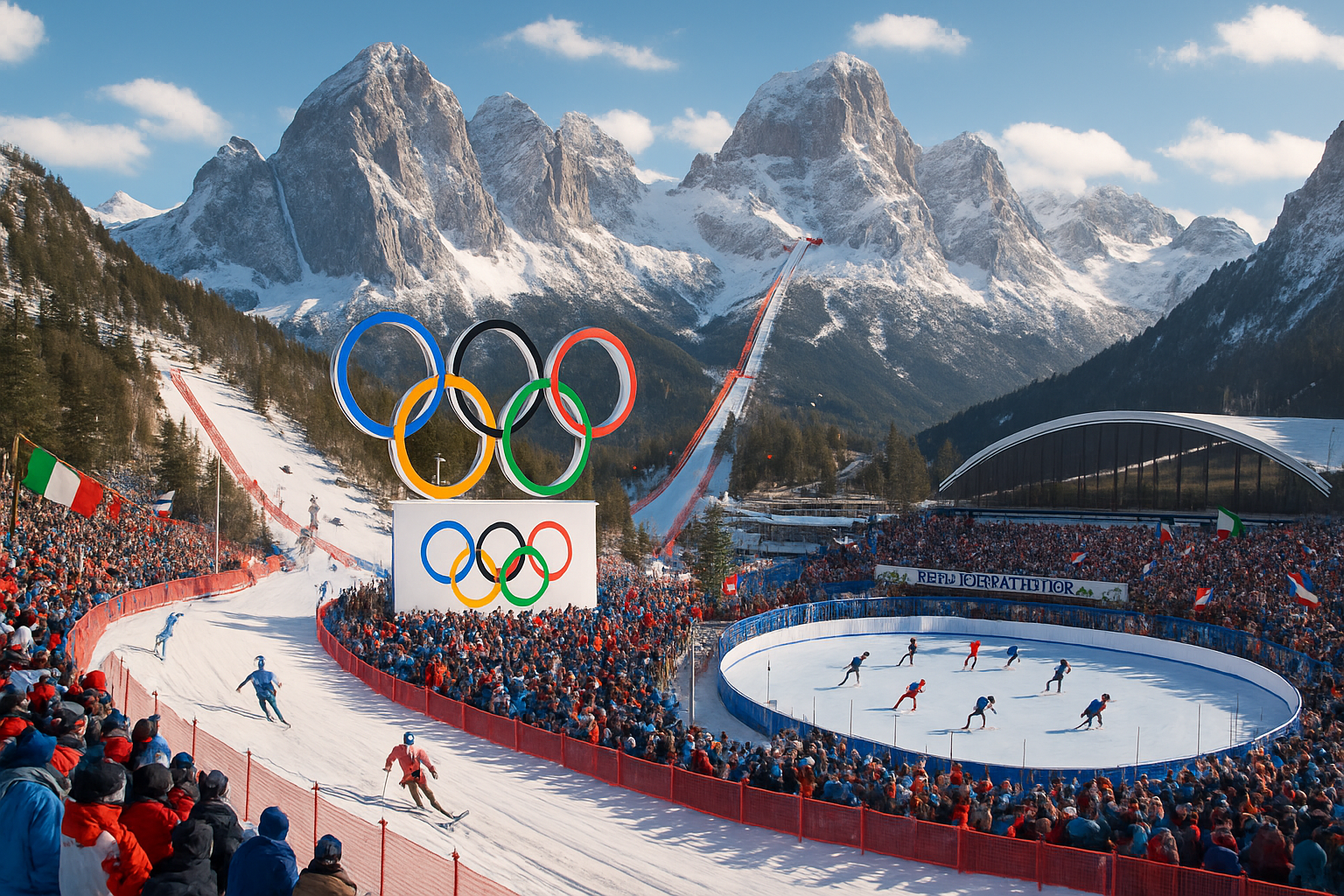
Italian alpine skiing legends Federica Brignone and Sofia Goggia are poised to deliver another dramatic chapter in the Milano-Cortina 2026 Winter Olympics as they chase giant slalom glory on home soil, while the Games continue to produce stunning upsets and historic breakthroughs across the most geographically dispersed Olympic venues in history.
The February 15 giant slalom competition represents a pivotal moment for Italian winter sports, with both athletes carrying the hopes of a nation that has already witnessed remarkable home victories throughout these revolutionary Games. Brignone, 35, recently became the oldest alpine skiing Olympic champion in history with her emotional Super-G gold at Cortina just days ago, competing 10 months after suffering a complete leg fracture.
Historic Breakthroughs Define Milano-Cortina 2026
The 2026 Winter Olympics have already established themselves as the most globally competitive in recent memory, with breakthrough performances reshaping the winter sports landscape. Australia's unprecedented success has captured worldwide attention, led by Jakara Anthony's remarkable comeback to win dual moguls gold after a devastating singles crash, becoming Australia's first-ever two-time Winter Olympic gold medallist.
"This has been an emotional rollercoaster, but Jakara has incredible character,"
— Scotty James, Australian Winter Olympian
The Australian breakthrough extends across multiple disciplines, with Cooper Woods claiming men's moguls gold and Josie Baff securing snowboard cross victory. This success has positioned Australia ahead of traditional winter powerhouses Canada and China in several medal categories, representing a fundamental shift in global winter sports demographics.
Global Winter Sports Revolution
Perhaps the most stunning upset came in men's figure skating, where Kazakhstan's Mikhail Shaidorov, 21, delivered a masterful performance scoring 291.58 points to claim his nation's first-ever Olympic figure skating medal. The victory came at the expense of overwhelming favorite Ilia Malinin of the United States, who suffered a devastating collapse to eighth place despite being the undefeated world champion since 2023.
Brazil's Lucas Pinheiro Braathen made history by winning the nation's first Winter Olympic gold medal in alpine skiing, securing victory in the men's giant slalom despite challenging conditions including heavy snowfall and reduced visibility at the Stelvio course in Bormio. The triumph marked South America's inaugural Winter Olympic gold medal, triggering celebrations described as "Carnival in Italian snow."
Lindsey Vonn's Tragic End and Medical Updates
The Games have also witnessed heartbreak, most notably with American skiing legend Lindsey Vonn's comeback attempt ending in a devastating crash during the women's downhill at Cortina's Tofana course. Racing with start number 13 just nine days after a complete ACL rupture, the 41-year-old champion lost control 13 seconds into her run after clipping a gate.
Following helicopter evacuation, Vonn underwent her latest surgery for a broken left tibia, with medical teams reporting steady progress in her recovery. The incident highlighted both the extraordinary courage of elite athletes and the inherent risks of Olympic competition at the highest level.
Revolutionary Hosting Model Proves Successful
Milano-Cortina 2026 has demonstrated the viability of sustainable, geographically dispersed Olympic hosting across seven venues spanning more than 400 kilometers. The revolutionary dual-city model has successfully maintained competitive excellence while addressing 21st-century environmental concerns and infrastructure realities.
Technology innovations have enhanced the Olympic experience, with Alibaba's Qwen AI system marking the first Olympic integration of Large Language Model technology for broadcasting and spectator services. OMEGA's AI-powered figure skating analysis has provided unprecedented insights into athletic performance, setting new standards for sports technology integration.
Cultural Innovation and Global Participation
The Games have showcased remarkable cultural innovations, including bilingual place names in the Alto Adige/South Tyrol region to accommodate the German-speaking population, and the introduction of Milo and Tina, dubbed the first "Gen Z" Olympic mascots. Sustainable Olympic villages featuring greenhouse spaces demonstrate environmental responsibility while maintaining athlete comfort.
Historic participations continue to expand winter sports globally, with Saudi Arabia making its Winter Olympic debut through alpine skier Fayik Abdi and cross-country competitor Rakan Aliriza. Caribbean nations Jamaica and Trinidad & Tobago have fielded their first Olympic bobsled teams, while Latvia has sent its largest-ever delegation of 68 athletes, achieving remarkable success including Roberts Krūzbergs' historic short track bronze medal.
Medal Race Intensifies
Norway maintains its traditional position atop the medal standings but faces unprecedented global competition. The democratization of winter sports has produced breakthrough performances across six continents, with emerging nations challenging established powerhouses in disciplines once dominated by Northern European countries.
Italy's strong home performance, boosted by victories from Federica Brignone and other local heroes, has positioned the host nation prominently in the medal race. The emotional significance of competing on home soil, with venues like Cortina's historic Tofana course providing stunning backdrops, has inspired Italian athletes to career-defining performances.
Ongoing Controversies and Resolutions
The Games have not been without controversy, particularly surrounding Ukrainian skeleton athlete Vladyslav Heraskevych's ban from wearing a memorial helmet honoring fallen Ukrainian athletes. The Court of Arbitration for Sport upheld the IOC's decision under Rule 50, which prohibits political demonstrations, despite support from Ukrainian President Volodymyr Zelensky, who awarded Heraskevych the Order of Freedom.
A separate quality control issue has emerged with Olympic medals physically breaking apart during celebrations, with ribbons detaching and medals cracking when dropped. Italian organizers have acknowledged the manufacturing defect and initiated repairs, though the unprecedented failure has overshadowed some athletic achievements.
Looking Ahead
As competition continues through February 22, Milano-Cortina 2026 has already established new paradigms for Olympic hosting, combining traditional athletic excellence with environmental sustainability, technological innovation, and cultural authenticity. The Games demonstrate that Olympic dreams transcend geographic boundaries, with winter sports no longer the exclusive domain of traditionally snow-covered nations.
The February 15 giant slalom competition featuring Brignone and Goggia represents more than a medal opportunity—it symbolizes the culmination of Italy's Olympic journey, hosting the Games across the spectacular Dolomites while showcasing the enduring power of sport to unite, inspire, and create lasting memories.
With over 3,000 athletes from 92 countries competing across 116 medal events in 16 sports, Milano-Cortina 2026 continues to demonstrate that the Olympic movement can successfully adapt to contemporary realities while preserving the fundamental values of international cooperation, athletic excellence, and human achievement that define the world's greatest sporting celebration.