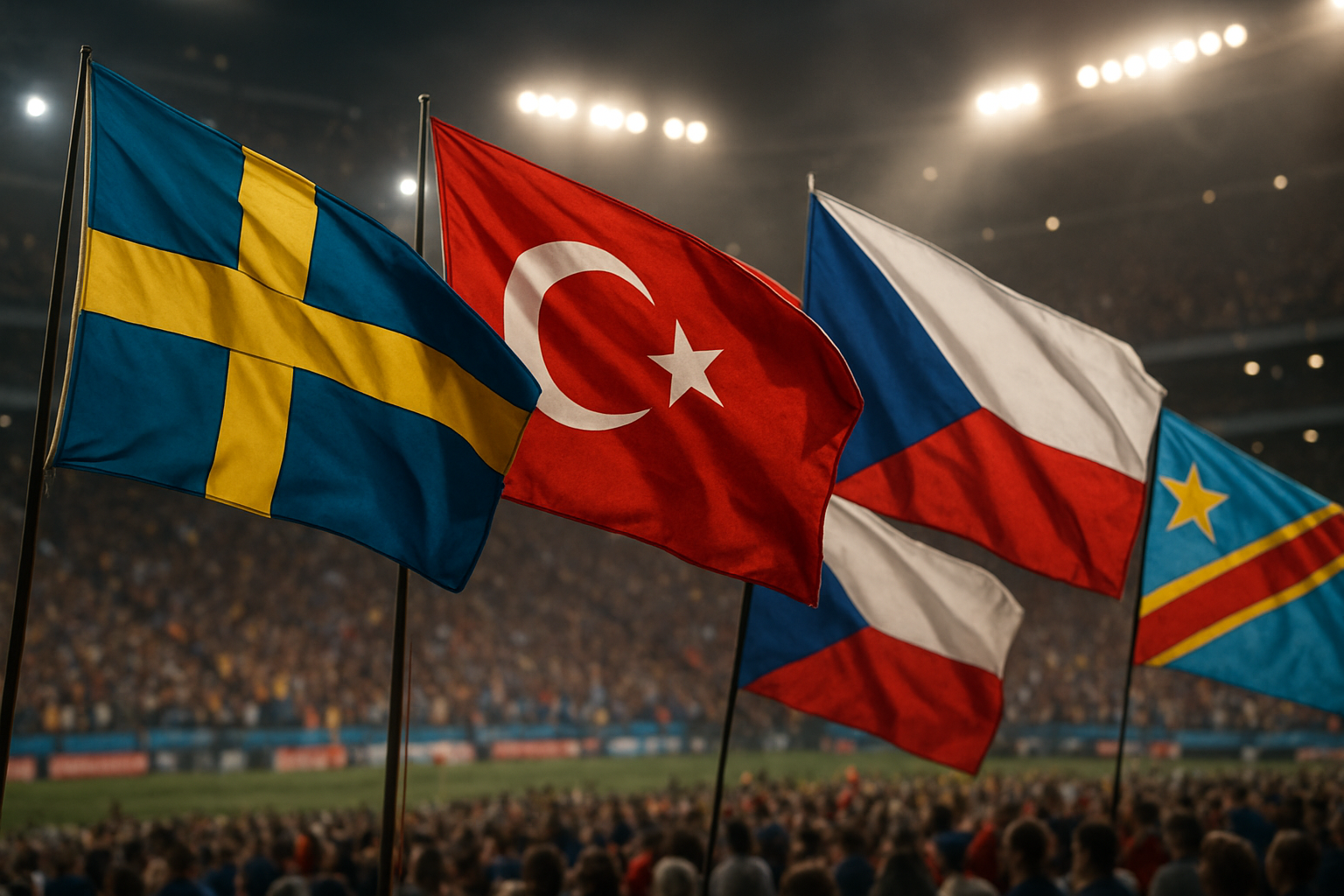
The final pieces of the 2026 FIFA World Cup puzzle fell into place on March 31st, as Sweden, Turkey, Czech Republic, and the Democratic Republic of Congo secured their places in the expanded 48-team tournament through dramatic playoff victories that ended years and decades of World Cup heartbreak.
The culmination of an intense qualification campaign saw nations across multiple continents achieve breakthrough moments, with Sweden ending their World Cup drought, Turkey returning after 24 years, Czech Republic qualifying for the first time in two decades, and DR Congo making history with their second-ever World Cup appearance.
Sweden's Dramatic Return
Viktor Gyökeres emerged as Sweden's hero, scoring a late winner in their 3-2 victory over Poland in Stockholm to send the Nordic nation to their first World Cup since 2018. The Arsenal striker's decisive 88th-minute goal capped off a remarkable turnaround for Swedish football under coach Graham Potter.
"It's completely insane what Viktor has achieved this season. This performance was world class."
— Graham Potter, Sweden Coach
Sweden's qualification represents a dramatic transformation from a team that struggled through regular qualification. Their relegation to Nations League C-division proved to be a blessing in disguise, providing an alternative pathway to the World Cup through the playoff system.
The victory was particularly sweet for Swedish fans who had endured disappointment in previous tournaments. The team's resurgence under Potter, who took over during a difficult campaign, showcased the impact of tactical innovation and player development in modern international football.
Turkey Ends 24-Year Wait
Turkey's 1-0 victory over Kosovo in Pristina marked the end of a painful 24-year absence from football's biggest stage. Kerem Akturkoglu's 53rd-minute goal was enough to secure qualification for the 2026 World Cup, sending Turkish fans into raptures across the country.
The victory was orchestrated by coach Vincenzo Montella, who successfully blended emerging talents with experienced internationals to create a team capable of ending Turkey's World Cup drought. For Kosovo, the defeat represented a missed opportunity to reach their first-ever major tournament, less than a decade after joining FIFA and UEFA.
Turkey's qualification holds particular significance as they return to a tournament where they achieved remarkable success in 2002, reaching the semi-finals on home soil. The 2026 campaign offers a chance to recreate those magical moments on the world stage.
Czech Republic's Penalty Triumph
In one of the most dramatic matches of the playoff finals, Czech Republic defeated Denmark 2-2 (3-1 on penalties) in Prague to secure their place at the 2026 World Cup. The match showcased the tension and drama that makes World Cup qualification so compelling.
After a 2-2 draw following extra time, the Czechs held their nerve in the penalty shootout, with Michal Sadílek converting the decisive spot-kick. For Czech Republic, it marked their return to the World Cup after a 20-year absence, having last appeared in 2006.
Denmark's defeat was particularly heartbreaking, as they had been among the favorites to qualify after their impressive Euro 2021 semi-final run. The penalty shootout proved cruel for the Danes, with only Christian Eriksen successfully converting his spot-kick among Danish penalty takers.
DR Congo's Historic Achievement
Perhaps the most emotional story of the qualification campaign belonged to the Democratic Republic of Congo, who defeated Jamaica 1-0 in extra time at Guadalajara's Estadio Jalisco to secure their first World Cup appearance since 1974.
Axel Tuanzebe's 100th-minute header from a corner kick sparked massive celebrations across the African nation. The former Manchester United defender's goal ended a 52-year wait for Les Léopards, who had competed as Zaire in their only previous World Cup appearance.
"The Leopards of DR Congo will play the 2026 World Cup after 52 years of absence. A goal achieved through pain and determination."
— Radio Okapi Report
The qualification was made even more special by the presence of President Félix Tshisekedi, who had personally galvanized the team with a flag ceremony to captain Chancel Mbemba before the playoff campaign.
Tournament Groups Confirmed
The successful qualifiers will join an expanded 48-team field when the 2026 World Cup begins on June 11th at Mexico City's iconic Estadio Azteca. The tournament, jointly hosted by the United States, Canada, and Mexico, will conclude on July 19th at the New York New Jersey Stadium.
DR Congo has been placed in Group K alongside football giants Portugal, Colombia, and Uzbekistan. Their opening match against Portugal on June 17th at Houston's NGR Stadium will mark a historic moment for African football.
Czech Republic finds themselves in an intriguing group with South Africa, South Korea, and co-hosts Mexico, while Turkey will compete in Group D with the United States, Paraguay, and Australia.
The Road to North America
The qualification campaigns highlighted the increased competitiveness of international football, with traditional powerhouses no longer guaranteed their place at major tournaments. The expanded 48-team format has created more opportunities for breakthrough nations while maintaining the intensity and drama of qualification.
Sweden's journey through the Nations League playoff route demonstrated the multiple pathways now available to reach the World Cup. Similarly, the intercontinental playoffs provided DR Congo and other nations with additional opportunities to secure their place on football's biggest stage.
The 2026 World Cup represents a watershed moment for the global game, with the tournament's expansion coinciding with significant improvements in football infrastructure and development programs worldwide. Nations like Czech Republic and Turkey have invested heavily in youth development and coaching education, investments that are now paying dividends on the international stage.
Looking Ahead
As the final qualifiers celebrate their achievements, attention turns to the tournament preparations across the three host nations. The 2026 World Cup will feature 104 matches across 16 cities, representing the largest and most ambitious World Cup in history.
For Sweden, Turkey, Czech Republic, and DR Congo, the qualification represents just the beginning of their World Cup journey. Each nation will enter the tournament with different expectations but united in their determination to make their mark on football's grandest stage.
The success of these qualification campaigns serves as a testament to the beautiful game's ability to inspire hope and unite nations in pursuit of shared dreams. As the countdown to June 11th begins, football fans worldwide can look forward to witnessing these remarkable qualification stories unfold on the world's biggest sporting stage.