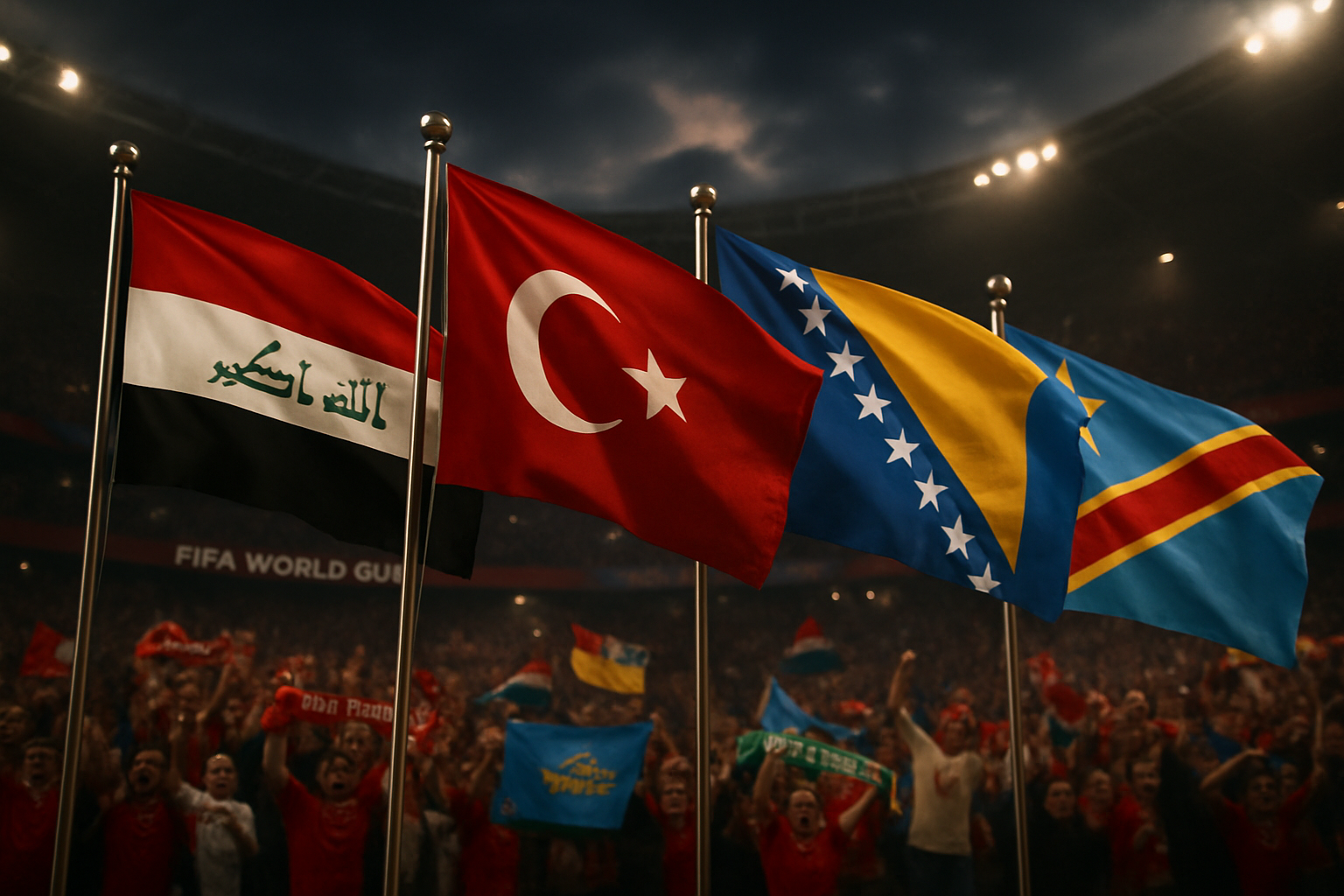
The final pieces of the 2026 FIFA World Cup puzzle fell into place on April 1, 2026, as Iraq secured their first World Cup appearance in 40 years, Turkey ended a 24-year drought, and Bosnia-Herzegovina shocked Italy in a dramatic penalty shootout that completed the expanded 48-team tournament field.
In what will be remembered as one of the most emotionally charged nights in World Cup qualification history, multiple nations achieved breakthrough moments while former champions were left to wonder what might have been. The results not only determined the final participants for the North American tournament but also highlighted the democratization of global football.
Iraq's Emotional Return to Football's Biggest Stage
At the Estadio BBVA in Monterrey, Mexico, Iraq's 2-1 victory over Bolivia marked the culmination of a remarkable journey that began with their last World Cup appearance in 1986. Goals from Ali Al-Hamadi and Aymen Hussein secured a famous win for the Lions of Mesopotamia, whose preparations had been severely disrupted by ongoing conflict in the Middle East.
"With everything going on in the Middle East at the moment it made it harder for the players. Delighted for the players, very good boys, very happy for the 46 million Iraqis."
— Graham Arnold, Iraq Head Coach
Coach Graham Arnold, the Australian tactician who had initially sought to have the fixture postponed due to regional disruption, challenged his players to "shock the world" - a mission they accomplished with characteristic resilience. The victory was particularly poignant given that Iraqi football had endured decades of instability, with the team unable to play home matches in their country for extended periods.
In Baghdad and cities across Iraq, celebrations erupted as fans who had waited four decades finally witnessed their national team's return to football's premier tournament. The qualification carries symbolic weight beyond sport, representing hope and unity for a nation that has faced immense challenges.
Turkey's Long-Awaited Comeback
Turkey's 1-0 victory over Kosovo brought to an end their 24-year absence from World Cup football, their last appearance coming at the 2002 tournament in South Korea and Japan where they finished third. The victory was particularly sweet for Turkish fans who had endured heartbreak in previous qualification campaigns.
The Turkish national team's return represents more than just athletic achievement. Football had become symbolic of the country's broader aspirations and resilience in recent years, with the national team finally able to play home matches regularly after years of instability.
Celebrations in Turkish communities worldwide, including a notable gathering in Berlin captured by media, reflected the global reach of Turkish football passion and the emotional investment in this long-awaited return to the world stage.
Bosnia's Penalty Heroics Stun Italy
Perhaps the most shocking result of the night came at Zenica's Bilino Polje Stadium, where Bosnia-Herzegovina defeated four-time World Cup winners Italy 4-1 in a penalty shootout following a 1-1 draw. The victory marked only the second World Cup qualification in Bosnia's independent history, following their 2014 Brazil appearance.
After Haris Tabaković's crucial equalizer canceled out Italy's early lead, the match went to penalties where Bosnia displayed remarkable composure. Benjamin Tahirović, Haris Tabaković, Kerim Alajbegović, and Esmir Bajraktarević all converted their spot kicks, while Italy could only manage one successful penalty through Sandro Tonali.
The defeat was devastating for Italy, who now face the ignominy of missing their third consecutive World Cup despite being defending European champions. Italian media described it as a "curse," with major outlets calling it a "coşmar fără sfârșit" (nightmare without end).
Tens of thousands of Bosnian fans gathered at Sarajevo's Vječna Vatra (Eternal Flame) to celebrate their nation's remarkable achievement, with peaceful celebrations taking place throughout the country in Banja Luka and Mostar as well.
Democratic Republic of Congo's Historic Achievement
The Democratic Republic of Congo's 1-0 extra-time victory over Jamaica marked their return to the World Cup after a 52-year absence, having last appeared in 1974 when the nation was known as Zaire. Axel Tuanzebe's 100th-minute goal secured the historic qualification in Guadalajara, Mexico.
The achievement was so significant that the Congolese government declared April 1 a national holiday, with President Félix Tshisekedi having personally galvanized the team with a flag ceremony to captain Chancel Mbemba before the crucial matches.
In Kinshasa, despite heavy rain, thousands of supporters poured into the streets to celebrate what many described as the most important sporting moment in their lifetimes. The qualification carries particular weight for a nation that has faced enormous challenges, with football providing a rare source of national unity and joy.
Sweden and Czech Republic Complete European Contingent
Sweden secured their World Cup return with a 3-2 victory over Poland, with Viktor Gyökeres scoring the decisive 88th-minute winner. The victory marked the end of Sweden's drought since the 2018 World Cup and validated coach Graham Potter's transformation of the national team.
The Czech Republic also secured qualification with a dramatic 2-2 draw against Denmark that they won 3-1 on penalties, with Michal Sadílek scoring the decisive penalty. This marks their return to the World Cup after a 20-year absence.
Tournament Implications and Global Impact
The completion of the 48-team field represents the culmination of FIFA's expanded World Cup format, which begins June 11, 2026, at Mexico City's Estadio Azteca and concludes July 19 at the New York New Jersey Stadium. The tournament will span three nations - the United States, Canada, and Mexico - in the most ambitious World Cup ever undertaken.
Iraq will join Group I alongside France, Senegal, and Norway, while Turkey enters Group H. Bosnia-Herzegovina finds themselves in Group B with Switzerland, Canada, and Qatar, setting up intriguing matchups that reflect the tournament's global diversity.
The expanded format has clearly democratized qualification opportunities, allowing nations like Iraq and the Democratic Republic of Congo to break through traditional barriers and achieve dreams that seemed impossible just months ago.
Italy's Crisis and Traditional Powerhouse Struggles
Italy's failure represents perhaps the most significant upset of the qualification period. The Azzurri's third consecutive World Cup miss, despite being defending European champions, has prompted political intervention, with Italian political parties calling for federation president Gabriele Gravina's resignation and demanding government informatives.
The international press was merciless in its coverage, with headlines ranging from "Another World Shame" to "Ciao Italia." The failure will cost Italy an estimated 30 million euros in sponsorship and prize money, while raising serious questions about the state of Italian football.
The result epitomizes how the expanded tournament format has challenged traditional hierarchies in world football, where qualification can no longer be taken for granted by any nation, regardless of their historical pedigree.
Economic and Cultural Ramifications
Beyond the sporting implications, these qualifications carry enormous economic significance for the qualifying nations. World Cup participation provides substantial FIFA prize money, increased tourism revenue, and international marketing opportunities that extend far beyond the tournament itself.
For Iraq, the qualification comes at a time when the nation is seeking to rebuild its international image and demonstrate stability. Football has historically served as a bridge for Iraqi diplomacy, and their World Cup return provides an invaluable platform for positive global engagement.
Similarly, the Democratic Republic of Congo's qualification offers the opportunity to showcase the nation's rich football tradition and potentially attract international investment in sports infrastructure and youth development programs.
Looking Ahead to 2026
As the dust settles on these historic qualification nights, attention now turns to the tournament itself. The 2026 World Cup promises to be the most inclusive and geographically diverse in history, with representation from every continent and a mix of traditional powerhouses alongside breakthrough nations.
The expanded format has proven its worth by providing opportunities for nations previously excluded from football's biggest stage. However, it has also demonstrated that no qualification is guaranteed, as Italy's absence starkly illustrates.
With nearly 2 million tickets already sold and global anticipation building, the stage is set for what promises to be a revolutionary World Cup. For the fans of Iraq, Turkey, Bosnia-Herzegovina, and the Democratic Republic of Congo, the long wait is finally over. Their dreams of World Cup participation have become reality, ensuring that the 2026 tournament will be remembered not just for its scale, but for the historic breakthrough moments that made it possible.
The beautiful game has once again demonstrated its power to unite nations and fulfill impossible dreams, setting the stage for what promises to be the most memorable World Cup in history.