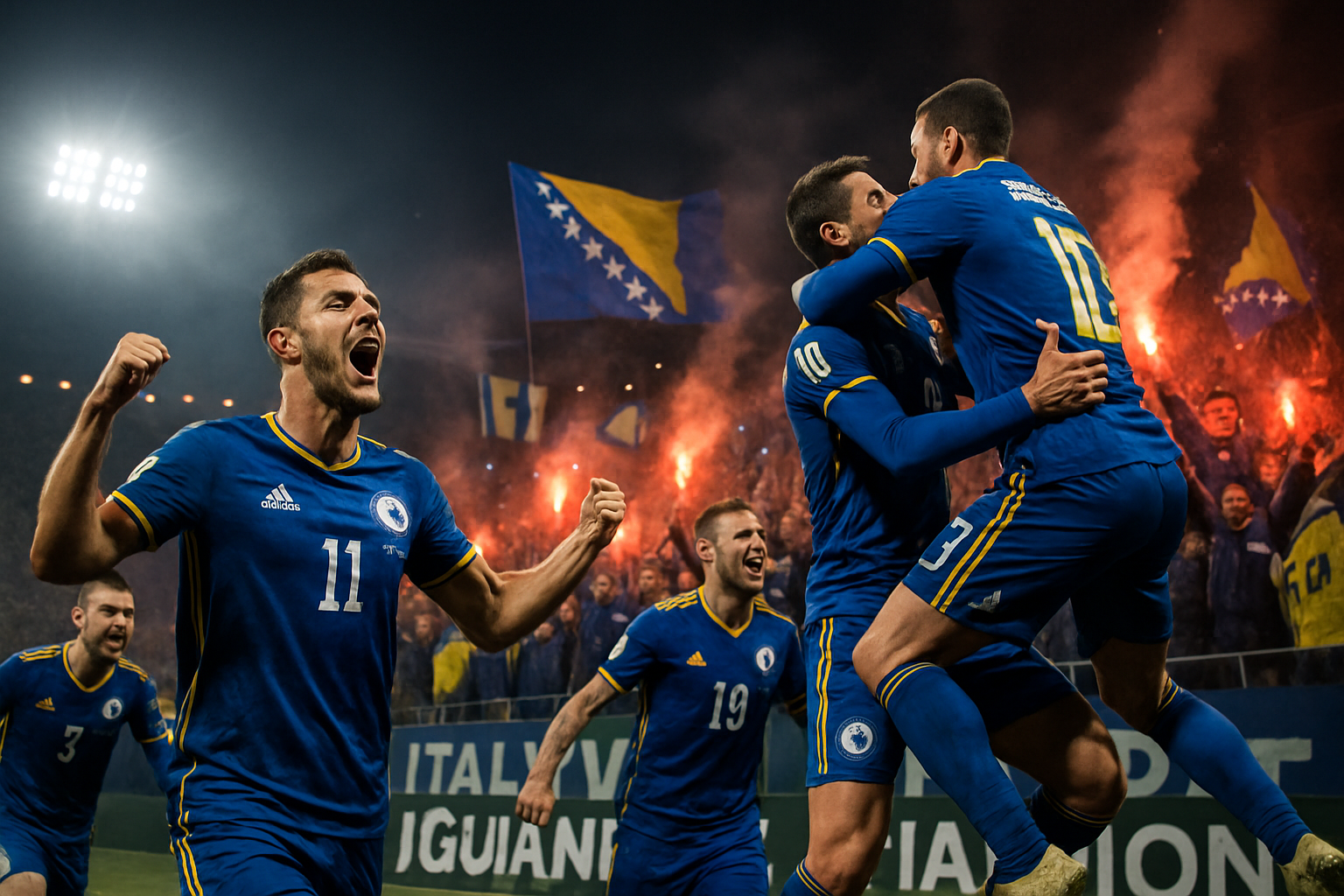
March 31, 2026, will be remembered as one of the most dramatic nights in World Cup qualifying history, as football giants fell and underdogs soared in a series of matches that redefined international football's competitive landscape.
Italy's stunning 4-1 penalty shootout defeat to Bosnia and Herzegovina at Zenica's Bilino Polje Stadium sent shockwaves through the football world, marking the Azzurri's third consecutive World Cup absence. Simultaneously, the Democratic Republic of Congo and Iraq secured historic qualifications that ended decades-long waits for football's biggest stage.
Italy's Unthinkable Nightmare Continues
The defending European champions' elimination represents perhaps the biggest shock of the 2026 qualifying campaign. After taking an early lead through a Nikola Vasilj goalkeeper error, Italy seemed destined for the tournament. However, substitute Haris Tabaković's equalizer for Bosnia forced extra time, and ultimately, a penalty shootout that would haunt Italian football for years to come.
The shootout was a masterclass in composure from Bosnia's players. Benjamin Tahirović, Haris Tabaković, Kerim Alajbegović, and Esmir Bajraktarević all found the net, while Italy managed only Sandro Tonali's successful conversion. Pio Esposito sent his effort over the crossbar, and Bryan Cristante struck the woodwork, sealing Italy's fate.
"A 4-1 penalty shootout defeat to Bosnia and Herzegovina was an unimaginable nightmare for the Azzurri. Assuming they make the next World Cup in 2030, which is no guarantee, it will have been 16 years between appearances."
— Sydney Morning Herald
Coach Gennaro Gattuso's emotional post-match interview captured the magnitude of the disappointment. Leonardo Spinazzola was seen in tears, acknowledging what many consider the end of an era for Italian football. The financial implications are staggering, with Gazzetta dello Sport reporting losses of approximately 30 million euros in sponsorship penalties, merchandising revenue, and FIFA prize money.
Bosnia's Historic Triumph
For Bosnia and Herzegovina, March 31 represented the culmination of a remarkable journey that began with their penalty victory over Wales in the semifinals. Captain Edin Džeko, who scored his 74th international goal to equalize against Wales, led his nation to only their second-ever World Cup qualification.
The scenes in Sarajevo were extraordinary, with tens of thousands of supporters gathering at the Vječna Vatra (Eternal Flame) to welcome their heroes home. Coach Sergej Barbarez, who had prepared his team with tactical discipline and mental fortitude, praised his players' character in the face of adversity.
Bosnia will compete in Group B alongside Switzerland, Canada, and Qatar when the expanded 48-team tournament begins on June 11, 2026, at the Estadio Azteca in Mexico City.
DR Congo's 52-Year Wait Ends
The Democratic Republic of Congo's qualification represents perhaps the most emotionally charged success story of the playoff finals. The Léopards defeated Jamaica 1-0 in extra time at Guadalajara's Estadio Akron, with former England under-21 international Axel Tuanzebe scoring the decisive goal in the 100th minute from a corner kick.
The victory marked the end of a 52-year World Cup drought, with the nation's last appearance coming in 1974 when they competed as Zaire. President Félix Tshisekedi had personally galvanized the team with a flag ceremony before their semifinal, presenting the national colors to captain Chancel Mbemba in a moment of profound national significance.
Celebrations erupted across Kinshasa, with thousands gathering at the Place Royale in scenes of pure jubilation. The match had been preceded by intense preparation, with the team understanding that victory was worth US$10.5 million to the Jamaican Football Federation, while representing immeasurable national pride for the Congolese people.
"La République démocratique du Congo tient enfin son billet pour la Coupe du monde 2026. Au terme d'un match longtemps indécis face à la Jamaïque, les Léopards ont arraché une victoire précieuse en prolongation."
— Radio Okapi
Iraq's 40-Year Journey Completed
Iraq's 2-1 victory over Bolivia in Monterrey completed one of international football's most remarkable comeback stories. Goals from Ali Al-Hamadi and Aymen Hussein sent the Lions of Mesopotamia to their first World Cup since 1986, ending a 40-year absence from football's premier tournament.
The match saw Bolivia take hope through Moisés Paniagua's strike, but Iraq's experience and tactical discipline proved decisive. Coach's preparation had emphasized the historical significance of the moment, with the entire nation watching as their team secured qualification for the expanded tournament.
Iraq will join Group I alongside France, Senegal, and Norway, marking their return to the World Cup stage after decades of political turmoil and reconstruction. The qualification represents not just sporting achievement but a symbol of the nation's resilience and determination.
The Democratization of World Football
These results perfectly encapsulate the changing dynamics of international football in 2026. The expanded 48-team format has created unprecedented opportunities for nations traditionally excluded from World Cup participation, while systematic investment in coaching, infrastructure, and youth development has enabled breakthrough performances.
Sweden also secured qualification with Viktor Gyökeres scoring an 88th-minute winner against Poland, while the Czech Republic defeated Denmark on penalties after a 2-2 draw. Turkey ended their 24-year World Cup absence by defeating Kosovo 1-0, with Kerem Aktürkoğlu's 53rd-minute goal proving decisive.
Global Implications
The night's results demonstrate how traditional football hierarchies continue to break down. Italy's elimination, despite being defending European champions, shows that historical success provides no guarantee of World Cup participation. Meanwhile, nations like Bosnia, DR Congo, and Iraq have proven that with proper preparation, tactical discipline, and unwavering determination, any team can compete at the highest level.
For Jamaica, the defeat represents another chapter in their ongoing World Cup drought, extending their absence to 28 years since their memorable 1998 appearance. Similarly, Bolivia's elimination continues their struggle to return to the tournament, maintaining their 32-year absence.
Tournament Preparations Intensify
With the final qualifiers now determined, attention turns to the unprecedented logistical challenge of hosting the first tri-national World Cup across the United States, Canada, and Mexico. The tournament faces ongoing challenges, including Iran's confirmed withdrawal due to geopolitical tensions—the first qualified nation excluded for such reasons in World Cup history.
Mexico has deployed 100,000 security personnel in the largest security operation in the country's history, responding to February's cartel violence that threatened tournament preparations. FIFA President Gianni Infantino maintains "complete confidence" in the hosting capabilities despite these challenges.
The expanded format will feature 104 matches across 16 cities, with nearly 2 million tickets already sold in the first two sales phases. The tournament promises to be the largest and most logistically complex World Cup in history, setting new standards for international sporting events.
Legacy of a Historic Night
March 31, 2026, will be remembered as the night when football's beautiful game showcased its most fundamental truth: on any given day, determination and preparation can overcome reputation and history. Bosnia's dragons soared, Congo's leopards roared, and Iraq's lions returned from the wilderness, while Italy's azzurri learned that in football, there are no guarantees.
As the football world absorbs these seismic results, one thing remains certain: the 2026 World Cup will feature a more diverse and competitive field than ever before, reflecting the true global nature of the world's most popular sport.