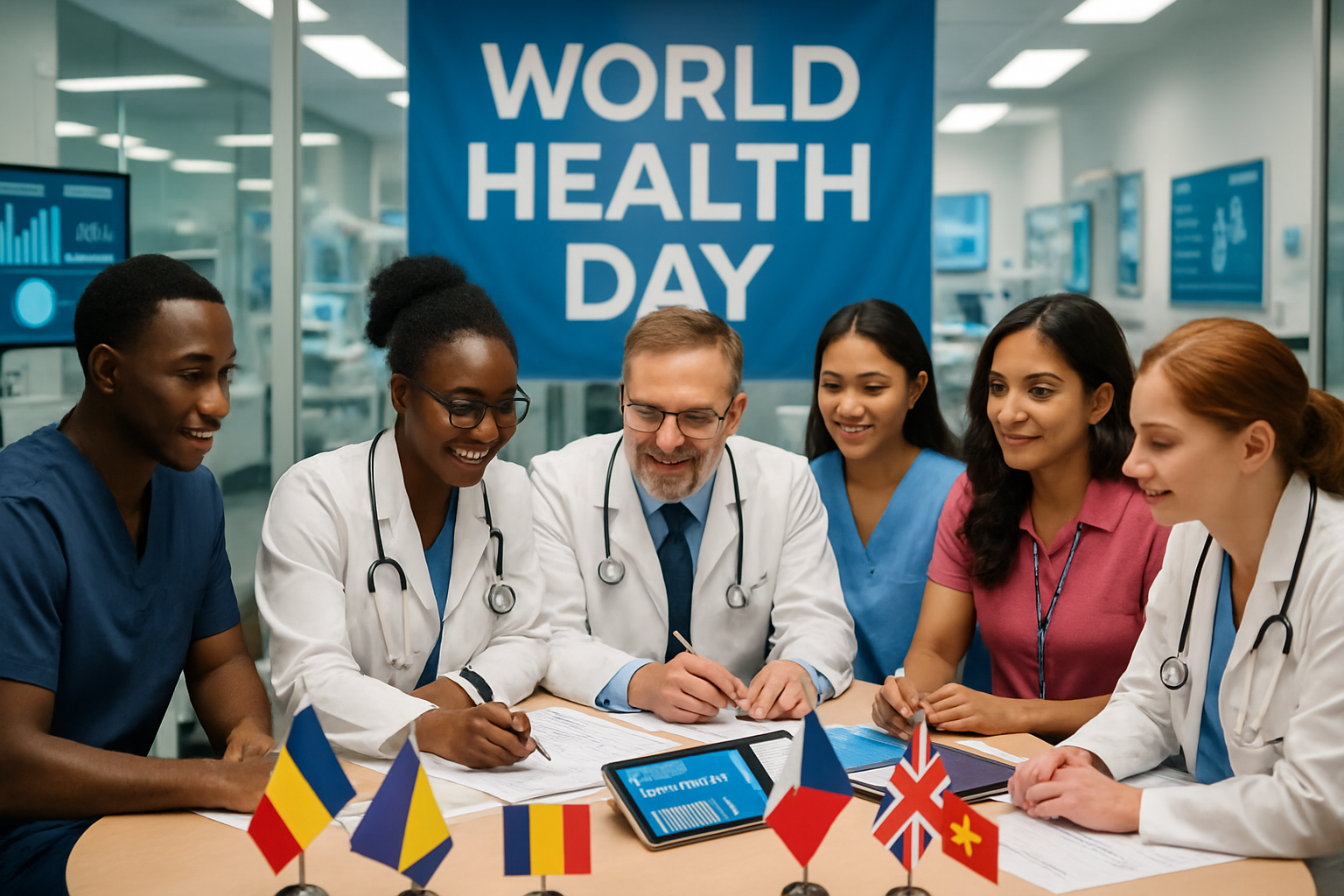
World Health Day 2026 arrives at a pivotal moment in global healthcare, as nations demonstrate unprecedented medical cooperation and breakthrough innovations that are fundamentally transforming how the world approaches health and wellness through what experts now call the "Therapeutic Revolution of 2026."
Across six continents, this World Health Day has unveiled remarkable medical achievements spanning from life-saving emergency interventions to groundbreaking genetic therapies, while highlighting the critical shift toward prevention-first healthcare strategies that are proving superior to traditional reactive treatment models.
Medical Heroics and Emergency Breakthroughs
The human face of medical excellence was dramatically illustrated when a Vietnamese orthopedic surgeon set up an emergency IV line to revive an unconscious Japanese woman on a Tokyo-bound flight. Working in cramped aircraft conditions during descent into Haneda Airport, the surgeon demonstrated the global healthcare community's commitment to saving lives regardless of circumstances or nationality.
Meanwhile, in Austria, healthcare professionals are addressing complex medical situations as burgenländische Landeshauptmann Hans Peter Doskozil underwent larynx removal surgery and received a speech prosthesis, highlighting advances in reconstructive surgery and assistive medical technologies that are transforming quality of life for patients with serious conditions.
Community-Centered Healthcare Revolution
Bosnia and Herzegovina exemplified the global trend toward community-centered healthcare as Sarajevo Canton Premier Nihad Uk visited the "Generation" Health Promotion and Improvement Center on World Health Day. The premier participated in activities promoting health and vitality for elderly citizens and attended the opening of an exhibition titled "Stop Violence Against Older Persons," developed in cooperation with the Austrian Social Affairs, Health, Care, and Consumer Protection Attaché Office.
"The best investment is investment in health – at every age! I enjoyed spending time with the Center's users who are living proof of how to live a fulfilling and active life regardless of age,"
— Premier Nihad Uk, Sarajevo Canton
This community approach reflects a broader transformation where healthcare systems are organizing around human flourishing rather than merely treating illness, with mental wellness being treated as essential community infrastructure comparable to transportation and education.
International Scientific Collaboration
Chad's celebration of World Health Day under the theme "Unite for Health, Support Science" demonstrated the growing emphasis on scientific research as an indispensable pillar of health security and sustainable development. Professor Mahamat Bechir, Permanent Secretary of the "One Health" platform, presented comprehensive approaches linking human, animal, and environmental health as the key to anticipating future health challenges.
In the Philippines, barangay health workers gathered at the University of the Philippines Diliman demanding recognition through their own Magna Carta, highlighting the critical role of community healthcare providers who serve as primary healthcare providers in every city and municipality while performing additional services including health education, maternal care, disease surveillance, and emergency response.
Breakthrough Medical Technologies
The United Kingdom showcased cutting-edge genetic innovations as scientists at Rothamsted Research in Hertfordshire developed CRISPR gene-edited wheat that produces bread with substantially reduced acrylamide levels when toasted, making it less carcinogenic. This breakthrough represents the sophisticated integration of advanced biotechnology with practical public health applications.
The development utilized CRISPR genome editing technology, adapted from naturally occurring bacterial systems, to selectively modify plant DNA for enhanced food safety. Such innovations demonstrate how the "Therapeutic Revolution of 2026" encompasses not just treatment advances, but fundamental improvements in food production and nutrition.
Prevention-First Economics Validated
Historical analysis reveals that countries implementing comprehensive prevention programs consistently report superior outcomes. Montana's mobile crisis teams achieved an 80% reduction in police mental health calls through proactive community intervention. Finland maintains its status as the world's happiest country for the ninth consecutive year through educational reforms that balance academic achievement with psychological wellbeing, preventing depression patterns from developing during school years.
Economic analyses demonstrate that prevention-focused strategies offer substantial cost reductions through decreased crisis interventions while achieving superior population health outcomes. Countries investing in comprehensive healthcare infrastructure report benefits extending beyond health to educational achievement, workforce productivity, and social stability.
Climate Health Adaptation
Healthcare transformations are occurring during unprecedented environmental challenges, with January 2026 marking the 18th consecutive month that global temperatures exceeded 1.5°C above pre-industrial levels. Prevention-first approaches are proving particularly valuable for managing climate-related health challenges through proactive intervention versus reactive crisis management.
Healthcare systems worldwide are addressing immediate medical needs while building long-term environmental resilience for evolving disease patterns, changing climate zones, and new health challenges that require adaptive medical infrastructure.
Global Cooperation Models Evolution
Despite funding challenges facing traditional multilateral health organizations, innovative cooperation models are emerging through bilateral partnerships and peer-to-peer knowledge sharing networks. Countries are transitioning from being healthcare recipients to becoming regional medical innovators through sustained research investment and international collaboration.
The distributed cooperation model allows for flexible, culturally responsive approaches while maintaining evidence-based medical standards. Smaller nations contribute research methodologies while larger countries offer technological innovations and implementation resources, creating a complementary global healthcare ecosystem.
Technology-Human Integration Success
The most successful healthcare innovations of 2026 demonstrate sophisticated integration of advanced technology with human-centered care approaches, avoiding the "wellness paradox" where technological solutions create healthcare inequality rather than improving access and outcomes.
Medical advances are being designed to benefit diverse populations regardless of geographic or economic constraints, with technology enhancing rather than replacing clinical judgment and personal medical relationships that remain fundamental to effective healthcare delivery.
World Health Day 2026: A Critical Juncture
World Health Day 2026 represents a critical juncture in global healthcare evolution, with evidence-based innovations successfully translating into accessible effective treatments. The convergence of precision medicine advances, international cooperation models, and prevention-focused strategies provides a foundation for resilient healthcare systems addressing 21st-century challenges.
Success in scaling these innovations globally depends on sustained political commitment to healthcare investment, comprehensive professional training, authentic community engagement, and continued international cooperation through knowledge sharing and resource optimization.
The "Therapeutic Revolution of 2026" offers unprecedented hope for accessible, effective, and equitable healthcare delivery that addresses immediate health needs while building long-term population wellness through coordinated international medical cooperation and innovation.
As nations demonstrate through their World Health Day initiatives, the future of healthcare lies not in treating disease but in organizing societies around human flourishing, with medical systems serving as foundations for community resilience, individual dignity, and collective prosperity in an interconnected world facing complex health challenges.