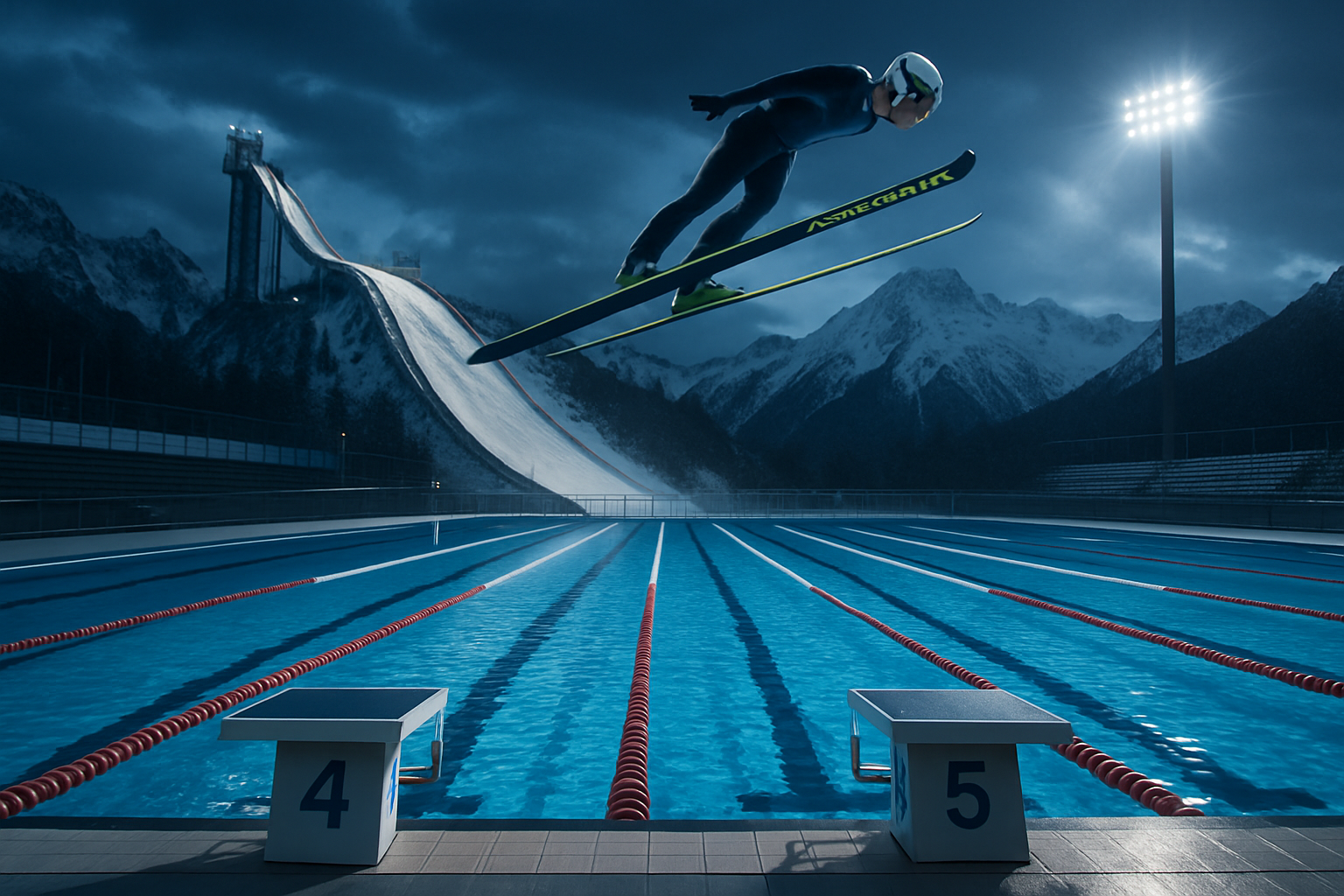
In a spectacular display of athletic excellence, two world-class athletes rewrote the record books within hours of each other, as Australia's Cameron McEvoy shattered the 17-year-old 50m freestyle world record in China while Sweden's Frida Westman soared to new national heights in Norwegian ski jumping competition.
The achievements represent a remarkable convergence of sporting excellence across different disciplines, continents, and conditions, demonstrating the global nature of elite athletic performance in 2026.
McEvoy's Historic Swimming Breakthrough
At the China Swimming Open in Shenzhen on Friday, 31-year-old Cameron McEvoy delivered what many considered impossible – breaking César Cielo's legendary 50m freestyle world record that had stood since the "supersuit" era of 2009. McEvoy's time of 20.88 seconds eclipsed the Brazilian's mark of 20.91, which had survived 17 years of assault from the world's fastest sprinters.
The achievement was all the more remarkable considering McEvoy's personal journey. Having won Olympic gold at Paris 2024 and a world title in 2025, the Australian entered the event with a personal best of 21.06 seconds – already a formidable time, but still 0.18 seconds away from Cielo's seemingly untouchable record.
"I knew I had a chance to do a PB. My old PB was 21.06, so maybe 20.99, but doing 20.88 is unreal. It's crazy,"
— Cameron McEvoy, speaking to China's state broadcaster CMG
McEvoy's analysis of his record-breaking performance revealed the meticulous preparation behind the historic swim. The Australian had been conducting what he described as "special stuff" in training, focusing on the unique demands of the 50m freestyle – the shortest and most explosive event in competitive swimming.
"The 50m, I look at it as a strength-based skill. It's different to the other events in swimming. A lot more strength and power is involved, and men peak in strength into their 30s, well into their 30s," McEvoy explained, highlighting the physiological advantages that come with athletic maturity in sprint events.
The Supersuit Era Record Falls
Cielo's record had achieved mythical status in swimming circles, having been set during the controversial "supersuit" era when high-tech swimsuits provided significant hydrodynamic advantages. These suits, later banned by FINA, had enabled a series of world records that many thought would remain untouchable in the modern era.
The gracious response from the now-retired Cielo demonstrated the sporting spirit that defines swimming at its highest level. Taking to social media to congratulate McEvoy, Cielo wrote: "Lightning fast swim! Incredible!" – a testament to the respect between generations of elite sprinters.
This breakthrough represents more than just a faster time; it symbolizes the evolution of swimming technique, training methodologies, and the relentless pursuit of human performance boundaries. McEvoy's achievement proves that with refined technique, exceptional starting mechanics, smooth stroke efficiency, and years of dedicated preparation, even the most enduring records can fall.
Westman's Swedish Ski Jumping Excellence
Meanwhile, in the dramatic setting of Vikersund, Norway, 25-year-old Frida Westman was making her own piece of history. The Swedish ski jumper achieved a remarkable feat by setting a new national record for the second consecutive day, soaring 225 meters in the Norwegian venue renowned for producing the sport's longest flights.
Westman's achievement represents the continuation of an extraordinary run of form that has seen her push the boundaries of Swedish ski jumping. Setting national records on consecutive days is virtually unheard of in the sport, where athletes typically peak for specific competitions after months of preparation.
The significance extends beyond individual achievement. Westman's performances at Vikersund – one of ski jumping's most prestigious venues – demonstrate Sweden's growing prominence in a sport traditionally dominated by Norway, Germany, and Austria. Her success builds upon the momentum created by recent Swedish achievements in winter sports, including their impressive showing at the Milano-Cortina 2026 Winter Olympics.
Technical Excellence and Global Impact
Both records showcase the technical sophistication of modern elite sport. McEvoy's swim demonstrated perfect integration of power, technique, and tactical awareness. His start, stroke mechanics, and finishing touch combined to create a performance that seemed to flow effortlessly, despite representing years of biomechanical refinement and conditioning.
Similarly, Westman's ski jumping excellence required mastery of complex technical elements: the approach run timing, takeoff mechanics, flight position optimization, and landing execution. At Vikersund's large hill, where athletes reach speeds exceeding 90 kilometers per hour, the margin between record-breaking success and serious injury is measured in millimeters and microseconds.
The Ripple Effect of Record-Breaking
These achievements will undoubtedly inspire the next generation of athletes while raising the bar for current competitors. In swimming, McEvoy's record sends shockwaves through the sprint community, forcing athletes and coaches worldwide to reconsider training approaches, technical strategies, and competitive preparation.
For ski jumping, Westman's consecutive records demonstrate that Swedish athletes can compete at the highest levels in traditionally Nordic-dominated sports. This success will likely drive increased investment in Swedish ski jumping programs and inspire young athletes to pursue excellence in winter sports.
Broader Sporting Context
These records emerge from a broader context of exceptional sporting achievement in 2026. The year has witnessed unprecedented global competitiveness across multiple disciplines, building on the legacy of the Milano-Cortina Winter Olympics, which demonstrated winter sports' democratization beyond traditional powerhouses.
The technological advancement, sports science innovation, and enhanced coaching methodologies pioneered during major international competitions continue to influence athlete preparation and performance analysis. Modern sports are experiencing an era where traditional barriers are being systematically dismantled through scientific advancement and international cooperation.
Looking Forward
As the swimming and ski jumping communities digest these historic achievements, attention turns to upcoming competitions where these new benchmarks will be tested. McEvoy's record sets a new standard for sprint swimming that will define the sport for years to come, while Westman's consistency suggests Swedish ski jumping has entered a new era of international competitiveness.
Both athletes have demonstrated that with dedication, technical excellence, and optimal preparation, the boundaries of human performance continue to expand. Their achievements serve as inspiration for athletes worldwide and reminder that in elite sport, today's impossible often becomes tomorrow's starting point.
The convergence of these records within a single weekend underscores the global nature of sporting excellence in 2026 – a year that continues to rewrite the definitions of what athletes can achieve when talent meets opportunity and preparation meets moment.