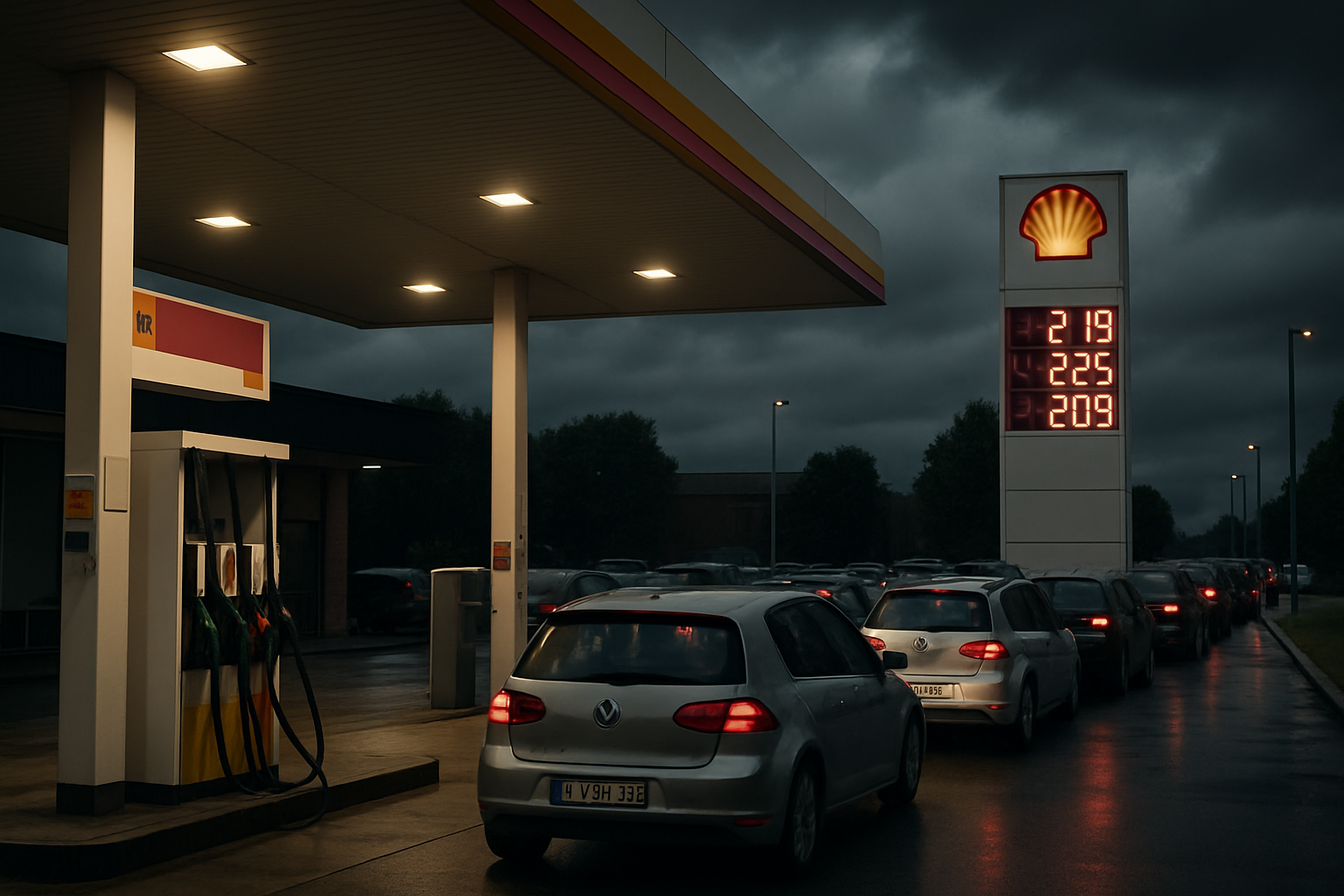
A devastating global energy crisis has engulfed the world as fuel prices reach historic levels, forcing governments across five continents to implement unprecedented emergency measures to shield consumers and critical industries from soaring costs triggered by ongoing Middle East conflict.
The crisis has reached its most severe point since the 1970s oil shocks, with oil prices breaching $100 per barrel for the first time since 2022. Brent crude peaked at $119.50, while West Texas Intermediate recorded an 18.98% single-day jump to $108.15 - the largest increase on record.
Iran's Strategic Chokepoint Closure Devastates Global Supply
The root cause of this unprecedented crisis lies in Iran's Revolutionary Guard declaring the Strait of Hormuz "unsafe for shipping," effectively blocking 40% of global seaborne oil transit through the critical 21-mile waterway. Over 150 oil and LNG tankers worth billions remain stranded in the Persian Gulf, with major shipping companies Maersk and MSC suspending all operations indefinitely.
This single-point failure of modern logistics has exposed dangerous over-dependence on strategic chokepoints, with no realistic alternative routes capable of handling the massive volume. Alternative Arabian Peninsula routes lack adequate capacity, creating significant time delays and cost penalties that ripple throughout global supply chains.
"This is the most severe energy security crisis in decades - the single-chokepoint vulnerabilities of our global system have been completely exposed."
— Samuel Ciszuk, Energy Security Analyst
Unprecedented Government Interventions Worldwide
The scale of government emergency responses has reached levels not seen since the 1970s energy crisis. France has announced €70 million in targeted aid for April, including a 20-cent-per-liter fuel subsidy for small transport businesses and fishing boats, plus zero excise tax on agricultural diesel.
In Bulgaria, diesel prices have surged 25% in the last month while gasoline increased 14%, according to Svetoslav Benchev, chairman of the Bulgarian Petroleum and Gas Association. The dramatic price increases have created what industry experts describe as an "energy and petroleum crisis" of unprecedented proportions.
Germany is implementing comprehensive market interventions, with authorities comparing current fuel price volatility to "war-driven explosions." The government is strengthening antitrust laws to prevent gas station price manipulation, while consumers face fuel approaching €2 per liter at many stations.
IEA Deploys Largest Strategic Reserve Release in History
The International Energy Agency has announced the largest strategic petroleum reserve release in its 50-year history - 400 million barrels from 32 member countries, more than double the 182.7 million barrels released during the 2022 Ukraine crisis.
Japan is releasing 80 million barrels starting March 16, marking the first deployment since the 2011 Fukushima disaster. This decision underscores Japan's extreme vulnerability, with 95% of its oil coming from the Middle East and 70% transiting through the now-closed Hormuz Strait.
Germany has confirmed participation in the coordinated release, while the United States is expected to be the largest contributor. Energy Secretary Christopher Wright is even considering lifting additional Russian oil sanctions to help stabilize global supply, potentially making "hundreds of millions of barrels of sanctioned oil" available to markets.
Aviation Industry Faces Unprecedented Crisis
The aviation sector is experiencing its worst disruption since COVID-19, with over 18,000 flights cancelled worldwide. Eight countries have simultaneously closed their airspace (Iran, Iraq, Israel, UAE, Qatar, Syria, Kuwait, and Bahrain), creating an "aviation black hole" that has severed critical Europe-Asia air corridors.
Dubai International Airport, the world's busiest with 86 million annual passengers, remains completely shut due to missile damage. Major carriers including Emirates, Air France-KLM, Wizz Air, and Bulgaria Air have suspended operations indefinitely.
Jet fuel costs have exploded from $85-90 per barrel to $150-200 per barrel, representing a staggering 122% increase. Airlines worldwide are implementing emergency fuel surcharges, with some carriers adding up to 50 euros to long-haul tickets.
Cross-Border Fuel Shopping Surge
The crisis has created unusual cross-border dynamics, with Norwegians flooding into Sweden specifically to purchase fuel. At gas stations in Strömstad, queues have reached unprecedented lengths as Norwegian motorists seek relief from even higher domestic prices.
"I have never seen lines as long as now," Anders Pedersen told Dagbladet while waiting at a Strömstad gas station, highlighting how energy price differentials are driving consumer behavior across national boundaries.
Electric Vehicle Interest Skyrockets
The fuel price crisis has triggered a massive surge in electric vehicle interest, particularly in Germany where the cost comparison between gasoline and electric vehicles has shifted dramatically. German media reports that electric cars now save drivers "hundreds of euros" compared to traditional gasoline vehicles, as charging costs remain relatively stable while fuel prices soar.
This trend represents a potential acceleration of the global transition to electric mobility, driven by economic necessity rather than environmental policy alone.
Australian Fuel Security Under Scrutiny
Australia finds itself in a particularly precarious position, with government figures revealing concerning data about the country's strategic oil reserves compared to international standards. While officials stress that fuel supply remains secure in the short term, the crisis has brought national energy security vulnerabilities into sharp focus.
The closure of key shipping routes in the Middle East has affected Australian fuel imports, though the government maintains that cancelled shipments have been replaced and additional supplies secured.
Financial Markets in Turmoil
Global financial markets have crashed under the weight of energy uncertainty. Pakistan's KSE-100 index recorded its largest single-day decline in history, falling 8.97%, while South Korea's KOSPI dropped 12%, triggering circuit breakers as the Korean won hit a 17-year low.
Major corporations are postponing significant financial decisions, with PayPal's $1.1 billion IPO indefinitely delayed due to market volatility. Central banks including the ECB and Bank of Japan are coordinating emergency liquidity measures, though traditional monetary policy tools have limited effectiveness against such structural geopolitical disruptions.
Natural Gas Crisis Compounds Energy Emergency
Compounding the oil crisis, natural gas prices have exploded by 24% in Europe and 78% in the United States, reaching €47.32/MWh - the highest level since February 2025. Qatar, which supplies approximately 20% of global LNG exports, has halted production at its massive Ras Laffan and Mesaid facilities following Iranian attacks.
Qatar's Energy Minister Saad Al Kaabi has issued stark warnings that Gulf states may be forced to declare force majeure "within weeks," potentially driving oil prices toward $150 per barrel in a scenario that could "bring down the economies of the world."
Nuclear Diplomacy Breakdown Fuels Crisis
The current energy emergency stems from the complete collapse of US-Iran nuclear negotiations, despite achieving what was described as "broad agreement on guiding principles" - the most progress since the 2018 JCPOA withdrawal.
The fundamental disagreement proved insurmountable: Iran insisted on nuclear-only discussions excluding ballistic missiles and proxy forces as "red lines," while the United States demanded comprehensive agreements covering missiles, armed groups, and human rights.
This diplomatic failure led directly to Operation Epic Fury, the largest US-Israeli military operation since 2003, which in turn triggered Iran's massive retaliation "Operation True Promise 4" and the subsequent closure of the Strait of Hormuz.
Long-term Energy Architecture Transformation
The crisis has exposed fundamental vulnerabilities in global energy architecture that extend far beyond immediate supply disruptions. The 21-mile Strait of Hormuz represents a dangerous single-point failure in modern logistics, with the Persian Gulf serving as a critical trade hub affecting not just energy but consumer goods and industrial materials worldwide.
Manufacturing networks dependent on Gulf logistics - from automotive to electronics to textiles - are experiencing severe disruptions. China has suspended refined fuel exports, while Singapore retailers warn of 30% increases in logistics costs.
"The situation is going on longer than people initially thought. Financial markets are becoming the ultimate constraint on prolonged conflict."
— Damien Boey, Market Analyst
Nuclear Governance Crisis Context
The energy crisis unfolds against a broader nuclear governance breakdown. The New START treaty expired on February 5, marking the first time in over 50 years without US-Russia nuclear constraints. Simultaneously, China continues nuclear expansion while Iran pursues 60% uranium enrichment with over 400kg of weapons-grade material.
UN Secretary-General António Guterres has warned that nuclear risks are at their "highest in decades," describing the current moment as the "greatest test of multilateral cooperation in the modern era."
Template-Setting Crisis for 21st Century
March 2026 represents a watershed moment in global energy security, establishing new paradigms for crisis management in an interconnected world. The rapid transition from diplomatic breakthrough to military confrontation demonstrates the fragility of modern crisis management mechanisms in the multipolar era.
Success in containing this crisis could provide a framework for future nuclear crisis resolution, strengthening diplomatic precedents. However, failure risks accelerating military solutions that could reshape Middle Eastern geopolitics for decades, encourage global nuclear proliferation, and undermine diplomatic credibility worldwide.
The recovery timeline remains uncertain, unlike weather-related disruptions that follow predictable patterns. Aviation industries cannot plan long-term schedules with multiple airspaces closed, while energy markets remain volatile with critical transit routes blocked.
As governments worldwide implement emergency measures not seen since the 1970s - from strategic reserve releases to fuel rationing to price controls - the world faces the most consequential energy crisis of the modern era. The implications will extend decades beyond current events, determining whether diplomatic or military solutions become the preferred framework for future international crisis management in an increasingly volatile and interconnected world.