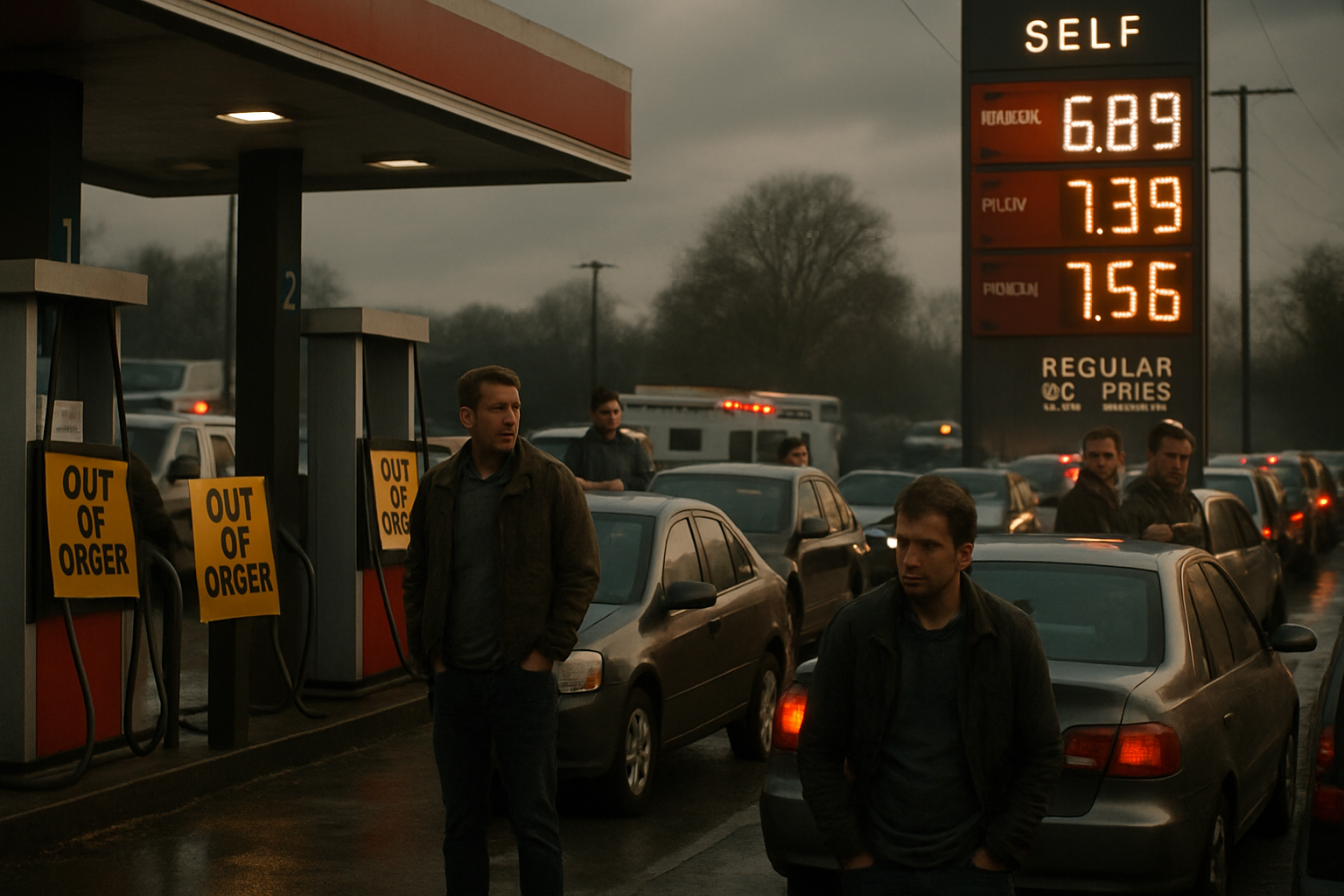
The world faces its most severe energy crisis since the 1970s oil shocks as Iran's Revolutionary Guard declared the Strait of Hormuz "unsafe for shipping," blocking 40% of global oil transit and triggering unprecedented fuel shortages across multiple continents.
Oil prices have surged past $100 per barrel for the first time since 2022, with Brent crude peaking at $119.50 and West Texas Intermediate reaching a record single-day jump of 18.98% to $108.15. The crisis has prompted governments worldwide to implement emergency measures ranging from fuel rationing to strategic reserve releases.
Philippines Declares National Energy Emergency
Philippines President Ferdinand Marcos Jr. declared a year-long "national energy emergency," activating the UPLIFT program as diesel prices approach P100 per liter. The government announced preparatory ASEAN meetings would shift online to conserve fuel resources, with only leaders-level summits to be hosted physically.
At Cebu City's Carbon Market, vendors face devastating impacts from rising oil prices. Fish vendor Josephine Salientes described the crisis: "There is little left in our salaries. Adding to the fact that rice prices have also increased. It's pitiful that, instead of earning a little extra, this is not possible due to the fish. It's expensive."
The Department of Energy proudly announced the arrival of 142,000 barrels of diesel, enough to last less than one day of national consumption, highlighting the scale of the supply challenge facing the archipelago nation.
Pakistan Implements Digital Fuel Rationing
Pakistan has agreed to roll out a mobile application-based quota system for fuel provision to two- and three-wheelers, ensuring targeted subsidies for low-income groups while minimizing fuel leakage. The system represents a technological solution to acute shortages affecting the nation of 230 million people.
"The participants agreed to expedite efforts to finalise a targeted subsidy framework using technological solutions, while ensuring continued coordination between the federal and provincial governments."
— Pakistan Ministry of Finance
South Africa Braces for Historic Price Increases
South African motorists face fuel price increases of up to R11.63 per liter unless government intervention occurs, marking the highest potential increases in the country's history. The crisis is compounded by India's new export levy, affecting up to 24% of South Africa's diesel and petrol imports from Indian refineries.
The combination of Middle East supply disruptions and Indian export restrictions creates a dual pressure on South African fuel markets, with industry analysts warning of "perfect storm" conditions.
European Nations Implement Emergency Controls
Germany has begun implementing temporary fuel price relief measures, though concerns remain about rising crude oil markets potentially driving prices higher once again. The country is restricting fuel price changes to once daily to prevent excessive volatility.
Airlines across Europe face unprecedented challenges as aviation fuel costs surge from $85-90 per barrel to $150-200, representing increases of up to 122%. This has forced carriers to implement emergency surcharges and cancel thousands of flights.
"Expensive kerosene and geopolitical tensions - the war in the Middle East poses major challenges for airlines. What does this mean for airlines and travelers?"
— German broadcaster analysis
UK Sees Highest Fuel Prices in Two Years
British motorists are experiencing petrol prices above 150p per liter for the first time in nearly two years, according to the RAC. The organization directly links these increases to the escalating Middle East conflict, warning of further rises ahead of the Easter break.
Venezuela Implements Work Week Shutdown
In an unprecedented move, Venezuela's interim president Delcy Rodriguez declared a week-long shutdown for public sector workers as extreme weather exacerbates the country's ongoing energy shortages. The measure affects the entire education sector and most government ministries as part of an "electric power saving plan."
"During this Holy Week, I want to announce that I have decreed days off on Monday, Tuesday, Wednesday, Thursday and Friday for the entire education sector," Rodriguez announced, citing 45 days of high temperatures affecting the power grid.
Egypt Orders Early Business Closures
Egypt has implemented an energy "lockdown," requiring all shops, restaurants, and commercial centers to close at 9:00 PM on weekdays, effective Saturday. The measure aims to limit energy costs that have more than doubled since the crisis began.
International Energy Agency Responds
The International Energy Agency (IEA) announced the largest strategic petroleum reserve release in its 50-year history, deploying 400 million barrels from 32 countries - double the amount released during the 2022 Ukraine crisis.
Japan is releasing 80 million barrels, marking the first deployment since the 2011 Fukushima disaster. With 95% dependence on Middle Eastern oil and 70% of supplies transiting through Hormuz, Japan represents one of the most vulnerable major economies to the current crisis.
Root Cause: Strait of Hormuz Blockade
The crisis stems from Iran's Revolutionary Guard declaring the 21-mile Strait of Hormuz "unsafe for shipping" following the breakdown of US-Iran nuclear negotiations despite recent diplomatic progress. The waterway handles 40% of global seaborne oil transit, making it irreplaceable in the global energy system.
Major shipping companies Maersk and MSC have suspended operations in the Persian Gulf, stranding over 150 oil and LNG tankers carrying billions of dollars in cargo. Iran has deployed an estimated 2,000-6,000 naval mines, while US forces have destroyed 28 Iranian mine-laying ships.
Aviation Industry Paralyzed
The aviation sector faces its worst crisis since COVID-19, with over 18,000 flights cancelled worldwide. Eight countries have simultaneously closed their airspace, creating an "aviation black hole" across Iran, Iraq, Israel, UAE, Qatar, Syria, Kuwait, and Bahrain.
Dubai International Airport, the world's busiest with 86 million annual passengers, remains shut due to missile damage. Major carriers including Emirates, Air France-KLM, Wizz Air, and Bulgaria Air have suspended operations indefinitely.
Financial Markets in Turmoil
Global financial markets have crashed, with Pakistan's KSE-100 index suffering its largest single-day decline in history at -8.97%. South Korea's KOSPI dropped 12%, triggering circuit breakers, while the Korean won hit a 17-year low.
Central banks including the European Central Bank and Bank of Japan are coordinating emergency liquidity measures, though traditional monetary policy tools show limited effectiveness against structural geopolitical disruptions.
Expert Analysis and Warnings
Energy analyst Samuel Ciszuk describes this as "the most severe energy security crisis in decades, with single-chokepoint vulnerabilities exposed." Qatar's Energy Minister Saad Al Kaabi has warned that Gulf states may declare force majeure "within weeks" if oil approaches $150 per barrel, threatening to "bring down the economies of the world."
The 21-mile Strait of Hormuz represents a geographic single-point failure in modern logistics, with no realistic alternative routes capable of handling the diverted volume. Alternative Arabian Peninsula routes lack adequate capacity and infrastructure, creating inevitable bottlenecks and cost increases.
Long-term Implications
The crisis exposes dangerous over-dependence on strategic chokepoints in volatile geopolitical regions, requiring fundamental restructuring of global energy architecture. While strategic petroleum reserves provide temporary relief, sustained disruptions demand accelerated supply diversification and renewable energy transitions that typically require years or decades to implement.
UN Secretary-General António Guterres has called this "the greatest test of multilateral cooperation in the modern era," as the international community grapples with the intersection of regional warfare, global energy security, and nuclear governance.
"This represents a template-setting moment for 21st-century crisis management, determining whether diplomatic or military solutions will provide the framework for future international stability."
— Crisis management expert
The recovery timeline remains uncertain, depending on military operations and diplomatic resolution rather than predictable factors like weather disruptions. Success in containing the crisis could provide a nuclear crisis resolution framework, while failure risks accelerating military solutions that could reshape geopolitics for decades.
March 2026 represents a watershed moment in global energy security, establishing new paradigms that will affect international stability mechanisms for decades beyond the current crisis.