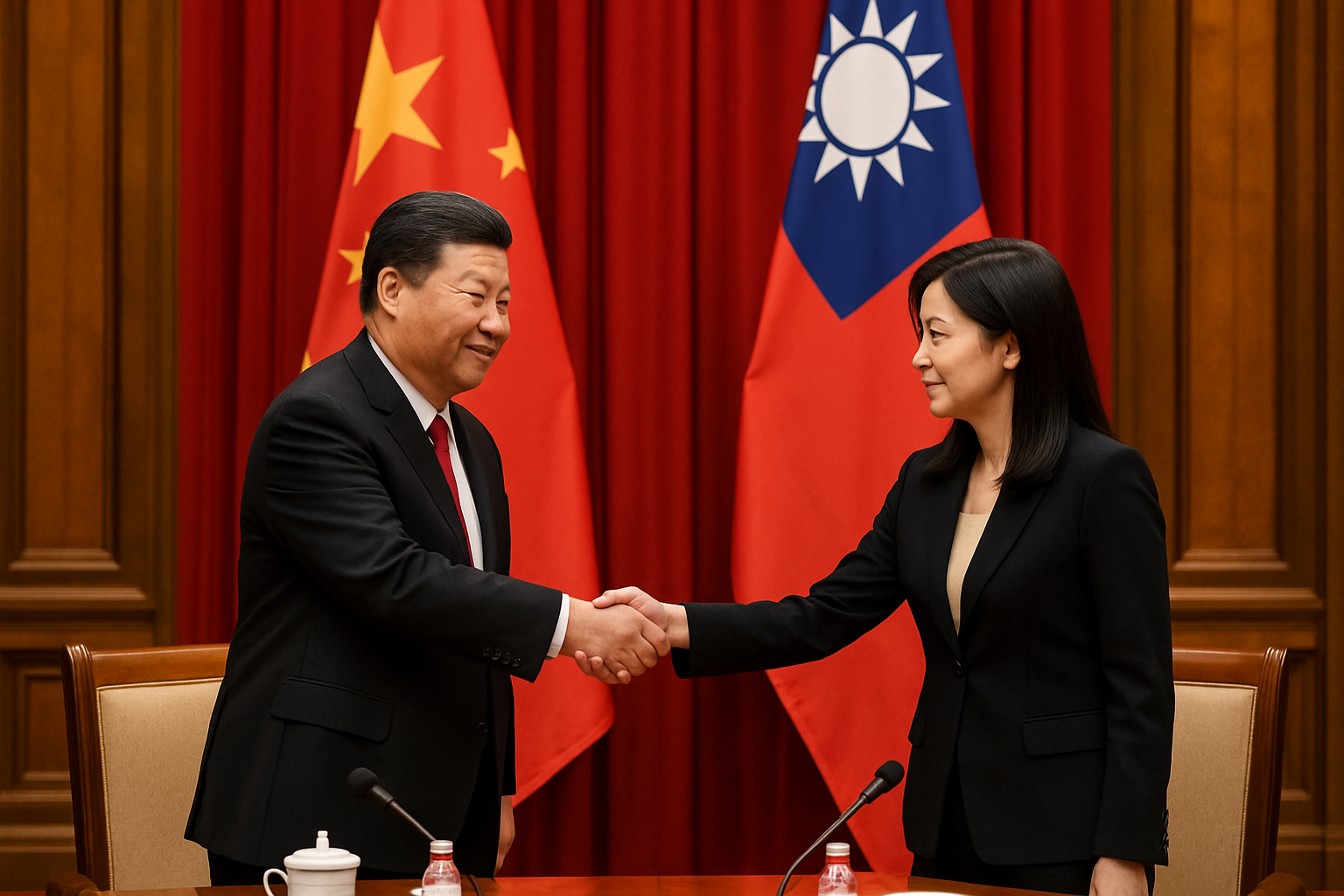
Chinese President Xi Jinping met with Taiwan's main opposition Kuomintang leader Cheng Li-wun in Beijing on Friday, declaring he had "full confidence" that Taiwanese and Chinese people would eventually be united while warning Beijing would "absolutely not tolerate" independence for Taiwan.
The historic encounter at the Great Hall of the People marked the first meeting between a Chinese president and a Taiwan opposition party leader in nearly a decade, representing the most significant cross-strait diplomatic development since China severed high-level contact with Taiwan in 2016.
Kuomintang (KMT) chairwoman Cheng Li-wun became the party's first leader to visit mainland China in ten years at Xi's personal invitation, undertaking a five-day journey from April 7-12 that includes stops in Beijing, Shanghai, and Jiangsu province. The visit has sparked intense debate in Taiwan, with critics accusing Cheng of being too accommodating to Beijing's agenda.
Beijing's Dual-Track Strategy Intensifies
The meeting underscores China's sophisticated dual-track approach toward Taiwan: combining relentless military pressure with strategic engagement of opposition parties to circumvent Taiwan's ruling Democratic Progressive Party (DPP) government.
Chinese military activity around Taiwan increased 23% in 2025, according to Taiwan Defense Minister Wellington Koo, with daily aircraft and naval deployments designed to "exhaust" the Taiwan population. The latest large-scale exercises were conducted in December 2025, demonstrating Beijing's advanced combat capabilities and readiness for potential military action.
"The general trend of compatriots on both sides of the Strait getting closer, edging nearer and becoming united will not change,"
— Xi Jinping, Chinese President
During their meeting, Xi emphasized that China will "absolutely not tolerate" independence for Taiwan while calling for joint efforts to advance "reunification." He urged both the KMT and Communist Party to "consolidate political mutual trust, maintain positive interaction, unite compatriots on both sides of the strait, and join hands to create a bright future of the motherland's reunification and national rejuvenation."
Taiwan Opposition's Reconciliation Gambit
Cheng Li-wun, who assumed KMT leadership in November 2025, has positioned herself as an advocate for dialogue to "avoid war" and promoted the concept of a "community of destiny" between Taiwan and mainland China. She characterized her journey as a "historic trip for peace," stressing shared cultural heritage while suggesting she would slow Taiwan's military build-up if elected.
The KMT leader's visit comes at a critical juncture in cross-strait relations, occurring just months after the postponement of the Trump-Xi summit originally scheduled for March 31-April 2, which was delayed due to the Iran crisis. Xi had previously told Trump during a February phone call that Taiwan represents "the most important issue" in China-US relations.
Regional and International Implications
The Beijing meeting takes place against the backdrop of heightened tensions across the Asia-Pacific region. Japan's Prime Minister Sanae Takaichi has strengthened her support for Taiwan following her historic electoral victory, while China's attempts to rally Southeast Asian nations against Japan have gained minimal traction among ASEAN countries, which prefer multilateral approaches to regional challenges.
China's systematic pressure campaign extends beyond traditional military exercises to include cyber attacks and psychological warfare, representing what Beijing calls the pursuit of "great rejuvenation of the Chinese nation." Recent military leadership changes, including the corruption investigation of General Zhang Youxia, have consolidated Xi Jinping's complete control over the People's Liberation Army, potentially clearing any internal opposition to Taiwan action.
The international community has responded with measured concern. The United States recently completed a historic trade agreement with Taiwan, eliminating tariffs up to 26% on agricultural imports and securing $85 billion in Taiwanese purchases of American goods. European officials continue to emphasize the importance of peaceful resolution while monitoring developments for broader regional security implications.
Economic and Strategic Calculations
Taiwan's position as the world's leading semiconductor producer adds critical economic dimensions to the crisis. The island produces 90% of the world's most advanced semiconductors, making cross-strait stability crucial for global supply chains affecting everything from smartphones to military systems.
China's approach reflects broader economic leverage strategies, including its recent announcement of zero-tariff access for 53 African countries beginning May 1, 2026, and its control of 60% of global critical minerals production and 90% of refining capacity. These moves demonstrate Beijing's comprehensive strategy of combining economic incentives with political pressure.
Domestic Taiwan Politics Under Pressure
The KMT has historically favored closer ties with China compared to the independence-leaning DPP, but Cheng's visit tests Taiwan's democratic unity amid external pressure. Public opinion polls consistently show preference for maintaining the status quo rather than immediate independence or unification, reflecting the complexity of Taiwan's strategic position.
Taiwan President Lai Ching-te has warned that Chinese seizure of Taiwan would threaten Japan, the Philippines, and other regional democracies, emphasizing the island's strategic importance beyond bilateral relations. The ruling DPP government continues to focus on defense modernization while maintaining what officials describe as "rock solid" relationships with the United States and other democratic partners.
Military Modernization and Nuclear Context
China's defense spending increased 7% to 1.91 trillion yuan ($277 billion) in 2026, supporting military modernization goals targeted for completion by 2035. This investment supports development of hypersonic weapons, naval capabilities, AI military applications, and autonomous systems designed to overcome Taiwan's geographic advantages.
The crisis unfolds amid a broader nuclear governance emergency, with the New START treaty having expired in February 2026, marking the first time in over 50 years without US-Russia nuclear constraints. UN Secretary-General António Guterres has warned that nuclear risks are at their "highest in decades," adding urgency to regional stability efforts.
Path Forward: Diplomacy vs. Military Solutions
The Xi-Cheng meeting represents both opportunity and risk for regional stability. Success in establishing sustainable dialogue mechanisms could provide frameworks for managing cross-strait tensions, while failure might accelerate military confrontation with global consequences.
Beijing's sophisticated approach combines military intimidation, economic pressure, and diplomatic engagement, representing the most comprehensive reunification strategy since the 1996 Taiwan Strait Crisis. The ultimate success depends on Taiwan's democratic resilience, sustained international support, and Beijing's strategic patience versus tactical pressure escalation.
Regional security experts emphasize that Taiwan's survival as a democracy has implications extending far beyond the island itself, potentially setting precedents for territorial disputes worldwide and influencing international approaches to authoritarian pressure on democratic societies.
As the meeting concluded, both sides maintained that the "path of talks remains open," but fundamental disagreements over Taiwan's status and the island's democratic identity continue to complicate any sustainable resolution. The coming months will test whether diplomatic engagement can provide alternatives to military confrontation in one of the world's most strategically critical regions.