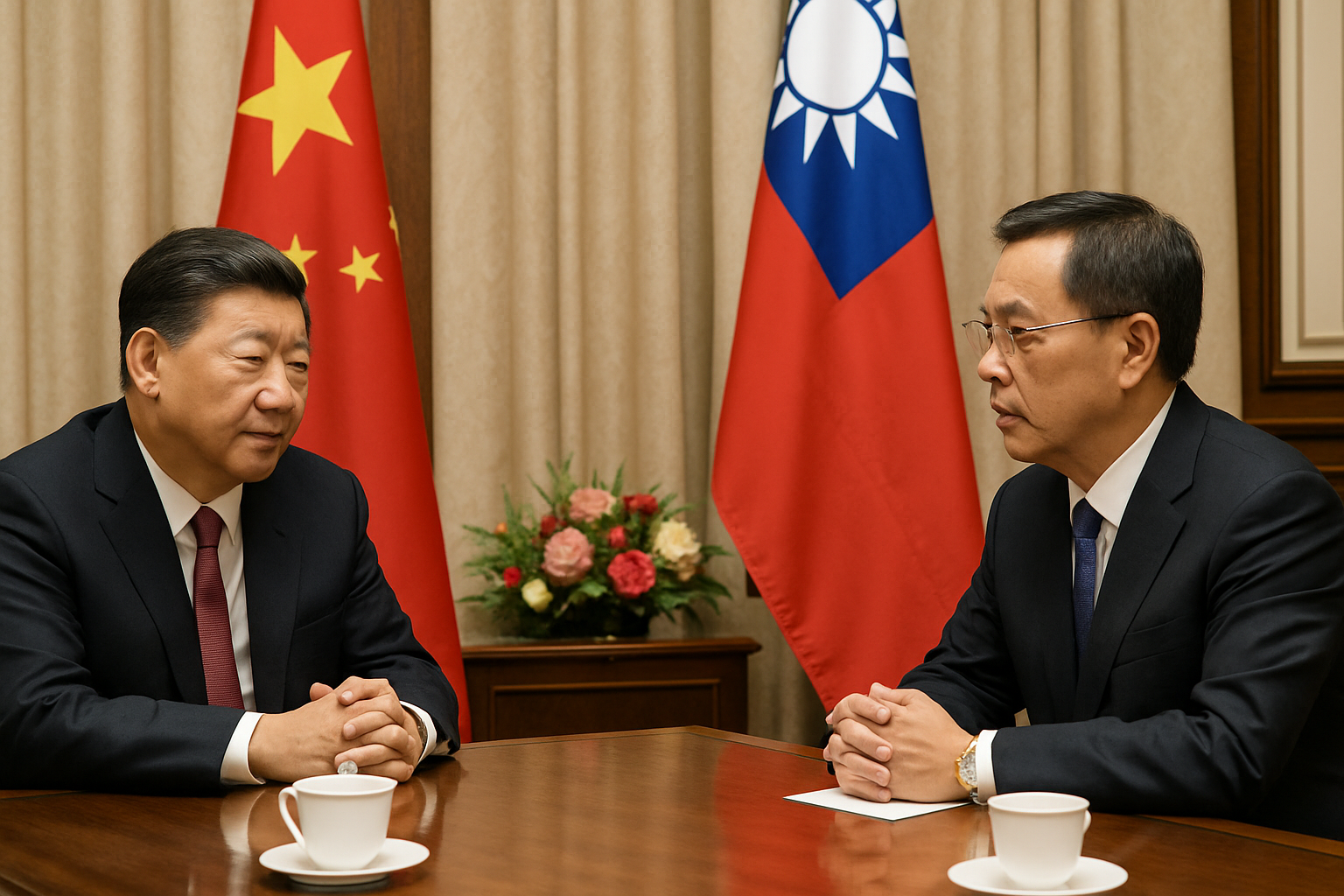
Chinese President Xi Jinping declared he has "full confidence" that China and Taiwan will eventually unite during a historic meeting with Taiwan opposition leader Cheng Li-wun in Beijing on Friday—the first such high-level encounter between mainland China and Taiwan's Kuomintang party in nearly a decade.
The meeting at the Great Hall of the People marked the most significant cross-strait diplomatic engagement since 2016, as Beijing pursues a dual-track strategy of military pressure combined with opposition party cultivation to bypass Taiwan's ruling Democratic Progressive Party government.
Xi told Cheng Li-wun, chairwoman of Taiwan's main opposition Kuomintang (KMT), that reunification between the island and mainland China is "in the direction of history," according to multiple international sources. The Chinese leader emphasized that Beijing would "absolutely not tolerate" independence for Taiwan, which he characterized as the chief culprit in undermining peace in the Taiwan Strait.
Historic Diplomatic Breakthrough
Cheng Li-wun's five-day visit to Beijing represents the first time a KMT chairperson has traveled to mainland China in ten years, breaking a diplomatic drought that began during the previous cross-strait tensions. Her visit, spanning April 7-12, 2026, includes stops in Beijing, Shanghai, and Jiangsu province at Xi Jinping's personal invitation.
During the meeting, the KMT leader advocated for dialogue to "avoid war" and promoted what she described as a "community of destiny" between Taiwan and mainland China. Italian media reported that she characterized her journey as a "historic trip for peace," positioning herself as a bridge between the two sides.
The timing of this diplomatic engagement is particularly significant, occurring just weeks before President Trump's postponed visit to Beijing, originally scheduled for March 31-April 2 but delayed due to the Iran crisis. The meeting demonstrates Beijing's sophisticated approach to cross-strait relations, engaging multiple diplomatic channels simultaneously.
Military Pressure Campaign Context
The diplomatic overture takes place amid unprecedented Chinese military pressure on Taiwan. Defense Minister Wellington Koo reported that Chinese military aircraft activity around Taiwan increased by 23% in 2025, with daily deployments designed to systematically "exhaust" the Taiwanese population.
This dual-track strategy—combining military intimidation with opposition party engagement—represents Beijing's most comprehensive approach to reunification since the 1996 Taiwan Strait Crisis. Chinese officials have made clear that military exercises and diplomatic outreach serve the same ultimate goal of "great rejuvenation of the Chinese nation."
The latest large-scale military exercises occurred in December 2025, featuring advanced combat capabilities demonstrations that regional analysts described as preparation scenarios for potential Taiwan action. These activities have prompted concerns from Japan, where Prime Minister Sanae Takaichi achieved historic electoral victory partly based on stronger Taiwan support.
International Strategic Implications
The Beijing meeting occurs within a complex international environment that includes escalating US-China competition and shifting regional alliances. Xi Jinping previously told President Trump during their February phone call that Taiwan represents "the most important issue" in China-US relations, urging American "prudence" regarding weapons supplies to the island.
Taiwan has strengthened its international partnerships despite Chinese pressure. The US completed a historic trade agreement with Taiwan eliminating up to 26% of agricultural import tariffs while securing $85 billion in Taiwanese purchases. This economic partnership provides Taiwan with crucial alternatives to Chinese economic dependence.
Regional responses vary significantly. Japan's unprecedented support under PM Takaichi contrasts with China's failed attempts to rally Southeast Asian nations against Japanese positions. ASEAN countries have demonstrated preference for multilateral approaches over bilateral confrontation, limiting Beijing's ability to isolate Taiwan through regional pressure.
Domestic Taiwan Political Dynamics
The KMT's engagement with Beijing presents both opportunities and risks for Taiwan's democracy. Historically, the KMT has favored closer economic and cultural ties with mainland China, contrasting with the independence-leaning positions of the governing DPP.
Cheng Li-wun's ability to navigate cross-strait relations while maintaining democratic credentials will be closely watched by Taiwan's 23 million citizens. Public opinion polls consistently show Taiwanese preference for maintaining the status quo rather than either immediate independence or rapid unification.
The success or failure of this diplomatic initiative could significantly influence Taiwan's next electoral cycle, as voters evaluate whether engagement with Beijing enhances Taiwan's security or compromises its autonomy. Opposition engagement may also affect international perceptions of Taiwan's democratic unity during external pressure.
Beijing's Consolidation Strategy
Xi Jinping's approach to Taiwan reflects broader changes within China's political and military establishment. Recent leadership changes in the People's Liberation Army, including the corruption investigation of General Zhang Youxia, have eliminated potential internal opposition to Taiwan military action.
Systematic consolidation of military command structure suggests Beijing has prepared comprehensive options for Taiwan, ranging from economic pressure and diplomatic isolation to direct military intervention. The current diplomatic engagement represents the "soft power" component of this multifaceted strategy.
China's control over 60% of global critical minerals production and 90% of refining capacity provides additional economic leverage. Meanwhile, the US-EU-Japan Critical Minerals Partnership, involving 55 countries, seeks to diversify supply chains away from Chinese dependence.
Economic Dimensions of Cross-Strait Relations
Economic considerations remain central to Beijing's Taiwan strategy. China's announcement of zero-tariff access for 53 African countries beginning May 1, 2026, demonstrates sophisticated economic diplomacy capabilities that could be applied to Taiwan under different political circumstances.
Taiwan's semiconductor leadership adds urgency to Beijing's reunification timeline. The island produces over 90% of the world's most advanced computer chips, making it crucial for global supply chains spanning from smartphones to military systems. Control over this industry would provide China with significant international leverage.
Current cross-strait economic ties remain substantial despite political tensions. However, Taiwan's diversification efforts, including enhanced partnerships with the US, Japan, and European allies, reduce dependence on Chinese markets and provide alternative development pathways.
Regional Security Architecture
The Taiwan issue has become central to broader Indo-Pacific security dynamics. President Lai Ching-te warned that Chinese seizure of Taiwan would threaten Japan, the Philippines, and other regional democracies, framing the issue as crucial for regional stability rather than merely bilateral Chinese-Taiwanese relations.
Democratic allies increasingly recognize Taiwan's survival as essential for maintaining the regional balance of power. Success of Taiwan's democracy and its ability to resist authoritarian pressure could embolden other regional actors, while failure might encourage further Chinese territorial expansion.
The interconnected nature of global supply chains means that any Taiwan Strait conflict would have worldwide economic consequences, affecting everything from automotive production to consumer electronics manufacturing across multiple continents.
Looking Ahead: Critical Decision Points
The coming months will prove decisive for cross-strait relations. Trump's rescheduled China visit, Taiwan's response to opposition engagement with Beijing, and continued military pressure campaigns will determine whether current diplomatic initiatives lead to sustainable dialogue or merely temporary tactical advantages.
Beijing's success in engaging Taiwan's opposition while maintaining military pressure represents a sophisticated approach to territorial disputes that other countries monitor closely. The template established through China-Taiwan interactions could influence approaches to other contested territories worldwide.
For Taiwan, the challenge remains navigating between security requirements and diplomatic opportunities while preserving democratic institutions and international partnerships. The island's ability to maintain unity while engaging selectively with Beijing may determine its long-term survival as a free society.
Xi Jinping's declaration of "full confidence" in eventual unification reflects Beijing's long-term strategic patience combined with immediate tactical flexibility. Whether this approach achieves reunification through peaceful means or necessitates alternative methods depends largely on Taiwan's response and international support for democratic principles in the face of authoritarian pressure.