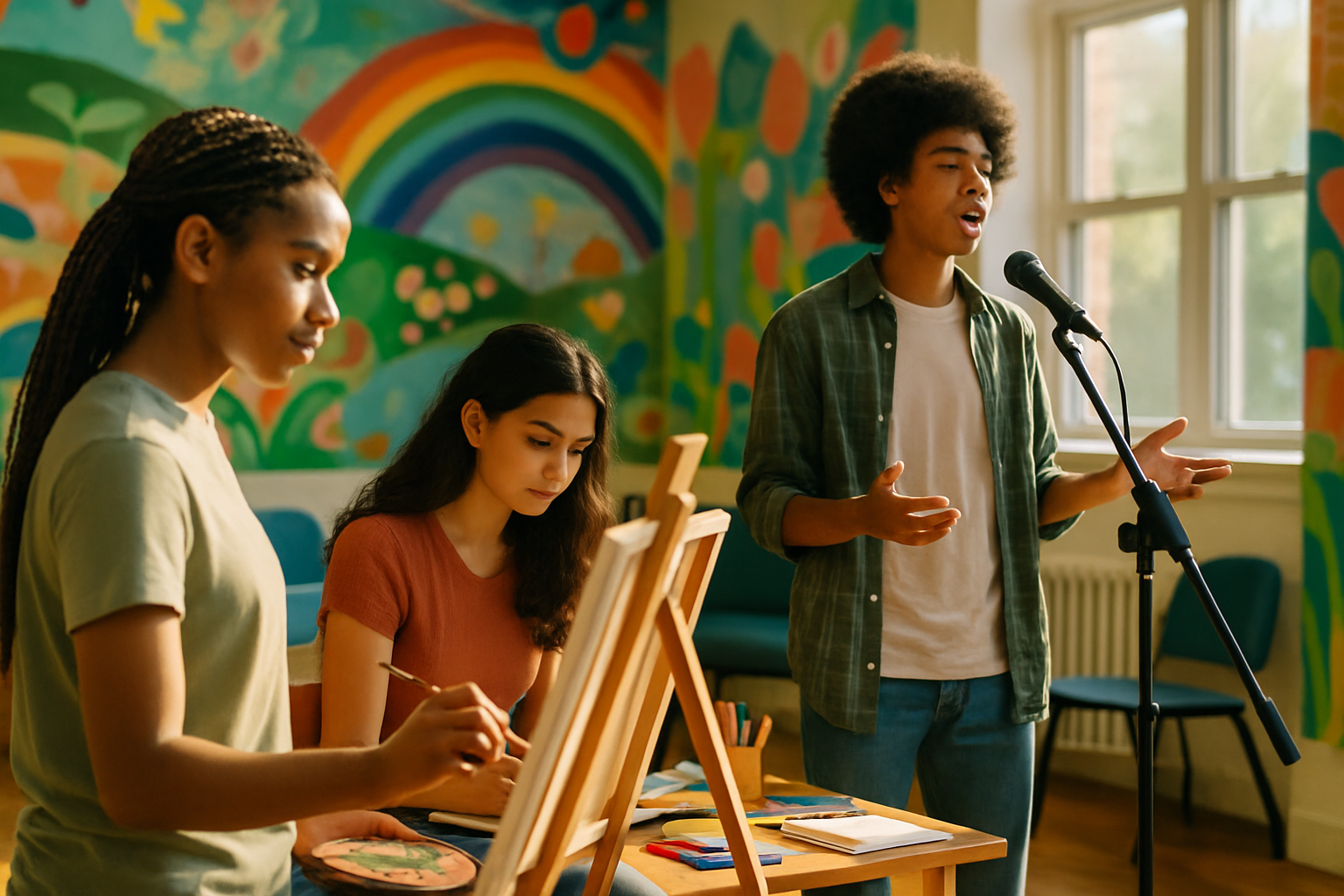
From the storytelling workshops of the Jisike Collective in London to cutting-edge prevention programs across continents, arts-based interventions are emerging as powerful tools in the fight against youth crime, offering at-risk young people creative pathways away from violence and criminal activity.
As governments worldwide grapple with rising youth crime rates and increasingly sophisticated juvenile criminal networks, a quiet revolution is taking place in community centers, schools, and cultural institutions. Programs harnessing the transformative power of creative expression are demonstrating remarkable success in preventing youth involvement in criminal activities, offering hope in communities devastated by cycles of violence.
The Jisike Collective: Storytelling as Intervention
In the heart of London, the Jisike Collective represents one of the most compelling examples of arts-based crime prevention. The organization uses storytelling workshops to engage at-risk youth, helping them process trauma and develop alternative narratives for their futures.
"Shaka," a 15-year-old born in Britain to African immigrant parents, exemplifies the challenges facing many young people today. Like thousands of others, he faced the dual pressures of cultural identity and social integration that can make youth vulnerable to criminal recruitment. The Jisike Collective's approach recognizes that behind every potential crime statistic is a young person with a story worth telling.
"When young people can tell their own stories, they begin to see themselves as authors of their destiny rather than victims of circumstance."
— Jisike Collective Program Coordinator
The program's methodology centers on creating safe spaces where participants can explore their experiences through narrative, poetry, and performance. This approach addresses what experts identify as a critical gap in traditional crime prevention: the need to provide young people with positive identity formation opportunities before they become involved in criminal activities.
Global Context: Youth Crime Sophistication
The urgency of innovative prevention approaches becomes clear when examining recent global trends. In Finland, authorities report alarming developments in what they term "crime as a service" operations, where minors are recruited through social media and chat applications to commit crimes including attempted murder for hire. This represents a disturbing evolution from traditional juvenile delinquency to organized criminal exploitation of vulnerable youth.
Lithuania is experiencing "uncontrollable teenage gangs" operating across major cities, evolved from casual gatherings to organized criminal enterprises using encrypted messaging for coordination. Similarly, Malaysia has witnessed coordinated attacks by groups of young motorcyclists on law enforcement officers, suggesting prior surveillance and premeditation that surpasses typical juvenile crime.
These developments underscore the critical need for prevention programs that address root causes rather than simply responding to criminal behavior after it occurs. Arts-based interventions offer a proactive approach, engaging youth before they become involved in criminal networks.
The Science of Creative Prevention
Research from the global mental health community provides compelling evidence for arts-based approaches. During the documented "Therapeutic Revolution of 2026," prevention-first strategies have demonstrated superior cost-effectiveness compared to traditional reactive intervention models.
Studies show that creative expression serves multiple functions crucial for at-risk youth: emotional regulation, community connection, trauma processing, and positive identity development. Queen Alexis, a young Black woman from British Columbia's Lower Mainland, rarely saw herself reflected in performing arts education spaces, highlighting how access barriers can leave vulnerable populations without crucial therapeutic outlets.
The performing arts provide what researchers term "alternative pathway development" – giving young people concrete skills, social connections, and future aspirations that compete with criminal recruitment. When youth have meaningful creative outlets and supportive communities, they become significantly less susceptible to criminal influence.
International Success Models
Across different cultural contexts, arts-based prevention programs share common success factors. In Montana, mobile crisis teams achieved an 80% reduction in police mental health calls through proactive community intervention that included creative expression components. Zimbabwe has implemented proactive family-school coordination addressing youth mental health before crisis development, incorporating traditional storytelling and performance.
The February 2026 Cultural Renaissance documented across multiple continents provides crucial context. Countries from Azerbaijan to Rwanda demonstrated that AI and digital tools can amplify rather than threaten cultural authenticity through thoughtful implementation respecting traditions while embracing technological possibilities.

This technological integration proves particularly relevant for youth programs. Social media platforms that criminal organizations use for recruitment can also serve as vehicles for positive creative expression and community building. The key lies in providing compelling alternatives that meet young people's needs for recognition, belonging, and purpose.
Addressing Systemic Challenges
Arts-based prevention programs must operate within broader contexts of systemic inequality and social pressure. The global investigation into mental health challenges revealed that 96% of children aged 10-15 use social media, with 70% experiencing harmful content exposure and over 50% facing cyberbullying. These digital pressures create additional vulnerability factors that creative programs must address.
Early smartphone exposure (before age 5) causes persistent sleep disorders, cognitive decline, and weight problems according to research from the University of Pennsylvania. University of Macau studies definitively prove short-form video scrolling damages cognitive development, causing social anxiety and academic disengagement. Children spending 4+ hours daily on screens face 61% increased depression risk.
Successful arts programs recognize these digital age challenges while leveraging technology's positive potential. Rather than competing with online platforms, effective programs integrate digital storytelling tools, social media for positive community building, and creative content creation that gives youth agency in their digital presence.
Economic and Social Benefits
Prevention-focused strategies generate substantial cost reductions through decreased crisis interventions while achieving superior population health outcomes. Initial prevention investments are justified through enhanced community resilience, reduced emergency care demands, and improved workforce productivity.
The economic multiplier effects extend beyond direct program costs. Communities with strong arts-based youth programs report increased cultural tourism, creative industry employment, enhanced international relationships, and overall community vitality. Young people involved in creative programs often become community assets, contributing to local cultural life and economic development.
"Investment in creative youth development is investment in community futures. Every young person engaged in positive creative activity is a victory against cycles of violence and despair."
— Community Development Researcher
Overcoming Implementation Barriers
Despite proven effectiveness, arts-based prevention programs face significant implementation challenges. Financial barriers prevent many marginalized families from accessing therapeutic arts programs. Queen Alexis's experience highlights how economic constraints can exclude the very populations most needing creative outlets.
The global memory crisis affecting semiconductor production until 2027 creates additional technological barriers. However, this constraint has paradoxically driven more thoughtful technology integration, treating digital tools as amplification serving program goals versus ends themselves.
Successful programs overcome these barriers through community partnerships, sliding-scale fees, integration with educational institutions, and leveraging existing cultural infrastructure. The most effective approaches combine professional artistic instruction with peer mentorship, creating sustainable community networks that persist beyond formal program participation.
Cultural Sensitivity and Local Adaptation
Effective arts-based prevention requires cultural sensitivity and local adaptation. Burkina Faso's emerging slam poetry movement, led by 21-year-old Doriane Wendyam Sawadogo, demonstrates how grassroots cultural emergence can maintain authentic local identity while developing international appeal.
Sawadogo's trajectory from studying David Diop's "Coup de pilon" in high school to becoming a prominent slam poet using "assumed aesthetics, dark tonalities, feminist engagement" illustrates how creative expression can provide positive identity development rooted in cultural heritage while addressing contemporary challenges.
Similarly, Azerbaijan's cultural programming positions the country as a bridge between Eastern and Western traditions through authentic international collaborations. These examples demonstrate that effective prevention programs must honor local cultural contexts while providing youth with skills and perspectives relevant to global opportunities.
Technology Integration Best Practices
The most successful youth programs demonstrate sophisticated understanding of technology's role in contemporary prevention efforts. Rather than viewing digital platforms as threats, innovative programs leverage social media, digital storytelling tools, and online community building as vehicles for positive engagement.
Canadian AI teaching assistants maintain critical thinking standards while providing personalized support. Singapore's WonderBot 2.0 demonstrates how heritage education can utilize conversational AI. Malaysia's world's first AI-integrated Islamic school combines technology with traditional learning, showing how innovation can enhance rather than replace cultural authenticity.
For youth crime prevention, this means creating digital content creation opportunities, online mentorship networks, and virtual creative showcases that compete with criminal recruitment's online presence. The key is ensuring technology serves human connection and creative development rather than replacing in-person relationships crucial for healthy youth development.
International Cooperation and Knowledge Sharing
Despite funding challenges affecting traditional multilateral organizations, bilateral partnerships and regional cooperation networks are driving innovation through peer-to-peer knowledge sharing. The distributed cooperation model allows flexible, culturally responsive approaches while maintaining evidence-based standards.
Countries implementing comprehensive, culturally-sensitive arts programs report improved community resilience, enhanced international competitiveness, and better preparation for 21st-century challenges. Success requires sustained political commitment, cultural integration enhancing local knowledge, and comprehensive stakeholder engagement.
International cooperation enables sharing of successful methodologies while respecting cultural differences. Programs proven effective in one context can be adapted rather than directly transplanted, maintaining core principles while adjusting for local conditions, resources, and cultural values.
The Path Forward
As criminal organizations become increasingly sophisticated in exploiting vulnerable youth, prevention programs must evolve to meet these challenges. The convergence of evidence-based prevention strategies, cultural therapeutic adaptation, and innovative international cooperation provides unprecedented opportunities for comprehensive youth development approaches.
Success requires moving beyond reactive crisis management toward proactive community infrastructure development. Arts and storytelling programs represent essential components of this infrastructure, providing young people with positive identity formation opportunities, creative skills, supportive communities, and alternative pathways to recognition and belonging.
The March 2026 moment represents a critical juncture where evidence-based innovations can be translated into accessible, effective interventions. The challenge involves harnessing technology's transformative potential while preserving human storytelling elements that provide emotional resonance and cultural significance.
"The future of youth crime prevention lies not in more sophisticated surveillance or harsher punishments, but in more compelling alternatives that speak to young people's fundamental human needs for purpose, belonging, and creative expression."
— Youth Development Policy Expert
The path forward requires unprecedented coordination between governments, educational institutions, cultural organizations, and communities. Success depends on recognizing creative expression not as luxury programming but as essential infrastructure for human flourishing and community safety.
As the Jisike Collective and similar programs worldwide demonstrate, when young people can tell their own stories, create meaningful art, and find supportive communities, they become authors of positive change rather than victims of circumstance. In an era of increasing global challenges, this transformation offers hope for breaking cycles of violence and building resilient, creative communities where all young people can thrive.