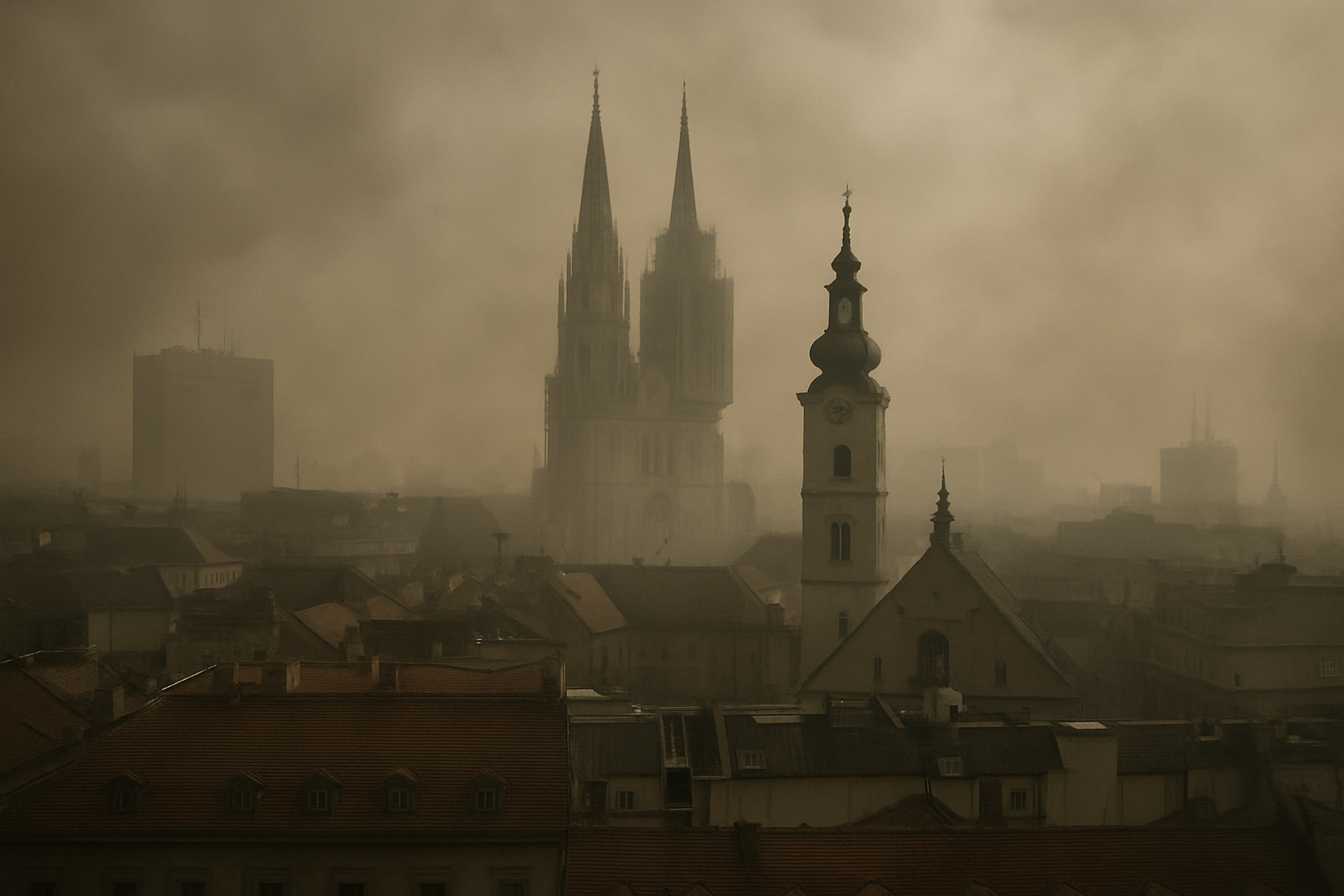
Zagreb faces a deepening air pollution crisis that ranks the Croatian capital among the top ten most polluted European Union capitals, with PM2.5 particulate matter levels consistently exceeding World Health Organization safety guidelines while questions persist about the adequacy of government intervention.
The air pollution plaguing Zagreb represents what environmental experts describe as a "biochemical assault" on the city's nearly one million residents. According to recent data analysis, the city consistently ranks dangerously low on air quality readings, with PM2.5 levels that can prove more harmful to human health than smoking cigarettes.
The Scale of Zagreb's Environmental Crisis
Zagreb's air pollution crisis stems from a toxic combination of geographical factors, meteorological conditions, and human activities. Despite having virtually no heavy industry compared to other European capitals, the city finds itself trapped in an environmental predicament that threatens the health of its residents daily.
The statistics paint a grim picture: around 240,000 people die prematurely each year across the EU due to polluted air, with approximately seven million deaths worldwide attributed to air quality issues. Zagreb's position in the upper half of the EU's most polluted capitals list is particularly alarming given its relatively small industrial footprint.
"Given that there is zero choice but to constantly breathe it (or you know… drop dead), polluted air can be more harmful than smoking."
— Environmental Analysis Report, Index/Nenad Jaric Dauenhaur
The crisis occurs within a broader context of unprecedented global environmental challenges. January 2026 marked the hottest month on record, extending an 18-consecutive-month streak of temperatures exceeding 1.5°C above pre-industrial levels. This sustained warming pattern has created additional stress on urban environments worldwide, with cities like Zagreb particularly vulnerable to compound environmental effects.
Geographic and Meteorological Factors
Zagreb's location contributes significantly to its air quality challenges. Situated in a basin surrounded by hills, the city experiences temperature inversions that trap pollutants close to ground level, particularly during winter months when heating systems increase particulate matter emissions.
The city's continental climate, characterized by hot summers and cold winters, creates conditions that alternately promote photochemical smog formation and particulate matter accumulation. During winter, residential heating using older, less efficient systems contributes to the pollution load, while summer heat creates ground-level ozone problems.
Human Activities and Pollution Sources
Despite Zagreb's minimal industrial presence, several human activities contribute to the air pollution crisis:
- Transportation: Vehicle emissions from an aging fleet and heavy traffic congestion in the city center
- Residential heating: Widespread use of wood-burning stoves and older heating systems, particularly in suburban areas
- Construction activities: Ongoing urban development projects that generate dust and particulate matter
- Cross-border pollution: Atmospheric transport of pollutants from neighboring regions with heavier industrial activity
The Health Impact
The health consequences of Zagreb's air pollution extend far beyond immediate respiratory irritation. Long-term exposure to PM2.5 particles has been linked to cardiovascular disease, lung cancer, stroke, and premature death. Children and elderly residents face particular risks, with the European Environment Agency establishing compelling links between air pollution and rising mental health problems.
PM2.5 particles are small enough to cross the blood-brain barrier, triggering inflammatory responses that contribute to depression, anxiety, and cognitive decline. This creates cascading psychological effects that compound the physical health impacts of environmental degradation.
Government Response: Promise vs. Performance
The critical question facing Zagreb residents remains: what concrete actions are being taken to address this environmental emergency? While Croatian authorities acknowledge the severity of the air quality crisis, the implementation of effective solutions has been slow and often fragmented.
Current government initiatives include:
- Air Quality Monitoring: Enhanced monitoring systems providing real-time data on pollution levels
- Traffic Management: Limited vehicle restriction policies during high pollution episodes
- Heating Regulations: Gradual phase-out of the most polluting heating systems
- Green Infrastructure: Urban planning initiatives incorporating more green spaces
However, environmental advocates argue that these measures remain insufficient given the scale and urgency of the crisis. The lack of comprehensive, coordinated action has led to growing public frustration and calls for more aggressive intervention.
Successful Models from Across Europe
Zagreb's situation is not unique in Europe, and several cities have successfully implemented strategies to improve air quality. Recent memory searches reveal coordinated environmental protection initiatives across multiple European countries, demonstrating that effective action is possible with sufficient political will and resources.
Cities like Stockholm have implemented congestion charging, while Paris has created low-emission zones that significantly reduced pollution levels. Milan's Area C program combines traffic restrictions with public transportation improvements, offering a model that could be adapted to Zagreb's specific circumstances.
Economic Dimensions of Environmental Action
The economic implications of Zagreb's air pollution crisis extend beyond immediate health costs. The city's tourism industry, worth hundreds of millions of euros annually, could suffer as environmental awareness among travelers increases. Real estate values in heavily polluted areas may decline, while healthcare costs related to pollution-induced illness continue to rise.
Conversely, successful air quality improvement programs demonstrate that environmental protection functions as an economic development strategy rather than a regulatory burden. Cities implementing comprehensive environmental protection often show greater economic resilience and attract sustainable investment across green technology manufacturing, eco-tourism, and environmental services sectors.
International Context and Climate Change
Zagreb's air pollution crisis occurs within the context of accelerating global climate change. The sustained warming pattern documented through 2026 has created additional stress on urban environmental systems, disrupting traditional weather patterns and potentially worsening air quality episodes.
The convergence of local pollution sources with global climate change creates compound environmental threats that require sophisticated, multi-faceted responses. Traditional approaches to air quality management may prove insufficient without considering the broader climate context and implementing adaptive management strategies.
Technology and Traditional Knowledge Integration
Successful environmental protection increasingly requires sophisticated integration of cutting-edge technology with traditional ecological knowledge and community-based management. Advanced air quality monitoring provides real-time data for public health responses, while satellite monitoring enables tracking of pollution sources and atmospheric transport patterns.
However, technology alone is insufficient. Community engagement and traditional environmental knowledge systems are essential for long-term effectiveness. The combination represents an evolution in environmental protection strategy that recognizes the limitations of purely technological approaches.
The Path Forward
Addressing Zagreb's air pollution crisis requires immediate, coordinated action across multiple sectors. The window for effective environmental action is narrowing as the city faces both local pollution challenges and broader climate change impacts.
Essential steps include:
- Implementation of comprehensive vehicle emission standards and low-emission zones
- Accelerated transition to cleaner heating systems with financial support for residents
- Enhanced public transportation to reduce private vehicle dependence
- Stricter enforcement of existing environmental regulations
- Integration with regional and EU-wide pollution reduction strategies
- Investment in green infrastructure and urban forest expansion
International Cooperation Imperative
Air pollution challenges cross political boundaries, making unilateral efforts insufficient. Success requires coordinated policy frameworks, shared monitoring systems, and collaborative enforcement mechanisms. Zagreb's integration with European environmental protection networks could provide access to funding, technology, and expertise necessary for effective action.
The diversity of approaches being tested across Europe provides multiple pathways for addressing air quality challenges. Knowledge sharing and international cooperation offer hope for scaling successful interventions while respecting local conditions and community needs.
A Critical Juncture
March 2026 represents a critical juncture for Zagreb's environmental protection efforts. The choice between reactive crisis management and proactive ecosystem service management may determine whether the city can address its air pollution crisis before it reaches irreversible proportions.
The tools, knowledge, and cooperation frameworks exist for effective environmental protection. The critical question is whether political will, economic incentives, and international cooperation can align rapidly enough to implement comprehensive solutions before the health and environmental costs become overwhelming.
"The challenge for 2026 is not to identify the problem, but to assume responsibility for solving it."
— Environmental Policy Analysis, 2026
Zagreb's residents deserve clean air, and the technology and policy mechanisms to achieve this goal are available. What remains is the political commitment and coordinated action necessary to transform environmental protection from a regulatory aspiration into a lived reality for the Croatian capital.
The city stands at a crossroads: continue with incremental measures while residents suffer the health consequences of polluted air, or implement the comprehensive, coordinated response that the scale of the crisis demands. The choices made in the coming months will determine not only Zagreb's environmental future but also its role as a model for urban environmental protection in an era of accelerating climate change.