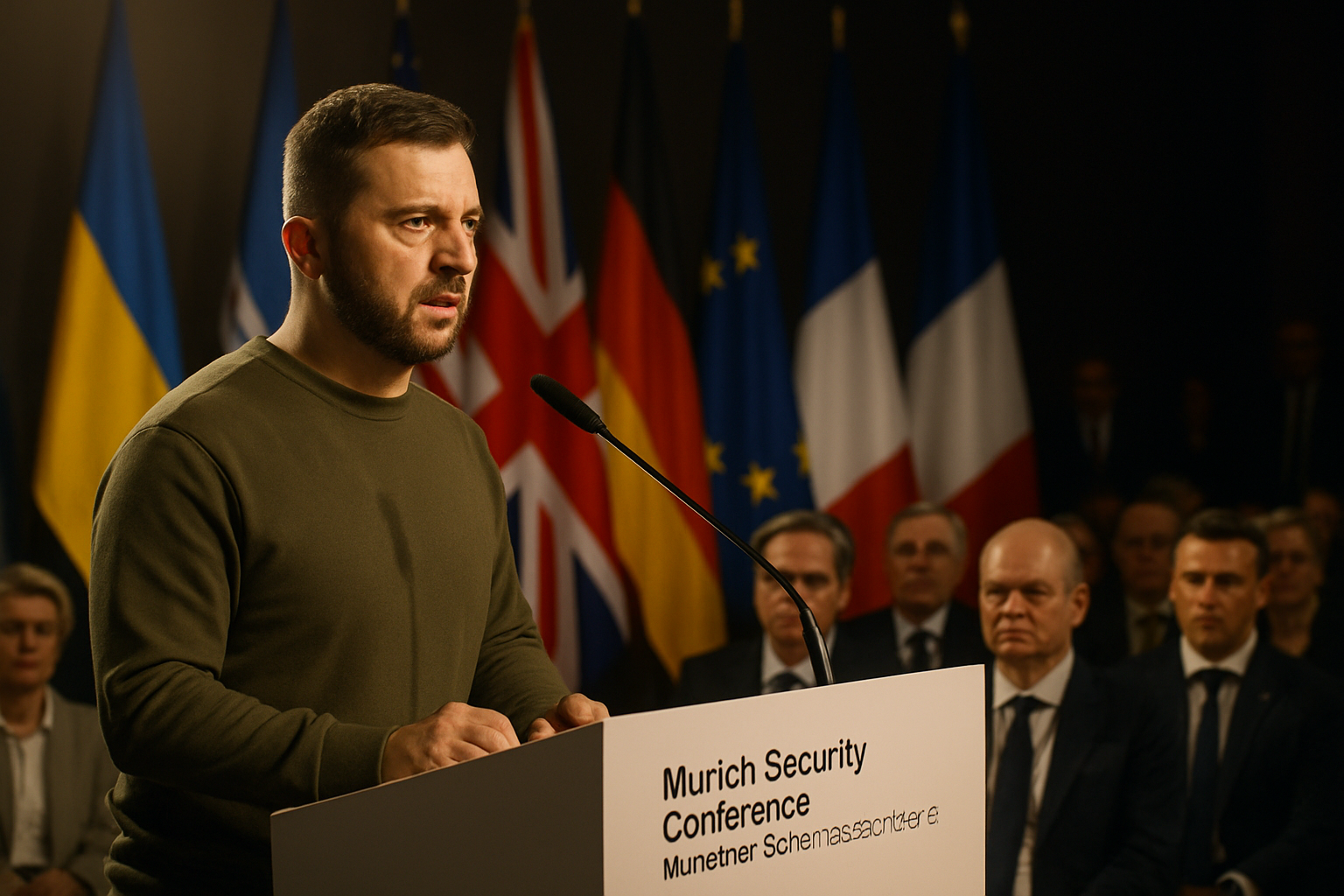
Ukrainian President Volodymyr Zelensky launched an intensive diplomatic campaign at the Munich Security Conference, holding critical discussions with US Secretary of State Marco Rubio and senior Trump administration officials as momentum builds toward crucial Geneva peace talks scheduled for February 17-18.
The 62nd Munich Security Conference became a pivotal diplomatic battleground as Zelensky worked to secure continued Western support while preparing for the next phase of trilateral negotiations with Russia and the United States. The Ukrainian leader's engagements included meetings with key figures who will shape the Geneva talks, including discussions with US presidential envoys Steven Witkoff and Jared Kushner.
High-Level US Engagement Signals Diplomatic Momentum
In a significant development, Zelensky confirmed he held phone conversations with both Witkoff, Trump's special envoy for Ukraine, and Kushner, the former president's son-in-law, ahead of the Geneva negotiations. These discussions underscore the Trump administration's direct involvement in the diplomatic process as talks evolve from the Abu Dhabi framework to European neutral territory.
The Ukrainian president also met directly with Secretary Rubio during the conference, focusing on strengthening Ukraine's air defense capabilities and coordinating the next steps in the trilateral negotiations. According to the Ukrainian President's Office, Zelensky briefed Rubio on the current frontline situation and discussed how the United States could help Ukraine protect its population during the harsh winter months while strengthening national resilience.
"We have discussed how Ukraine can be helped to protect the population in the midst of winter cold and to strengthen our resilience," Zelensky stated in his social media message following the Rubio meeting.
— Volodymyr Zelensky, Ukrainian President
Putin Condemned as "Slave to War" in Conference Address
Zelensky delivered a forceful address to the Munich Security Conference, denouncing Russian President Vladimir Putin as a "slave to war" and highlighting the systematic destruction of Ukraine's energy infrastructure. His speech provided stark evidence of Russia's targeting of civilian facilities, revealing that every single power plant in Ukraine has been damaged by Russian attacks.
"There is not a single power plant left in Ukraine that has not been damaged by Russian attacks. Not one," Zelensky declared to the international audience, emphasizing the scale of Russia's systematic campaign against civilian infrastructure.
The Ukrainian leader's remarks came as he received the prestigious Ewald von Kleist Award from the Munich Security Conference on behalf of the Ukrainian people, recognizing their resilience and sacrifice in defending democratic values against authoritarian aggression.
Geneva Talks: Evolution from Abu Dhabi Success
The upcoming Geneva negotiations represent a significant evolution from the Abu Dhabi trilateral talks that achieved a historic breakthrough earlier this month. The February 5 Abu Dhabi talks resulted in the largest prisoner exchange in five months, with 314 prisoners swapped, and the restoration of US-Russia military communications after a four-year suspension.
Ukrainian Defense Minister Rustem Umerov, who will lead Ukraine's delegation in Geneva, described the Abu Dhabi talks as "substantial and productive," with detailed discussions on ceasefire implementation and monitoring mechanisms. The Russian delegation will be headed by Vladimir Medinsky, a Putin advisor and chief negotiator, while the US will continue its mediation role under Steve Witkoff.
The shift to Geneva, a traditional neutral venue for international diplomacy, signals the growing seriousness of the peace process as it moves beyond technical discussions toward more substantive political negotiations.
Security Concerns and Diplomatic Challenges
During a press conference in Munich, Zelensky addressed concerns about personal security, stating he does not dwell on potential threats from Putin similar to those faced by the late Russian opposition leader Alexei Navalny. "I cannot think about Vladimir Putin and his plans to poison me, if there are any. I try not to think about this, otherwise I would only think about this," Zelensky told journalists.
The Ukrainian president also held significant discussions with Azerbaijani President Ilham Aliyev, briefing him on Ukraine's energy situation and emphasizing that Russia's reluctance to end the war is the primary cause of the ongoing conflict.
Nuclear Crisis Adds Urgency to Diplomatic Efforts
The diplomatic activities at Munich occur against the backdrop of a serious nuclear governance crisis. The New START treaty between the US and Russia expired on February 5, 2026, marking the first time in over 50 years without nuclear arms control constraints between the superpowers. UN Secretary-General António Guterres warned this creates a "grave turning point" with nuclear risks at their "highest in decades."
This nuclear vacuum adds considerable urgency to the Geneva talks, as the restored US-Russia military communications serve as the only remaining major diplomatic channel between the nuclear superpowers. The Pentagon confirmed that these communications include deconfliction protocols covering global operations in Syria, the Arctic, and Africa.
Military Pressure Continues Amid Diplomatic Progress
Despite the diplomatic momentum, military escalation continues on the ground. Russian forces have accelerated territorial gains, capturing 481 square kilometers in January 2026 compared to 260 square kilometers in December 2025. The ongoing "winter weapon" strategy has left over 1,170 buildings in Kyiv without heating during temperatures as low as minus-30°C.
Zelensky disclosed that 55,000 Ukrainian soldiers have been officially confirmed killed, with a "large number" still missing in action, providing concrete data on the human cost of the nearly four-year conflict. The systematic targeting of energy infrastructure during extreme winter conditions has created a humanitarian crisis affecting over 17.8 million Ukrainians who are accessing winter support programs.
International Support Reinforced
The Munich conference reinforced international support for Ukraine with the European Union's historic €90 billion loan package - the largest ever for a single nation - though Slovakia, Czech Republic, and Hungary refused participation, revealing persistent European divisions. Sweden and Denmark announced a €246 million air defense package, while the World Bank allocated $40 million for energy restoration efforts.
The conference theme, "Era of Disruptive Politics," reflected the most sobering assessment in the event's 62-year history, with German Chancellor Friedrich Merz declaring that the "post-war order no longer exists."
Path Forward to Geneva and Beyond
As diplomatic activities conclude in Munich, attention turns to Geneva where the trilateral talks will test whether the humanitarian breakthroughs achieved in Abu Dhabi can translate into progress on the fundamental territorial disputes that remain the core sticking point. Eastern Ukrainian territories under Russian control continue to represent the primary obstacle to a comprehensive peace agreement.
The Geneva talks are positioned as a crucial test of whether sustained diplomatic engagement can produce territorial compromise solutions or if the conflict will continue to escalate militarily. Success could end Europe's deadliest war since World War II and provide a template for 21st-century conflict resolution, while failure may intensify operations and undermine diplomatic credibility globally.
With the Trump administration establishing a June 2026 deadline for a comprehensive peace agreement and Washington emerging as a potential venue for future talks, the Geneva negotiations represent a critical stepping stone toward what could become the highest-level diplomatic engagement since the conflict began. The international community watches as diplomatic innovation is tested against the traditional limitations of territorial dispute resolution in an era where the foundations of international order face their greatest challenges since World War II.