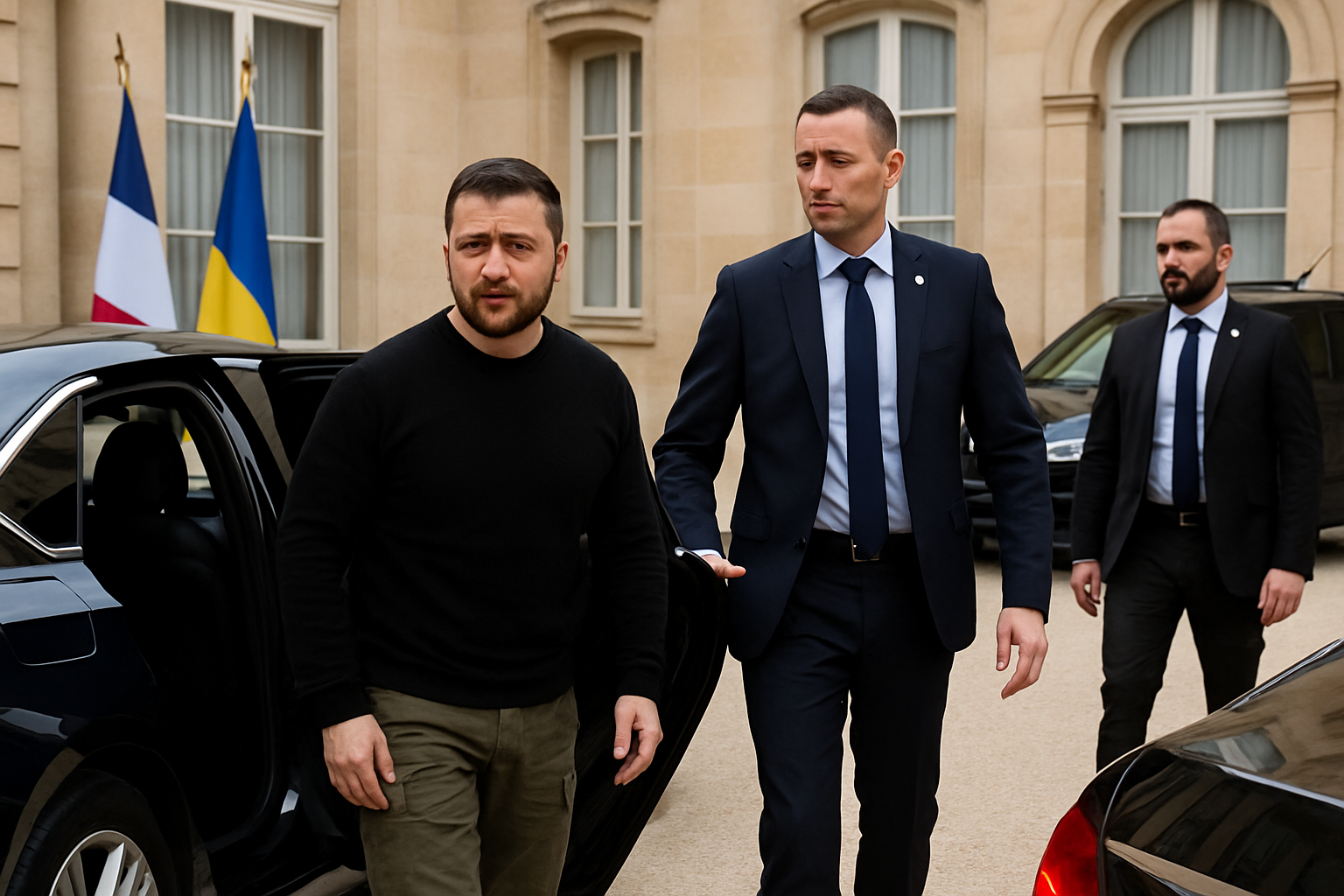
Ukrainian President Volodymyr Zelensky arrived in Paris on Friday for high-stakes discussions with French President Emmanuel Macron on intensifying pressure against Russia, as the escalating Iran crisis threatens to divert international attention from Ukraine's fight and derail recent diplomatic momentum in peace negotiations.
The visit comes at a particularly challenging moment for Ukraine, as the widening Middle East conflict has raised serious questions about the continued supply of weapons—particularly crucial air defense systems—from Western partners. The Iranian crisis has already forced the indefinite postponement of trilateral peace talks between Ukraine, Russia, and the United States that had shown promising progress in recent months.
Iran Crisis Overshadowing Ukraine Conflict
Zelensky has repeatedly warned that Ukraine's acute shortage of air defense missiles will be exacerbated by the Iran crisis, as Gulf Arab states have drawn down their own air defense stocks to repel daily attacks. In a stark illustration of the resource competition, Zelensky noted that Gulf states had used more PAC-3 air defense missiles against Iranian strikes in a few days than Kyiv had received from Washington over four years.
The timing could not be worse for Ukraine's diplomatic efforts. The country had achieved unprecedented momentum in peace negotiations, including a historic 314-prisoner exchange with Russia in February—the first such swap in five months—and the restoration of US-Russia military communications after a four-year suspension. However, according to Zelensky's recent announcement, these trilateral talks have been indefinitely postponed "due to the situation around Iran."
"Due to situation around Iran, there are still no necessary signals for trilateral meeting, but talks will resume as soon as security situation and general political context allow."
— President Volodymyr Zelensky
French-Ukrainian Strategic Partnership
The Paris meeting with Macron serves multiple strategic purposes for Ukraine. French sources indicate the discussions will focus on ramping up pressure on Russia, including targeting Moscow's "shadow fleet" of oil tankers that help circumvent international sanctions. This comes as the European Union has struggled to maintain unity, with Hungary threatening to block both the €90 billion EU loan package for Ukraine and the 20th sanctions package against Russia over pipeline disputes.
France has emerged as one of Ukraine's most steadfast supporters, with Macron repeatedly emphasizing that the war in the Middle East "will not divert" attention from Ukraine. The French president has been pursuing what he terms "alternative dialogue with Russia" to ensure France remains "part of ending war process with voice heard," even as Germany opposes direct talks with Putin.
The visit also represents Ukraine's strategic pivot during the diplomatic pause. With peace talks on hold, Zelensky has been engaging Middle Eastern partners, announcing that Ukrainian military experts will deploy to Persian Gulf states to combat Iranian "Shahed" drone attacks—the same drones that have devastated Ukrainian infrastructure. This represents an evolution from aid recipient to security provider, leveraging battlefield experience into new strategic partnerships.
Military Situation Deteriorates
The diplomatic pause comes as Ukraine faces increasingly challenging military circumstances. Russian territorial gains have accelerated significantly, with Moscow capturing 481 square kilometers in January 2026 compared to 260 square kilometers in December 2025—an 85% increase representing the fastest gains in months. Over 10,000 Russian drones and bombs were launched in January 2026 alone.
The systematic targeting of civilian infrastructure continues unabated. Russia's "energy terrorism" strategy has left more than 1,170 buildings in Kyiv without heating during sub-zero temperatures, and Ukrainian nuclear plants have been forced to halt electricity production for the first time in the conflict. Recent attacks in Pokrovsk and Kostiantynivka regions in Donetsk Oblast have been particularly intense.
Zelensky has disclosed that 55,000 Ukrainian soldiers have been officially confirmed killed since the invasion began, with a "large number" still classified as missing in action. International estimates suggest the actual military death toll could be 2-3 times higher when including missing personnel and undocumented casualties.
Nuclear Governance Crisis
Adding urgency to the diplomatic efforts is the unprecedented nuclear governance crisis. The New START treaty between the United States and Russia expired on February 5, 2026, marking the first time in over 50 years without bilateral nuclear constraints between the superpowers that control 80% of global nuclear weapons. UN Secretary-General Guterres has warned of a "grave turning point" with nuclear risks at their "highest in decades."
The restored military communications between Washington and Moscow, achieved through the Abu Dhabi diplomatic breakthrough, now represent the only remaining formal diplomatic channel between the nuclear superpowers. This makes the suspension of broader peace talks particularly concerning for global security architecture.
International Support Despite Divisions
Despite the challenging circumstances, Ukraine continues to receive unprecedented international support. The EU's €90 billion loan package represents the largest single-nation assistance in European history, though Slovakia, Czech Republic, and Hungary have refused participation, exposing deep divisions within the bloc.
Additional support includes Sweden and Denmark's €246 million air defense package featuring Tridon systems, Germany's commitment of 35 Patriot missiles, and continued World Bank funding for energy restoration. Over 17.8 million Ukrainians are currently accessing winter support programs as the country struggles with systematic infrastructure attacks.
Looking Ahead: June Deadline Looms
The Trump administration had established a June 2026 deadline for comprehensive peace negotiations, with talks potentially moving to Washington venue for presidential-level engagement. This evolution from Abu Dhabi to Geneva to Washington had suggested a deliberate diplomatic escalation strategy. However, the Iran crisis has now created uncertainty around this timeline.
The fundamental sticking points remain unchanged: eastern Ukrainian territories under Russian control represent the core disagreement, with Russia demanding territorial recognition and insisting that any Putin-Zelensky talks occur in Moscow, while Ukraine maintains its territorial integrity position and seeks long-term security guarantees.
As Zelensky meets with Macron in Paris, both leaders face the challenge of maintaining momentum in supporting Ukraine while managing the expanding crisis in the Middle East. The success or failure of their coordination could prove decisive for Ukraine's position when peace talks eventually resume, and for the broader question of whether the international community can effectively manage multiple simultaneous crises in an increasingly multipolar world.
The stakes extend far beyond Ukraine's borders. This diplomatic moment will test whether the framework for 21st-century conflict resolution can adapt to interconnected regional crises, or whether competing priorities will undermine efforts to resolve Europe's deadliest conflict since World War II.