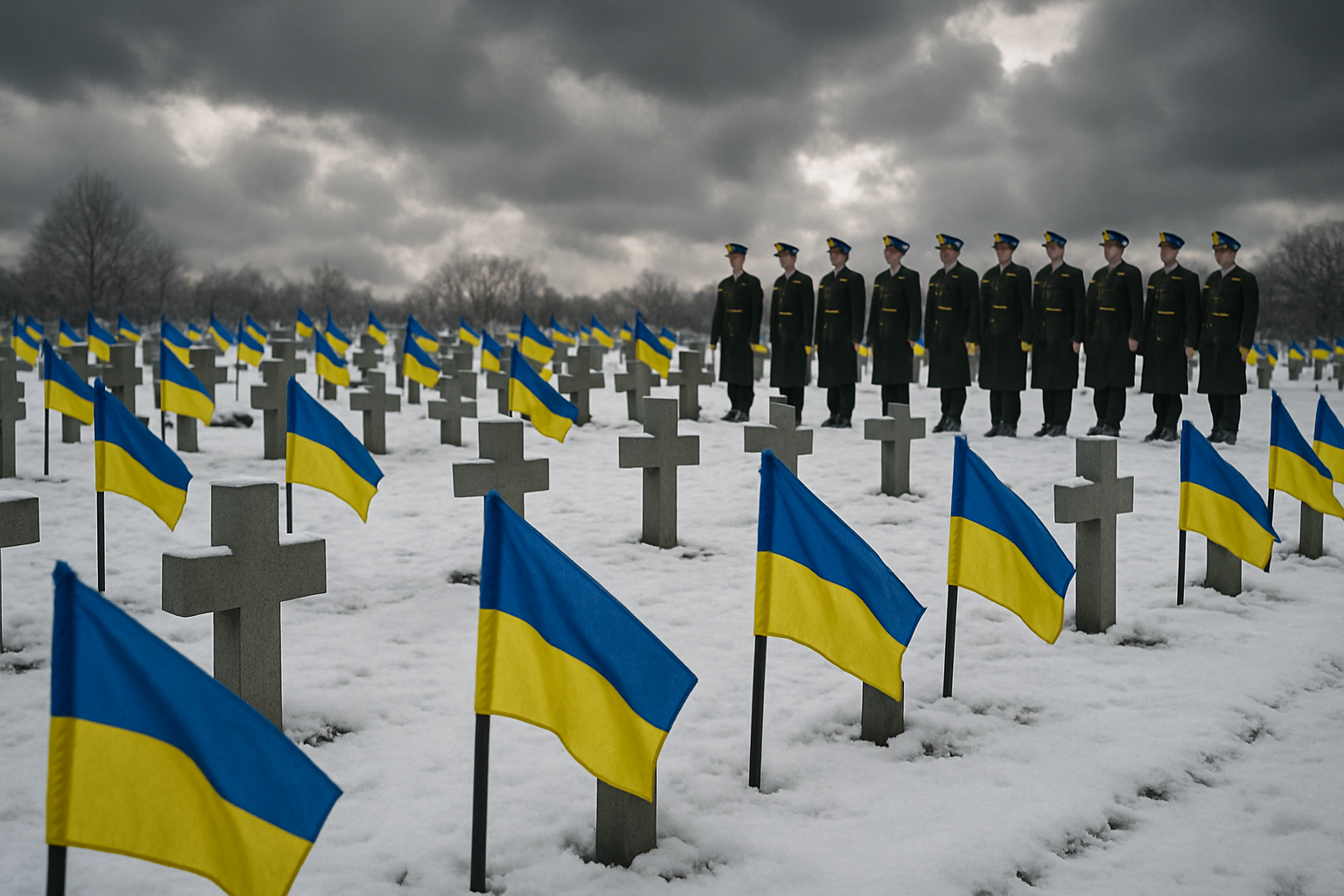
Ukrainian President Volodymyr Zelensky revealed that approximately 55,000 Ukrainian soldiers have been killed since Russia's full-scale invasion began in February 2022, marking the first official casualty figure disclosed by Ukraine's leadership in nearly a year.
The stark revelation came during an interview with French television channel France 2 on February 4, 2026, as Zelensky also announced expectations for an upcoming prisoner exchange with Russia following trilateral negotiations in Abu Dhabi involving Ukraine, Russia, and the United States.
"In Ukraine, 55,000 military personnel have officially died on the battlefield, both career soldiers and mobilized personnel," Zelensky stated during the interview. He emphasized that this figure represents only confirmed battlefield deaths and does not include "a large number of people" officially considered missing in action.
First Official Casualty Count in Nearly a Year
This disclosure represents Ukraine's first official casualty figure since early 2025, when Ukrainian officials had been reluctant to provide specific numbers citing operational security concerns. The figure of 55,000 killed soldiers significantly updates previous estimates and provides concrete data on the human cost of the nearly four-year conflict.
According to multiple international sources, various foreign research centers estimate that the actual number of Ukrainian military deaths could be two to three times higher than the official count. The discrepancy highlights the challenges of accurately tracking casualties in an active war zone where soldiers can be missing in action for extended periods.
The Romanian outlet Digi24 reported that Zelensky also estimated Russia would need to sacrifice an additional 800,000 soldiers over two years to militarily capture eastern Ukraine, the territories Moscow seeks to annex. This projection underscores the massive scale of potential future casualties if diplomatic solutions remain elusive.
Prisoner Exchange Developments
Concurrent with the casualty disclosure, Zelensky announced significant progress in prisoner exchange negotiations with Russia. Speaking from ongoing trilateral talks in Abu Dhabi, the Ukrainian president expressed optimism about securing the release of Ukrainian prisoners of war in the near future.
"Following trilateral meetings in the United Arab Emirates, Ukraine expects a prisoner exchange with Russia in the near future, with talks set to continue tomorrow," Zelensky stated, according to Ukrainian media reports. This would mark the first prisoner swap between the two nations in four months, representing a potential breakthrough in humanitarian negotiations.
The prisoner exchange discussions are occurring alongside broader peace negotiations involving Ukrainian Defense Minister Rustem Umerov, Russian military intelligence director Igor Kostyukov, and US Special Envoy Steve Witkoff. These talks represent the second round of trilateral negotiations aimed at finding pathways to end the conflict.
Diplomatic Context and Challenges
The casualty announcement and prisoner exchange news emerge against the backdrop of intensified Russian attacks on Ukrainian infrastructure. Just days before the Abu Dhabi talks, Russia launched what Ukrainian energy company DTEK described as the "most powerful blow" of 2026 against Ukraine's energy infrastructure, leaving over 1,170 buildings in Kyiv without heating during temperatures as low as minus-30°C.
NATO Secretary-General Mark Rutte made a surprise visit to Kyiv just before the negotiations began, addressing the Ukrainian Parliament and condemning the Russian attacks as sending a "bad signal" ahead of diplomatic talks. The timing of the massive assault broke an informal agreement between Trump and Putin to avoid targeting energy infrastructure during peace negotiations.
European divisions remain evident in the diplomatic approach to Russia. Germany continues to oppose direct talks with Putin, citing "maximalist demands," while France and Italy push for maintaining diplomatic channels. The United Kingdom and France have pledged potential troop deployments to enforce any future peace agreement, which has prompted Russian threats.
Military Situation and Strategic Implications
The Institute for Study of War reports that Russian forces captured 481 square kilometers of Ukrainian territory in January 2026, compared to 260 square kilometers in December 2025, indicating an acceleration in Russian territorial gains. Over 10,000 Russian drones and bombs were launched against Ukrainian targets in January alone, representing a significant escalation in the conflict's intensity.
Russia has shifted its strategy to what analysts describe as "logistics terror," targeting Ukrainian transportation infrastructure instead of focusing solely on energy facilities. This tactical change has resulted in over 20 civilian deaths in recent weeks, with Ukrainian railway officials warning that eastern routes are becoming "high risk" for civilian travel.
The Ukrainian military has implemented new defensive measures, including a Starlink terminal registration system developed in cooperation with SpaceX to prevent Russian forces from using the satellite internet service for drone operations. Elon Musk confirmed that SpaceX successfully blocked Russian attempts to use Starlink for military purposes.
International Support and Humanitarian Crisis
International support for Ukraine continues despite the mounting casualties. Sweden and Denmark announced a €246 million air defense package, including advanced Tridon Mk2 systems, while Poland deployed fighter jets preemptively in response to Russian attacks. The World Bank has allocated $40 million specifically for Ukrainian energy system restoration efforts.
The humanitarian crisis deepens as over 17.8 million Ukrainians have accessed winter support programs due to ongoing power outages and infrastructure damage. Emergency warming centers have been activated across multiple regions, particularly in Kyiv, Kharkiv, and Zaporizhzhia, where Russian attacks have been most concentrated.
Warsaw has provided 90 emergency generators to Kyiv to help address heating shortages, while various European nations continue to supply military and humanitarian aid. The European Union maintains its sanctions regime against Russia while supporting Ukraine's defensive capabilities.
Looking Forward
Despite the grim casualty figures and ongoing attacks, Zelensky maintains "cautious optimism" about achieving what he terms "lasting and dignified peace." The prisoner exchange negotiations represent a potential confidence-building measure that could facilitate broader diplomatic progress.
The Abu Dhabi talks are expected to continue through the week, with the potential to establish a framework for future higher-level negotiations. However, significant obstacles remain, particularly regarding the long-term fate of eastern Ukrainian territories currently under Russian control, which both sides consider non-negotiable.
As Ukraine approaches the four-year mark of Russia's invasion, Zelensky's disclosure of the 55,000 killed soldiers serves as a sobering reminder of the conflict's human cost while diplomatic efforts continue to seek pathways toward resolution. The upcoming prisoner exchange, if successful, could provide a humanitarian breakthrough that demonstrates the possibility of cooperation even amid ongoing hostilities.