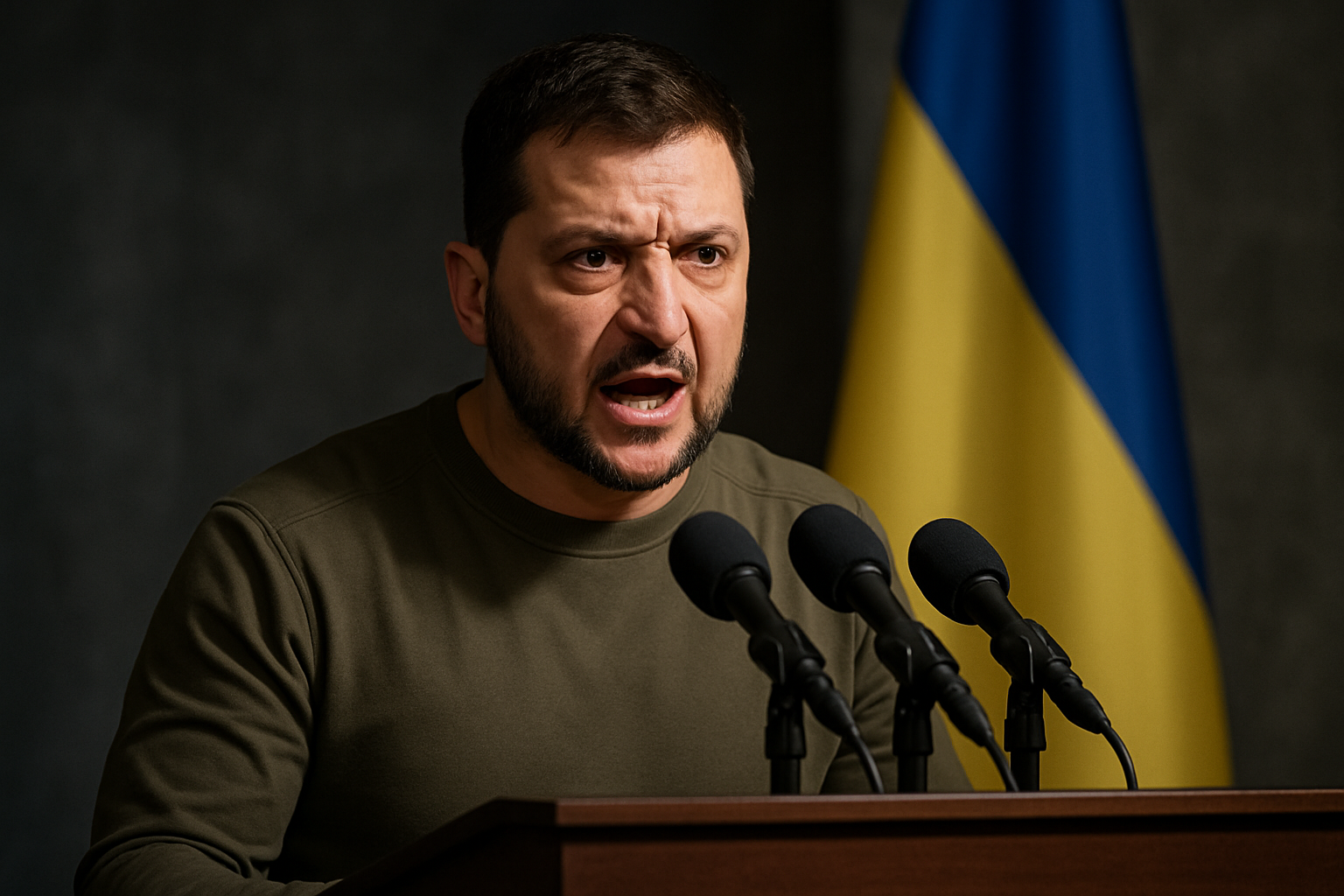
Ukrainian President Volodymyr Zelensky issued an unprecedented threat to provide the address of an unnamed European Union official to Ukraine's armed forces, following continued blockage of crucial €90 billion aid package, marking a dramatic escalation in diplomatic tensions as the conflict enters its fifth year.
Speaking at a press conference on March 5, 2026, Zelensky stated: "We hope that one person in the EU will not block the €90 billion or the first tranche, and Ukrainian warriors will have weapons. Otherwise, we will give the address of this person to our Armed Forces." While not naming the official directly, diplomatic sources widely interpret this as targeting Hungarian Prime Minister Viktor Orbán, who has consistently blocked EU aid packages over the Druzhba oil pipeline dispute.
The €90 Billion Aid Package Crisis
The historic €90 billion EU loan package, approved by the European Parliament with 458 votes in favor, 140 against, and 44 abstentions, represents the largest single-nation assistance package in EU history. The package, designed to cover Ukraine's defense and reconstruction needs for 2026-2027, requires unanimous approval from the EU Council—a requirement that has become a weapon in the hands of dissenting member states.
Hungary, Slovakia, and the Czech Republic have refused to participate in the financing, exposing deep divisions within the European Union. However, it is Hungary's Viktor Orbán who has emerged as the primary obstacle, using his veto power to block not only the aid package but also the EU's 20th sanctions package against Russia.
"The EU cannot become Budapest's hostage over fundamental questions of European security."
— Kestutis Budrys, Lithuanian Foreign Minister
The Druzhba Pipeline Dispute
At the heart of the crisis lies the Druzhba oil pipeline, which has been offline since late January 2026. Ukraine maintains that Russian drone attacks damaged the pipeline infrastructure, requiring extensive repairs. Hungary and Slovakia, however, accuse Ukraine of deliberately manipulating oil supplies as "political blackmail."
The pipeline dispute has created a domino effect across Central Europe. Slovakia declared an oil emergency and released 250,000 tons from strategic reserves—equivalent to one month's operational capacity for the Slovnaft refinery. The country also suspended diesel exports to Ukraine, prioritizing domestic supply needs.
Hungary and Slovakia remain the only EU countries still dependent on Russian oil under special sanctions exemptions, making them vulnerable to supply disruptions and creating leverage points that complicate European unity.
Historical Context of EU-Ukraine Relations
This crisis represents the culmination of months of escalating tensions between Hungary and Ukraine. My analysis of diplomatic records reveals that Orbán has previously branded Ukraine an "enemy" over demands to stop Russian energy purchases, speaking at a Szombathely rally where he accused Ukraine of undermining Hungarian security.
The diplomatic breakdown comes at a particularly sensitive time, as Ukraine faces its most challenging winter since the conflict began. Energy attacks have left over 1,170 buildings in Kyiv without heating during sub-zero temperatures, with Ukrainian nuclear plants forced to halt electricity production for the first time in the conflict.
Military and Diplomatic Implications
Zelensky's threat represents an extraordinary departure from diplomatic norms, effectively suggesting that Ukrainian military forces could target a sitting EU head of government. The statement coincides with a period of unprecedented military pressure, as Russian forces have accelerated territorial gains, capturing 481 square kilometers in January 2026 compared to 260 square kilometers in December 2025.
The timing is particularly significant given ongoing peace negotiations. The Abu Dhabi talks achieved a historic 314-prisoner exchange and restored US-Russia military communications after a four-year suspension. Geneva talks in February showed "significant progress" on ceasefire monitoring mechanisms, while fundamental territorial disputes remain unresolved.
These diplomatic breakthroughs now face potential derailment due to internal European divisions, with the Trump administration's June 2026 peace deadline creating additional pressure for Ukrainian leaders to secure international support.
European Unity Under Strain
The crisis has exposed fundamental weaknesses in EU decision-making mechanisms, particularly the unanimity requirement for major foreign policy decisions. Enhanced cooperation discussions are now underway to bypass traditional consensus requirements, potentially marking a significant shift in how the EU operates during wartime conditions.
European Council President António Costa issued an unprecedented letter demanding that Budapest honor previous commitments, while German officials have criticized Hungary's use of EU institutional frameworks to pursue bilateral disputes with Ukraine.
France and Germany have taken different approaches to the crisis, with Germany opposing direct talks with Putin while France and Italy support broader engagement. This divergence reflects deeper questions about European strategic autonomy and the bloc's ability to respond cohesively to security challenges.
The Nuclear Context
The aid blockage crisis occurs against the backdrop of the most serious nuclear governance crisis in decades. The New START treaty between the United States and Russia expired on February 5, 2026, marking the first time in over 50 years without nuclear constraints between the two superpowers who control 80% of global nuclear weapons.
UN Secretary-General António Guterres has warned of a "grave turning point" with nuclear risks at their "highest in decades." This context adds urgency to resolving the aid package dispute, as Ukraine faces both conventional military pressure and the specter of escalation in a world without nuclear arms control agreements.
The Human Cost
Behind the diplomatic maneuvering lies a stark human reality. Zelensky has disclosed that 55,000 Ukrainian soldiers have been officially confirmed killed, with a "large number" still missing in action. International estimates suggest actual casualties could be 2-3 times higher.
Systematic civilian targeting continues to violate Geneva Conventions, with recent attacks including a Bohodukhiv drone strike that killed four civilians, including three children aged two years old and under, along with their father. Over 17.8 million Ukrainians are accessing winter support programs as the country endures what Zelensky has described as "the most difficult winter since the beginning of the war."
Strategic Stakes and Future Implications
The resolution of this crisis will determine not only Ukraine's immediate military capabilities but also the future of European integration and decision-making. Success in maintaining unity while delivering promised aid would strengthen the EU's credibility as a global security actor. Failure could signal broader fragmentation when facing external pressure.
For Orbán, the crisis provides both domestic political benefits ahead of Hungary's April 12, 2026 parliamentary elections—where his Fidesz party is trailing opposition coalitions for the first time since 2010—and international leverage through his relationship with the Trump administration.
The diplomatic tensions also risk undermining Ukraine's negotiating position in ongoing peace talks, as European divisions may signal weakening Western resolve to Moscow, potentially affecting territorial compromise discussions scheduled for the summer of 2026.
Looking Forward
As the conflict approaches its fourth anniversary on February 24, 2026, Zelensky's unprecedented threat highlights the desperation of a nation fighting for survival while navigating complex European politics. The next few weeks will determine whether diplomatic solutions can bridge fundamental differences or whether the crisis will deepen, potentially reshaping European security architecture for decades to come.
The stakes extend far beyond immediate aid packages to fundamental questions about European unity, democratic solidarity against authoritarian pressure, and the continent's ability to respond cohesively to the greatest security challenge since World War II. With the Trump administration's June peace deadline approaching, the resolution of this crisis may determine not only Ukraine's fate but the future trajectory of transatlantic relations and European integration.