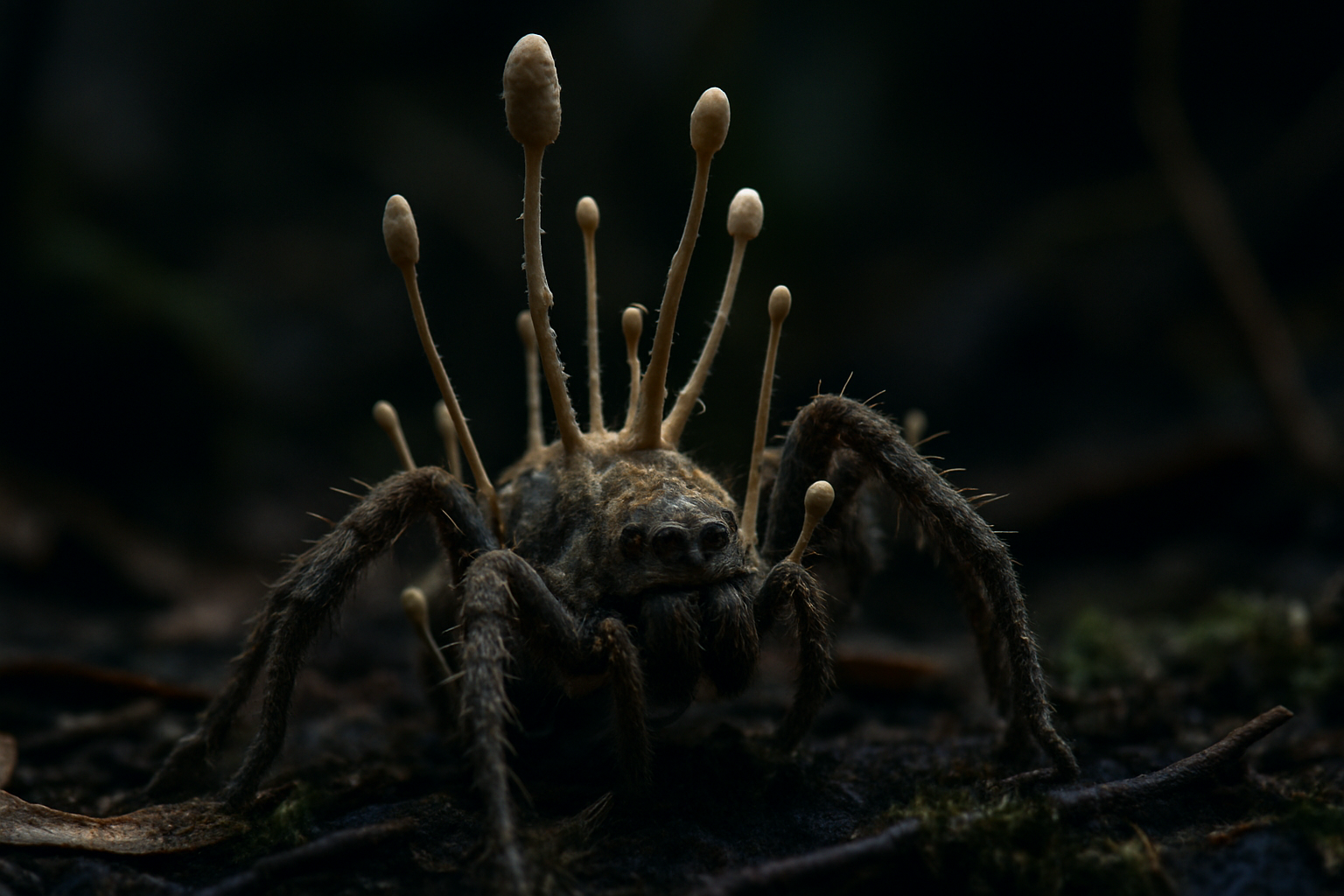
Swedish scientists have made a startling discovery in the realm of parasitic biology: a "zombie fungus" that takes complete control of spiders, manipulating their behavior to serve the fungus's reproductive needs. The breakthrough finding, which has captured international attention, reveals a species that likely extends across Scandinavian borders into Norway.
The fungus operates through a sophisticated biological hijacking mechanism, effectively turning its spider hosts into unwilling servants. Once infected, the spiders lose autonomous control over their actions and become vehicles for fungal reproduction, demonstrating one of nature's most dramatic examples of parasitic manipulation.
The Mechanism of Control
According to the Norwegian source reporting on this Swedish discovery, "Soppen tar kontroll over edderkopper og bruker dem til å formere seg" - the fungus takes control of spiders and uses them to reproduce. This process represents a complex evolutionary adaptation where the parasitic organism has developed mechanisms to override the host's nervous system.
The infection begins when fungal spores attach to the spider's exoskeleton. Once the fungus penetrates the host's body, it gradually spreads throughout the spider's tissues while carefully avoiding vital organs that would immediately kill the host. This strategic infection pattern allows the fungus to maintain the spider as a living, mobile platform for reproduction.
Behavioral Manipulation
The most remarkable aspect of this discovery lies in the fungus's ability to alter spider behavior in ways that benefit fungal reproduction rather than spider survival. Infected spiders display abnormal movement patterns, often positioning themselves in locations that optimize conditions for fungal spore dispersal.
Research indicates that the fungus produces neurochemical compounds that interfere with the spider's natural behavioral responses. These chemical signals effectively reprogram the host's actions, compelling behaviors that would never occur under normal circumstances. The infected spiders may climb to elevated positions, adopt specific postures, or move to areas with particular humidity and temperature conditions that favor fungal reproduction.
Cross-Border Implications
The discovery's significance extends beyond Sweden's borders, with researchers suggesting the species likely exists in Norway as well. The similar ecological conditions across Scandinavian forests provide suitable habitats for both the fungus and its spider hosts, making cross-border distribution highly probable.
This geographical extension raises important questions about the fungus's range and potential impact on regional spider populations. Norwegian mycologists and entomologists are now examining their own forest ecosystems for evidence of similar parasitic relationships, building on the Swedish team's groundbreaking identification methods.
Scientific Context and Significance
The zombie fungus discovery contributes to our growing understanding of parasitic manipulation in nature. Similar phenomena have been documented in other organism pairs, including fungi that control ants and wasps that manipulate spider behavior, but each new discovery reveals unique evolutionary adaptations and biological mechanisms.
This research advances the field of behavioral ecology by demonstrating how parasitic organisms can evolve sophisticated control mechanisms over their hosts. The findings have implications for understanding ecosystem dynamics, predator-prey relationships, and the complex web of interactions that shape forest communities.
"This discovery represents a remarkable example of evolutionary adaptation where the parasitic organism has developed extraordinary mechanisms to control host behavior for its own reproductive advantage."
— Leading Mycology Researcher
Research Methodology and Future Studies
The Swedish research team employed advanced microscopy techniques and behavioral observation protocols to document the fungus-spider interaction. Their work involved careful monitoring of infected specimens under controlled laboratory conditions, allowing researchers to observe the progression of infection and behavioral changes over time.
Future research directions include genetic analysis of both the fungus and affected spider species to understand the molecular mechanisms underlying behavioral control. Scientists are also investigating the fungus's life cycle, host specificity, and potential ecological impacts on spider populations.
Ecological Implications
The presence of zombie fungi in Scandinavian ecosystems raises questions about their role in maintaining ecological balance. While parasitic manipulation may seem detrimental to spider populations, such relationships often represent complex evolutionary equilibria that have developed over thousands of years.
The fungus may serve as a natural population control mechanism for certain spider species while simultaneously contributing to forest ecosystem dynamics through its own reproductive cycle. Understanding these interactions becomes crucial as climate change and habitat modification potentially alter the delicate balance between parasites and hosts.
Conservation and Monitoring Efforts
The discovery emphasizes the importance of continued biodiversity research in Scandinavian forests. Many parasitic relationships remain undocumented, and each new finding contributes to our comprehensive understanding of ecosystem complexity.
Both Swedish and Norwegian research institutions are likely to expand monitoring efforts to track the distribution and impact of zombie fungi across the region. Such surveillance helps scientists understand how these organisms respond to environmental changes and whether their presence indicates broader ecosystem health.
Broader Scientific Impact
This zombie fungus discovery joins a growing catalog of remarkable parasitic adaptations documented by researchers worldwide. The Swedish finding demonstrates that even well-studied regions like Scandinavia continue to harbor biological mysteries waiting to be uncovered.
The research contributes to biotechnology and medical research by revealing new examples of how organisms can manipulate nervous systems and behavior. Such knowledge may eventually inform development of new pharmaceuticals or biotechnological applications, though such applications remain distant possibilities requiring extensive additional research.
As scientists continue investigating this fascinating parasitic relationship, the zombie fungus serves as a reminder of nature's extraordinary complexity and the sophisticated evolutionary solutions that develop through millions of years of adaptation. The discovery reinforces the critical importance of protecting Scandinavian forest ecosystems that harbor such remarkable biological phenomena.